
© Mark Hertzberg (2021)
Most of the hundreds of thousands of words written about Frank Lloyd Wright’s work are about his design aesthetic, his life, or are histories of the homes and public buildings he designed. A new book by Joseph M. Siry offers a new analysis of his work. Siry puts the mechanical engineering of four of Wright’s landmark buildings – the Larkin Building, the SC Johnson Administration Building and Research Tower, and the Rogers Lacy Hotel – in a broader context of American architecture.
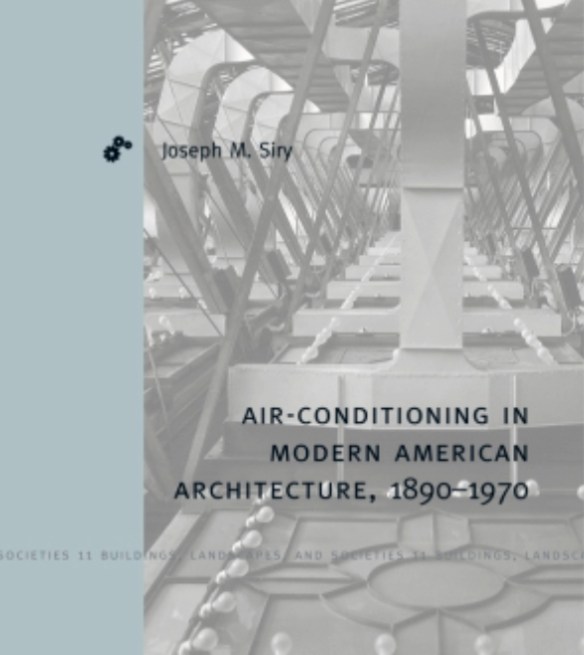
Siry, who teaches art history at Wesleyan University, has just published his fifth book, Air-Conditioning in Modern American Architecture, 1890-1970 (University Park: The Penn State University Press;, 2021). His previous Wright books are Beth Sholom Synagogue: Frank Lloyd Wright and Modern Religious Architecture (Chicago: The University of Chicago Press, 2012) and Unity Temple – Frank Lloyd Wright and Architecture for Liberal Religion (New York: Cambridge University Press, 1996).
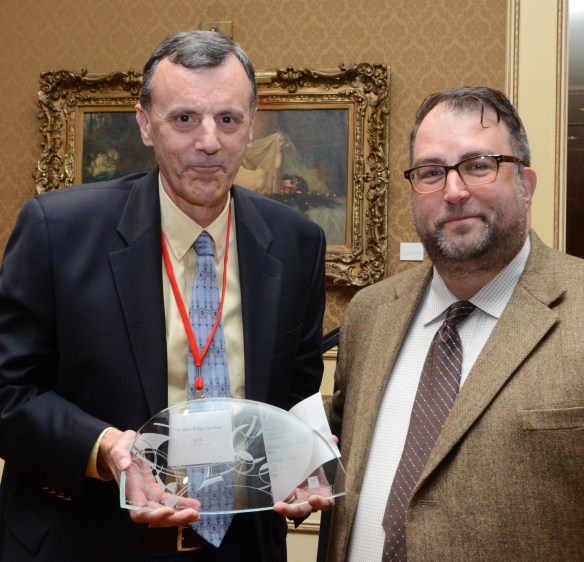 Siry, left, accepts a Wright Spirit Award from Scott Perkins and the Frank Lloyd Wright Building Conservancy in 2015.
The Larkin Building in Buffalo (1903) was one of the nation’s first air conditioned buildings. Wright, of course, eschewed traditional design. One of the building’s signature features was its large central atrium work space. Wright put the building’s mechanical systems in the four corner stair towers and in four adjacent towers. Russell Sturgis, a contemporary critic, was flummoxed by the design. He wrote in a 1906 article in the Architectural Record wondering why there were “no chimneys, giving an opportunity for an agreeable breaking of the masonry into the sky and the sky into the masonry?”
The SC Johnson Administration Building was designed in 1936. Air conditioning had already proven to be economically beneficial in a variety of factories – including at the Ford Motor Company – in improving efficiency not only in terms of workers’ comfort and morale, but also in processes where precise temperature and humidity controls were vital in machining and for ink-drying in printing. A growing number of hotels, offices, retail shops, and movie theaters were incorporating the new technology which was also displayed throughout the 1933 Century of Progress World’s Fair in Chicago. An unanticipated benefit was that hay fever sufferers no longer felt the need to call in sick when working in air conditioning (including Congressmen and U.S. senators when the U.S. Capitol was air conditioned in the late 1930s). Later, the economic growth of the South after World War II was spurred by companies’ abilities to air condition their factories, hotels, and stores.
Wright called the Larkin Building “the male sire of its feminine offspring,” the SC Johnson Administration Building in Racine, designed in 1936. H. F. Johnson Jr. was the company president. He famously gave workers the day off if it were 90 degrees or warmer outside. Johnson charged both J. Mandor Matson, his first architect, and Wright with designing what was then commonly called a “windowless” office building.
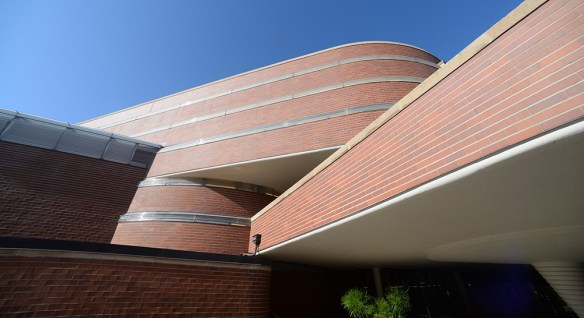
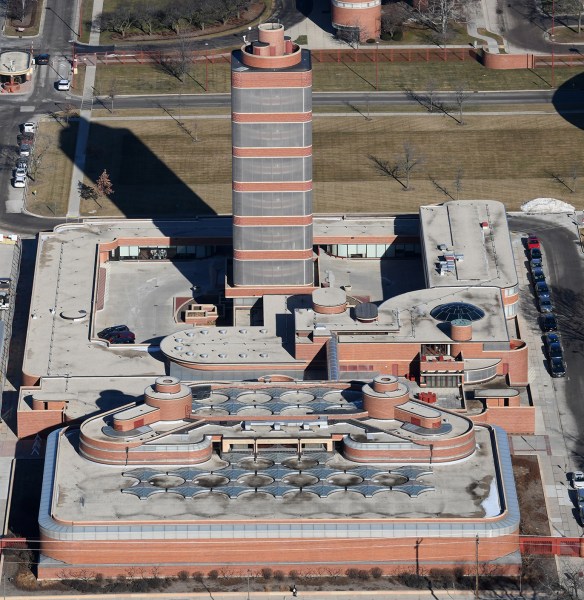
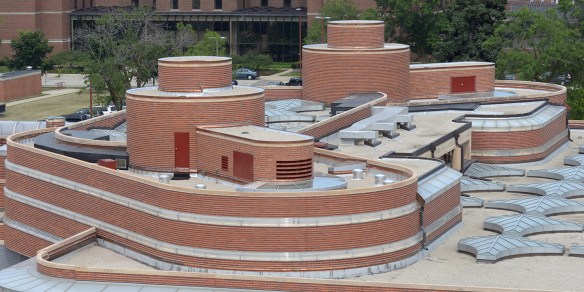
The Administration Building opened in April 1939, concurrent with the opening of the New York’s World’s Fair. An article in LIFE magazine previewing the fair noted that while it was certainly wonderful, people should travel to Racine to see the streamlined new SC Johnson office building if they wanted to glimpse the future. The Research Tower, designed in 1943/1944 and constructed between 1947 and 1950, was the coda to Wright’s office building. The mechanicals in the former are in the “nostril” atop the tap root tower, just as they were in the two “nostrils” (Wright’s term) atop the Administration Building.

 Ventilation grills are visible on the face of the mezzanine of the Great Workroom.
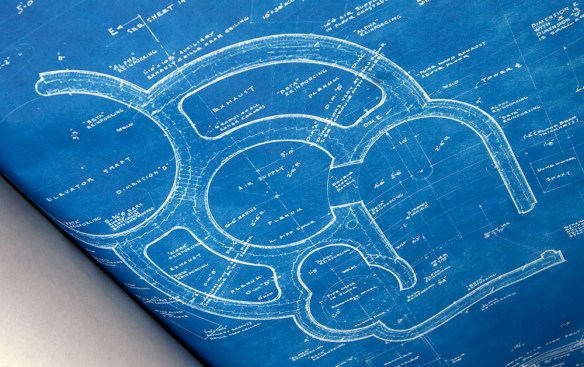 The Tower’s exhaust plenums are the two kidney shapes.

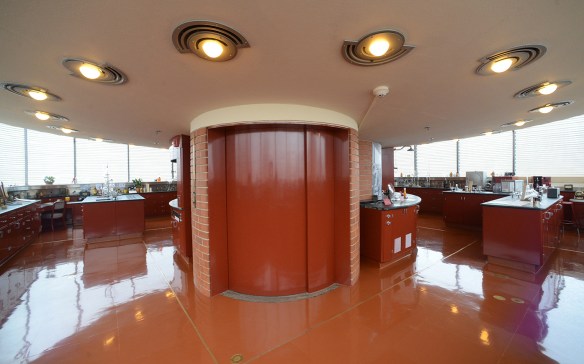 Ceiling ventilation in the Research Tower was built into ceiling light fixtures.

The Rogers Lacy Hotel in Dallas (1946) was not realized because Lacy died in December 1947. I had little awareness of Wright when I was in high school (1964-1968) but one of my classmates was Lacy’s grandson. My classmate’s father was one of the architects of the Houston Astrodome, the world’s first air conditioned stadium, which opened in 1965.
Siry concludes, “In the Johnson buildings, Wright reinvented the windowless type, creating workspaces that were better illuminated and apparently more open to the outdoors than many windowed buildings. His client, Johnson, had provided the impetus to devise optimal air-conditioned interiors. But Wright reinterpreted that aim to create unprecedentedly inventive architecture, an his integration of mechanical systems into his aesthetic inspired such later modernists as Louis Kahn.”
Siry’s book was an outgrowth of the section of his 2009 course on contemporary world architecture focusing on sustainability and energy conservation. “It gradually was clear that HVAC systems had a vast history in relation to modern architecture that had only been touched on, but those systems had been a huge factor in buildings’ energy demands. So I thought it would be useful to try to lay out the history of air-conditioning from its origins through into the 1970s, before energy consciousness took hold in architecture.” He is now focusing on developments since the early 1970s, “to trace the history of conservation methods and thinking about sustainability.” The new book took nine years of research and writing. There is no timeline for a succeeding volume.
If readers burst out of their Wright bubble, they will find the book as a whole is captivating. I wrote Siry that as a layperson (and someone who did miserably in science classes) I never thought I would be entranced by a book about air conditioning. But I was. The book can be ordered from the publisher or through your favorite local bookshop. I urge people to support local book shops and book publishers, rather then reflexively order from you know where.
https://www.psupress.org/books/titles/978-0-271-08694-1.html
Siry is Professor Art History and the William R. Kenan Jr. Professor of the Humanities at Wesleyan University in Connecticut.
Addendum on April 29: Radiant floor heating was used in the Administration Building. Wright also used it in Wingspread, the home he designed for Johnson in 1937. Karen Johnson Boyd, H.F.’s daughter, who grew up in Wingspread, told me that it was unpredictable whether one might freeze or burn their toes on the floor in the morning. When she and her then-husband Willard Keland commissioned Wright to build the Keland House in 1954, one of the conditions was that Wright let a radiant floor heating expert from Indiana handle that aspect of the job, she said. He agreed to do so.
-30-

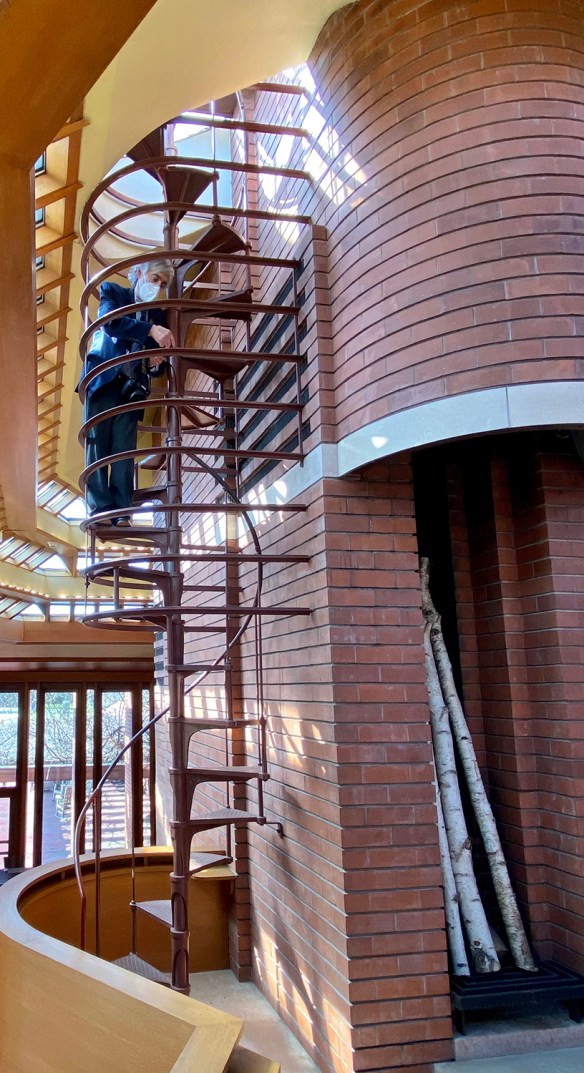 Marcus White turned the tables on me and took pictures of me at work.
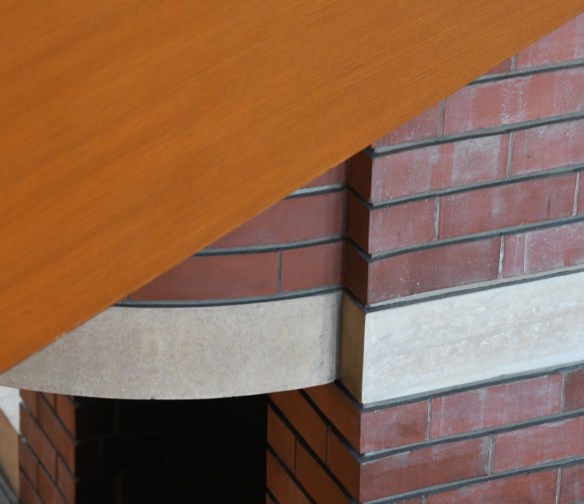 One of the first floor fireplaces is framed by the wood of the balcony
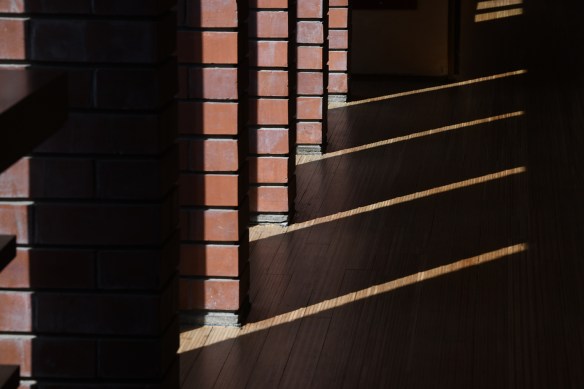 Late afternoon sun skims across the floor outside the master bedroom.


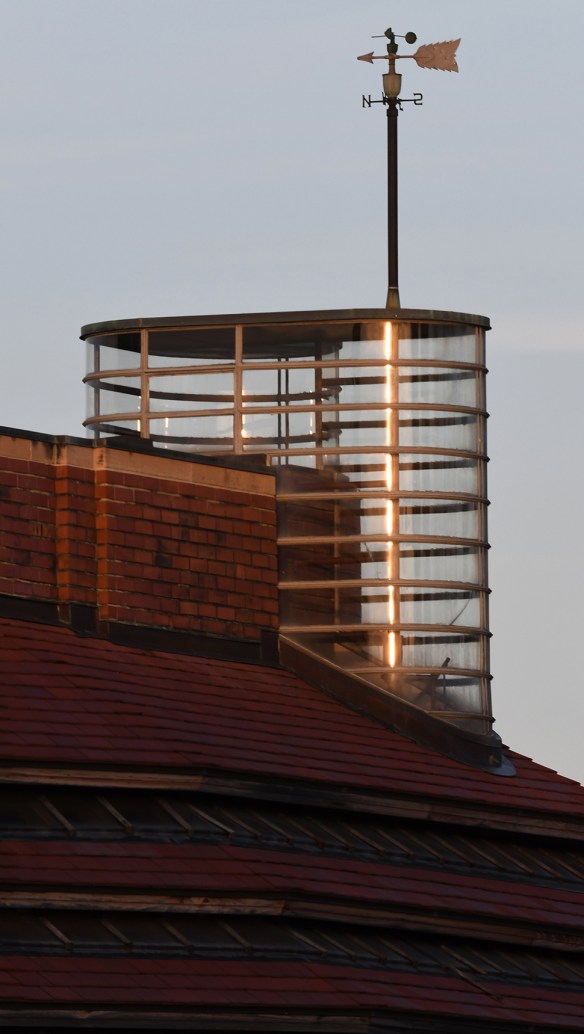 Had I not been directed to a parking area other than the one I thought I should go to, I would not have seen the sun highlight the crow’s nest when I returned to my car. Note to Marcus…this is why that 300mm lens is in my trunk, ready for action.
 Wright in Racine