(c) Mark Hertzberg 2016
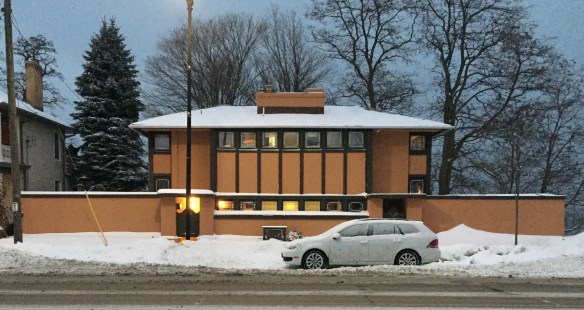
And a big thank you to Cindy Hertzberg for telling me to look at the light as we drove past the house this evening!
(c) Mark Hertzberg 2016
And a big thank you to Cindy Hertzberg for telling me to look at the light as we drove past the house this evening!
(c) Mark Hertzberg 2016
Gene had a very wry sense of humor. I initially did not understand what was his last jab at one section of the World of Wright until he explained it to me. There was quite a kerfuffle on the Frank Lloyd Wright Building Conservancy’s Wright Chat web forum a couple of years ago when I posted photos of the wood gates Gene had made for the entry way of the rehabilitated Hardy House.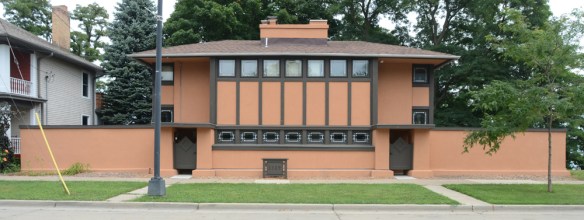
The original gates were taken off by the Archers, the third stewards of the house (1947-1957). I pointed out that the design Gene asked carpenter Chad Nichols to build was Wright’s first gate design for the house, not the simpler one that Wright ultimately executed, shown in a photo by Anne Sporer Ruetz (Hardy House: 1938 – 1947) of her friend Mary Hill putting on her roller skates:
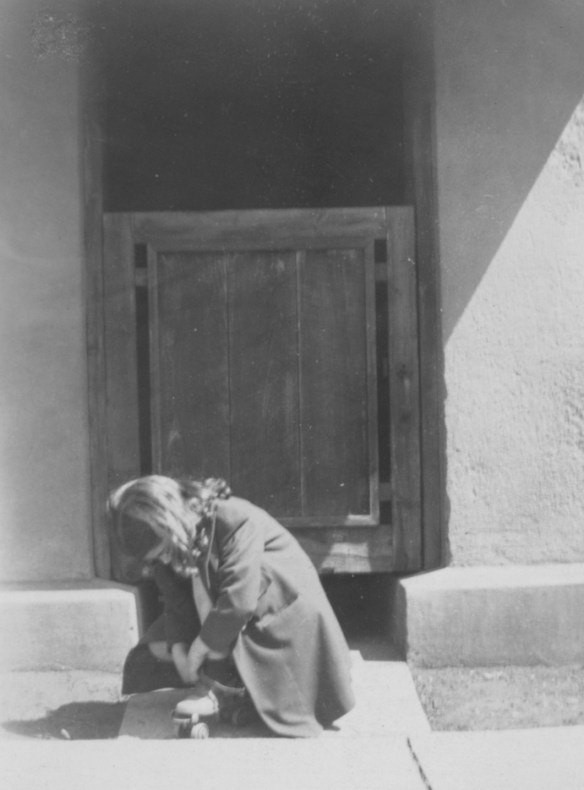
Oh, how the forum lit up with criticism of Gene for ruining the project and for reinventing history. I wondered in response – as I pointed out that to me the most important thing to consider was that Gene had literally saved the house for another hundred years – if Gene should also be condemned for having a television set and a microwave oven in the house because those weren’t historically authentic either.
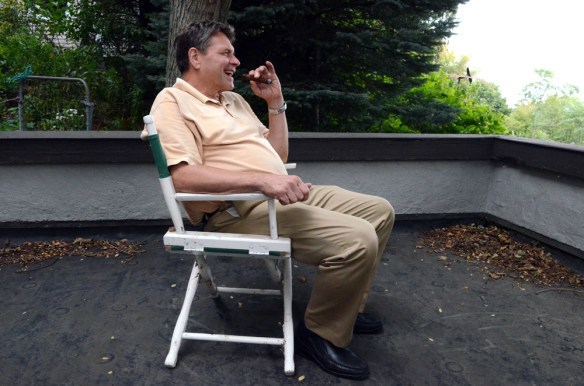
Gene was hurt by the blog comments. Genuinely hurt. If you knew him, you would understand his feelings. He was the CEO and president of Educators Credit Union which grew to become a major financial institution in Wisconsin under his stewardship so he was certainly a serious man when he had to be. But he was never too serious. He took umbrage at my photo of him smoking a cigar on the dining room terrace with his brother the day he closed on the house because he though it made him look like a “fat cat.” The dispute reinforced his feeling that some in the Wright World are too serious and judgmental.
He found a way to thumb his nose at them when he commissioned a shield to hide the unsightly gas meter in front of the house (moving it was not a practical option).
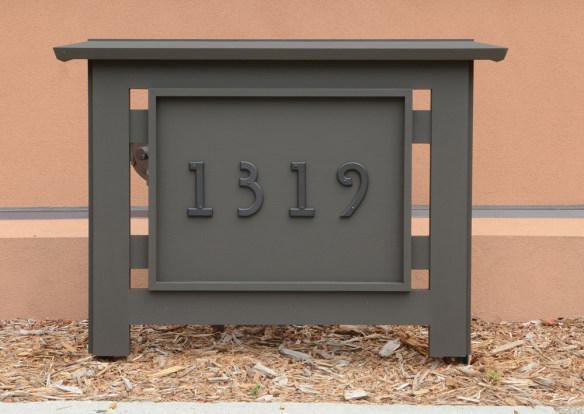
I didn’t realize until Gene told me with a smile…he purposely designed it as one of the original gates, albeit turned on its side. Here’s to you, Gene! I laugh whenever I think of your joke on what a friend of mine called “Gategate.”
Postscript after reading an email this morning…Full house museum restoration was way out of budget consideration. I focus on Gene having literally saved the house. It was imperiled. I focus on several thousand people having the opportunity to see the house, which had been closed to the public for several decades. Many, many of them expressed their gratitude to Gene. They include recognized Wright scholars. Gene had told me “this is something I could do for the Racine community” when he considered buying the house. Indeed he did, for Racine and for the Wright community, even if not everyone agreed with all of his decisions.
by Mark Hertzberg (c) 2016
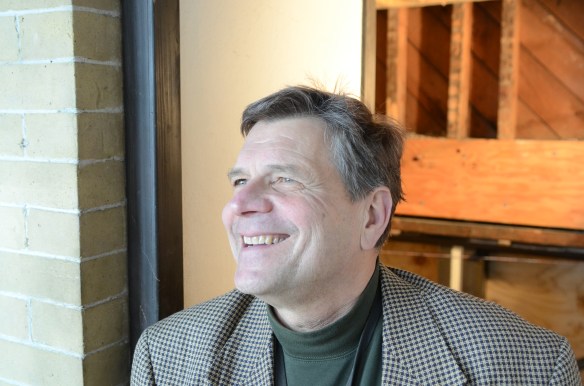
Eugene Szymczak, who became the seventh steward of Frank Lloyd Wright’s Thomas P. Hardy House in Racine (1904-06) died suddenly in his sleep at home Saturday evening. He was 67.
To me, Gene was more than the man who rehabilitated a very distressed Wright home and saved it for another century, he was a dear friend. Gene’s fascination with the house began when he was a college student working one summer on a city garbage truck route. His route took him down Main Street, and once a week he picked up the garbage from the north courtyard of the Hardy House. He bought himself a nice camera and photographed places in Racine that moved him. One was the Hardy House (in Gene’s typically modest manner, though, shunning extravagant things, he soon returned the camera because he thought it too much of a luxury).
Our adventure together with the Hardy House began with an email from him August 8, 2012, when he surmised I was trying to sell the house for the owners by word-of-mouth: “I was wondering what the expectations are for the potential buyer for the Hardy house. Can we get together and talk?”
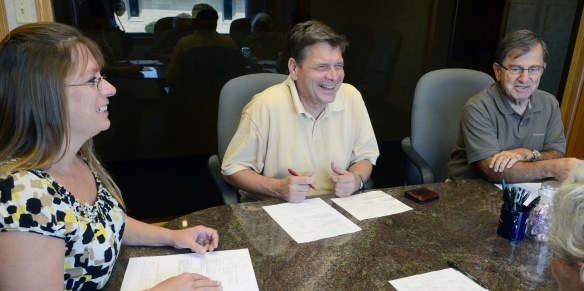
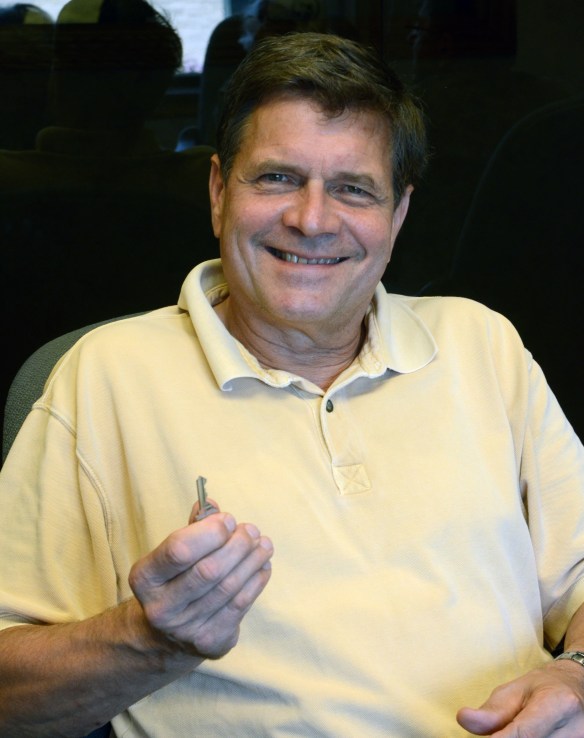
Gene at the closing for the house, above, and with the house key, below:
I took him through the house. Its condition was daunting. Equally daunting was the engineering study another potential buyer had commissioned. Gene wasn’t fazed. As we left the house he said, “I don’t have children this is something I could do for Racine.” Indeed. Gene, president of Educators Credit Union in southeastern Wisconsin, was altruistic. He gave of himself to countless community improvement efforts.
He then wrote me, “Thanks for taking my family and myself through the house. It was really a treat to have you take us on tour…It will be interesting to see how things move forward. It is an enormous responsibility as well as a source of joy and frustration.”
The late John G. Thorpe of the Frank Lloyd Wright Building Conservancy advised me to stay out of the sale to Gene, and leave it to professionals. Still, I wanted Gene and the then-owners to meet. A week later, over cashews and lemonade at their apartment, Gene made them an offer for the house, and suddenly it was sold. I had told Gene what pastry to bring Mrs. Yoghourtjian; he also brought her and her husband a Japanese print evocative of the famous Marion Mahony view of the Hardy House from the lake bank below.
Gene followed that visit with one more nice email before writing one that I just might forgive him for tonight, “I would hope that Margaret and I could become friends. She makes great lemonade and I make killer baklava [he did!]. Life is all about being true to your beliefs and a blessing to others….Sincerely, Gene”
Although we were friends, I had not yet been exposed to Gene’s wry sense of humor. Five days before the scheduled closing he wrote that he was having second thoughts about the purchase and was thinking of buying the property, doing a tear-down, and putting up something with a three-car garage underneath. I was on the verge of calling the Yoghourtjians to call off the sale when I finally got hold of Gene (who was on his way to visit Lynda Waggoner at Fallingwater). “Just kidding!” was the crux of the conversation.
Below are photos of Gene during a planning meeting during the rehabilitation of the house in January, 2013:
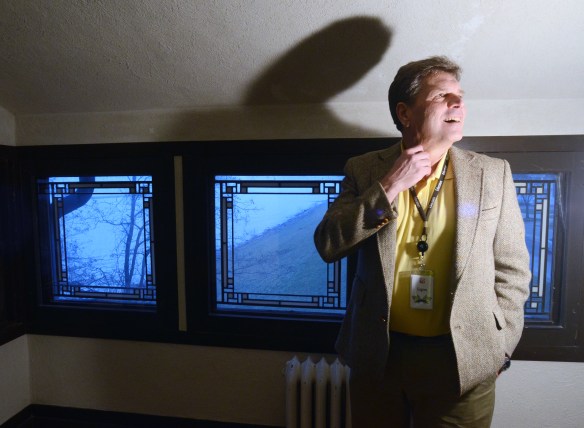
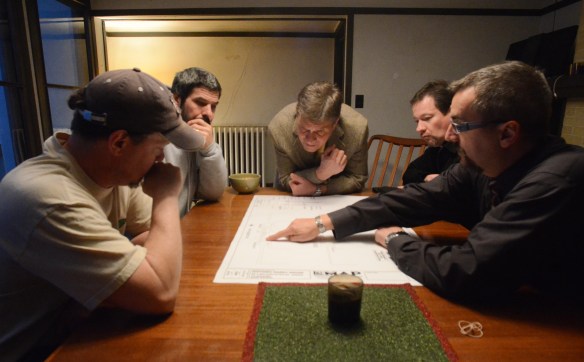
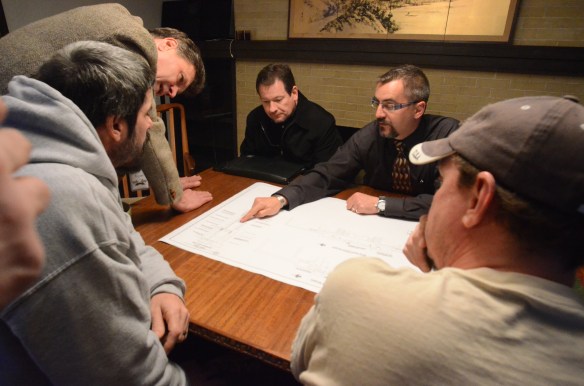
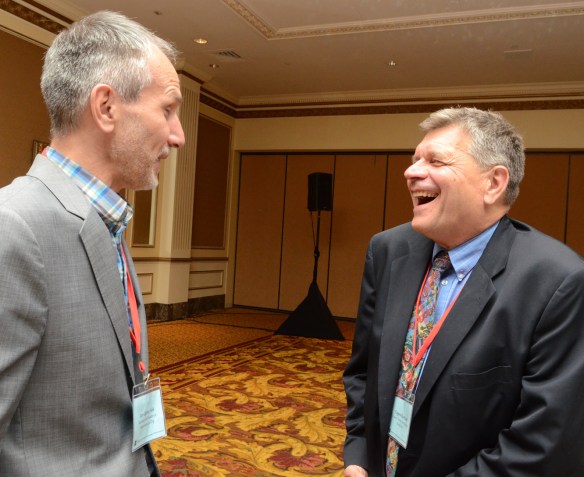
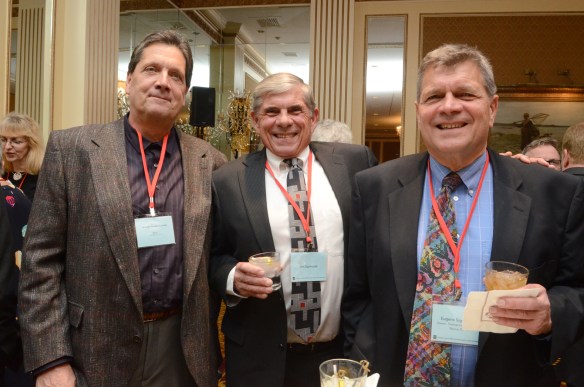
Gene’s stewardship of the house was recognized a year ago by the Frank Lloyd Wright Building Conservancy when he was awarded the prestigious Wright Spirit Award in the Private Home category at the annual meeting, fittingly in Milwaukee, following a tour of the house. I photographed him with architect and scholar Jonathan Lipman, author and curator of the Frank Lloyd Wright and the Johnson Wax Buildings book and national museum show, and with his brothers Tom, left, and Jim, before the award presentation.
Anne Hasse, a teacher at Wakanda Elementary School in Menominee, Wisconsin, is one of the team that teaches a Wright and architecture immersion class that is another past Wright Spirit Award winner. Gene always welcomed her students when they visited Racine in the spring. When told of Gene’s passing she commented, “To open up that house to a bunch of kids, only Gene would do that. Just a big-hearted guy.”
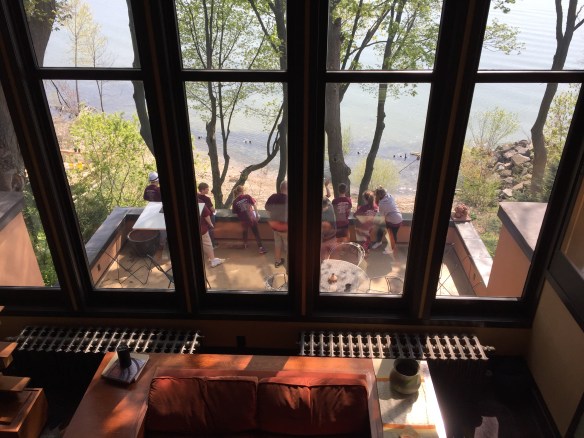
Wakanda students on the dining room terrace in May.
When I told Gene’s neighbor of his passing Marco said, “Gene will finally get to meet Frank Lloyd Wright.” I told him, “No, Frank Lloyd Wright will finally get to meet Gene.”
Gene was unassuming. He bristled when I photographed him enjoying a cigar with his brother on the dining room terrace of the house after the closing because he feared it portrayed him as a “fat cat” who had just bought a house. To me it showed easy-going Gene.
Wright scholar David Jameson, who toured the house this summer with Tim Samuelson, Chicago’s Cultural Historian, and Eric O’Malley, another Wright Spirit Award winner, wrote this evening, “What a shame Gene got so little use of the Hardy House. But he was a very good steward of it. Anybody who has conserved a Wright house (particularly a Prairie one) knows just how expensive it turns out to be. But to meticulously return it to its original (even more glorious, perhaps) condition is possibly the finest memorial one could actually have.
“I don’t worry about the Hardy House. Not only has it got good bones but it now has a civic hold on Racine. It’s their’s as much as Wright’s.
“Here’s to Gene. May all private owners of remarkable Wright houses be as generous with history as him. I think Gene’s memorial will most likely be that the Hardy House will live on because he cared.”
Robert Hartmann of Racine, past president of Frank Lloyd Wright Wisconsin, also knew Gene. Told of his passing he asked to repeat what he wrote Gene, as president of the organization, when Gene bought the house: ”
Dear Gene,
All too often the words “Thank you” are left unspoken. So, as a fellow citizen of Racine, let me simply say thank you for purchasing the Hardy house. It is comforting to know that this iconic Wright design is in your caring hands. I believe that in future years Wright scholars ie Mark Hertzberg and architectural historians alike will chronicle September 17th 2012 as a benchmark date in the life story of the Hardy house. Your intention to restore the home…is further evidence that the future of the Hardy house is indeed a bright one. I don’t think it’s an overstatement to say that Racine will be a better place in which to live because of your recent actions.
Now, let me put on my other hat, president of Frank Lloyd Wright Wisconsin, and again say,thank you for purchasing the Hardy house. Our organization which is dedicated to the preservation of Wright’s architectural legacy in his native state congratulates you on the purchase of the Hardy house and views your plans for its restoration as not only having local and state significance but recognize, as you do, that the restoration of the Hardy house will be celebrated by a national and international audience as well.
Again, Thank you
Regards
Bob
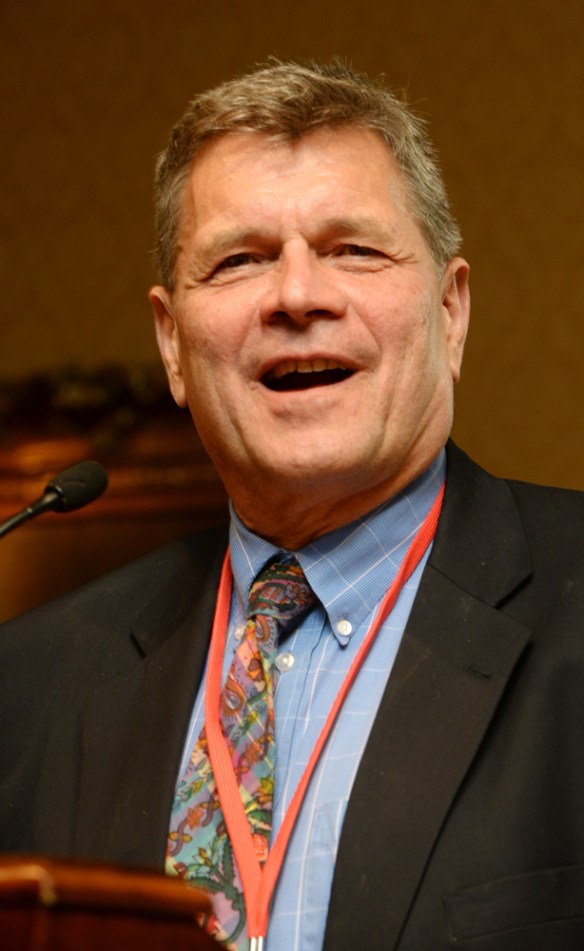
Eugene Szymczak accepting his Wright Spirit Award
Photos (c) Mark Hertzberg
I found a long-forgotten folder of photos today from April, 2014. They made me smile as I relived a wonderful reunion at Frank Lloyd Wright’s Hardy House between Margaret Yoghourtjian, left, and Anne Sporer Ruetz. They are chatting in the dining room in the photo below.
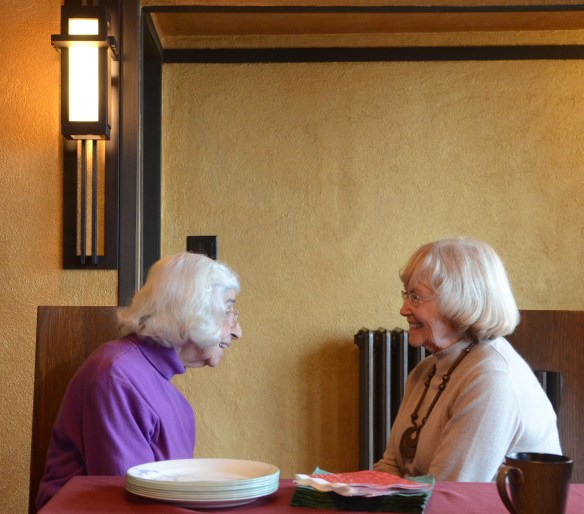
Margaret (and her late husband Jim) were stewards of the house from 1968 – 2012. Anne was five when her parents became the second stewards of the house in 1938. The Sporers lived there until 1947. This was the first time they had met, and it was their first look at the house after Gene Szymczak had completed most of his rehabilitation of the house that he undertook after buying the house from Jim and Margaret.
Neither Anne or Margaret is tall. The second photo was taken when they both stood in one of the low closets in the south bedroom on the balcony level.
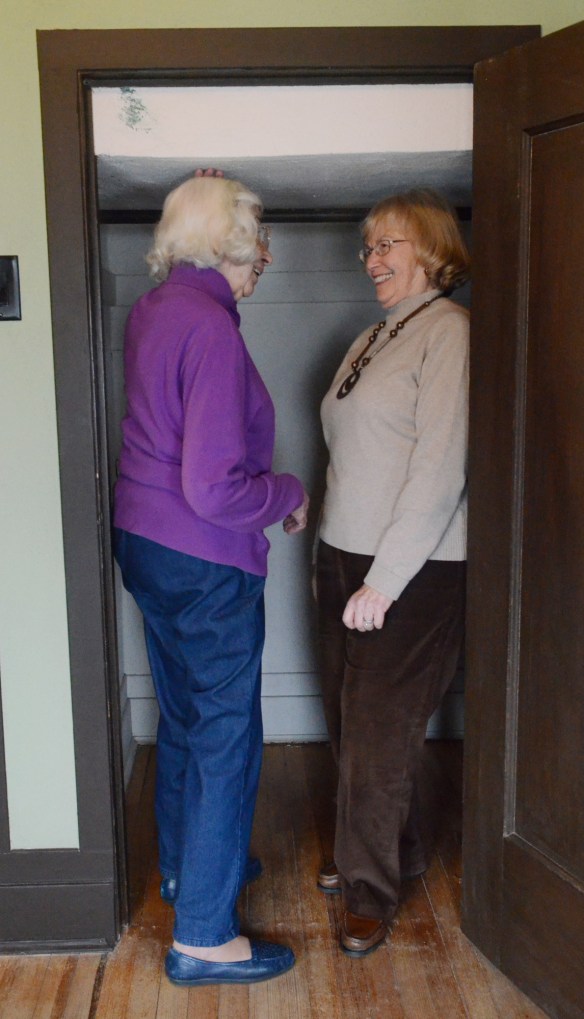
Thank you, Anne and Margaret, for helping me smile today!
(c) Mark Hertzberg
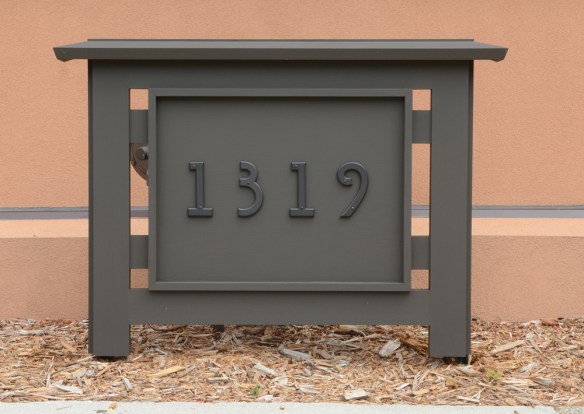
Put in parentheses between all the kudos Gene Szymczak has gotten for his rehabilitation of Frank Lloyd Wright’s Thomas P. Hardy House in Racine has been the oft-repeated question, “But what about the ugly gas meter in front of the house?” Moving the meter is cost-prohibitive even though some Wright-philes have proposed a Kickstarter fund to help out.
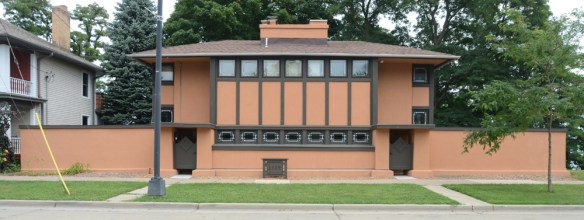
Wonder no more. Chad Nichols, the Racine craftsman who reprised Wright’s wood gates (removed by the third owners, 1947-1957) has made a shield to cover the front of the meter. It is open to the top and sides so meter readers can access it. The house number is in the middle of the shield.

Photos (c) Mark Hertzberg
These are three recent photos of windows at Wingspread, Taliesin, and the Hardy House. 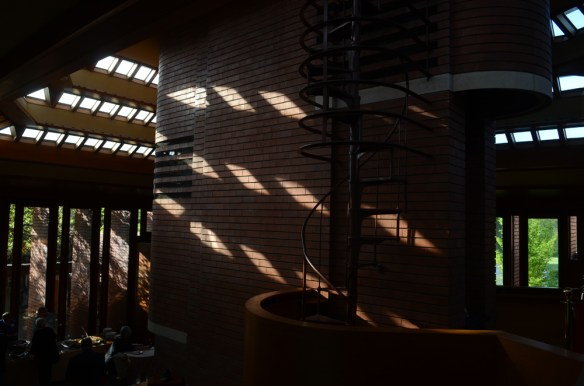
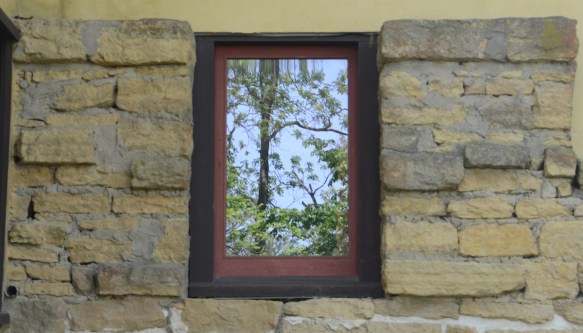
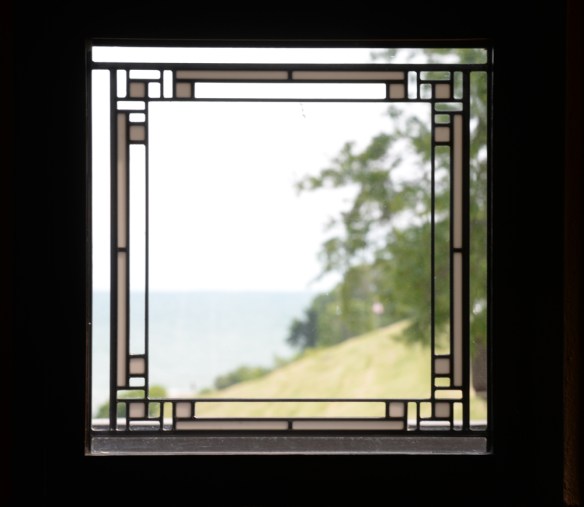
(c) Mark Hertzberg
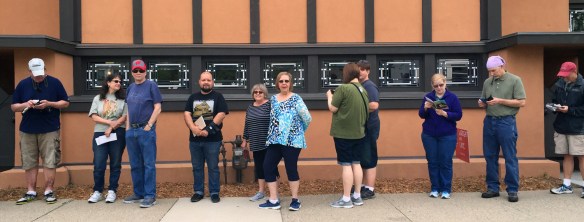
More than 400 people from across the country came to Racine a week ago for Frank Lloyd Wright Wisconsin’s annual Wright and Like tour. Ten sites were featured. Their architects included Wright, Edgar Tafel, Charles Montooth, John Randal McDonald, Hans Geyer, and Helmut Ajango.
Generally people who think of architecture in Racine tend to focus on Wright, Montooth, Tafel, and McDonald. But there is much more to Racine’s rich architectural heritage. Friday evening’s special presentation at Wingspread was the premiere presentation of an audio visual review of some twenty significant architects whose work is in Racine. Future presentations of the program will add Holabird and Root, Howard van Doren Shaw, and McKim, Mead, and White to the mix. These two photos show the line of people waiting to see Wright’s Thomas P. Hardy House before the tour opened.
Next year’s Wright and Like will be Saturday June 3 in Milwaukee.
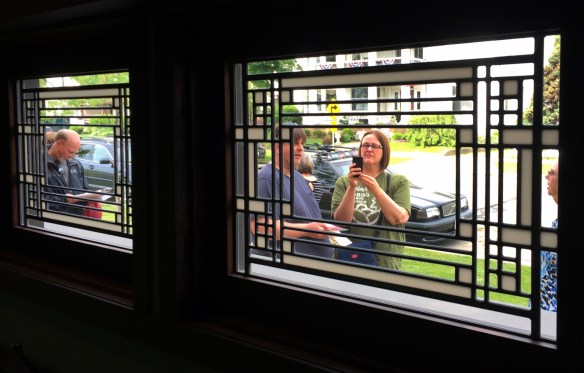
(c) Mark Hertzberg
When I talk to school children about Frank Lloyd Wright’s work I sometimes tell them that the only “computer” he had to work with was the one between his ears. I try to explain that he had a gift for knowing what light would do at different times of the day and of the year to illuminate and help keep a room warm before the days of electricity as we know it.
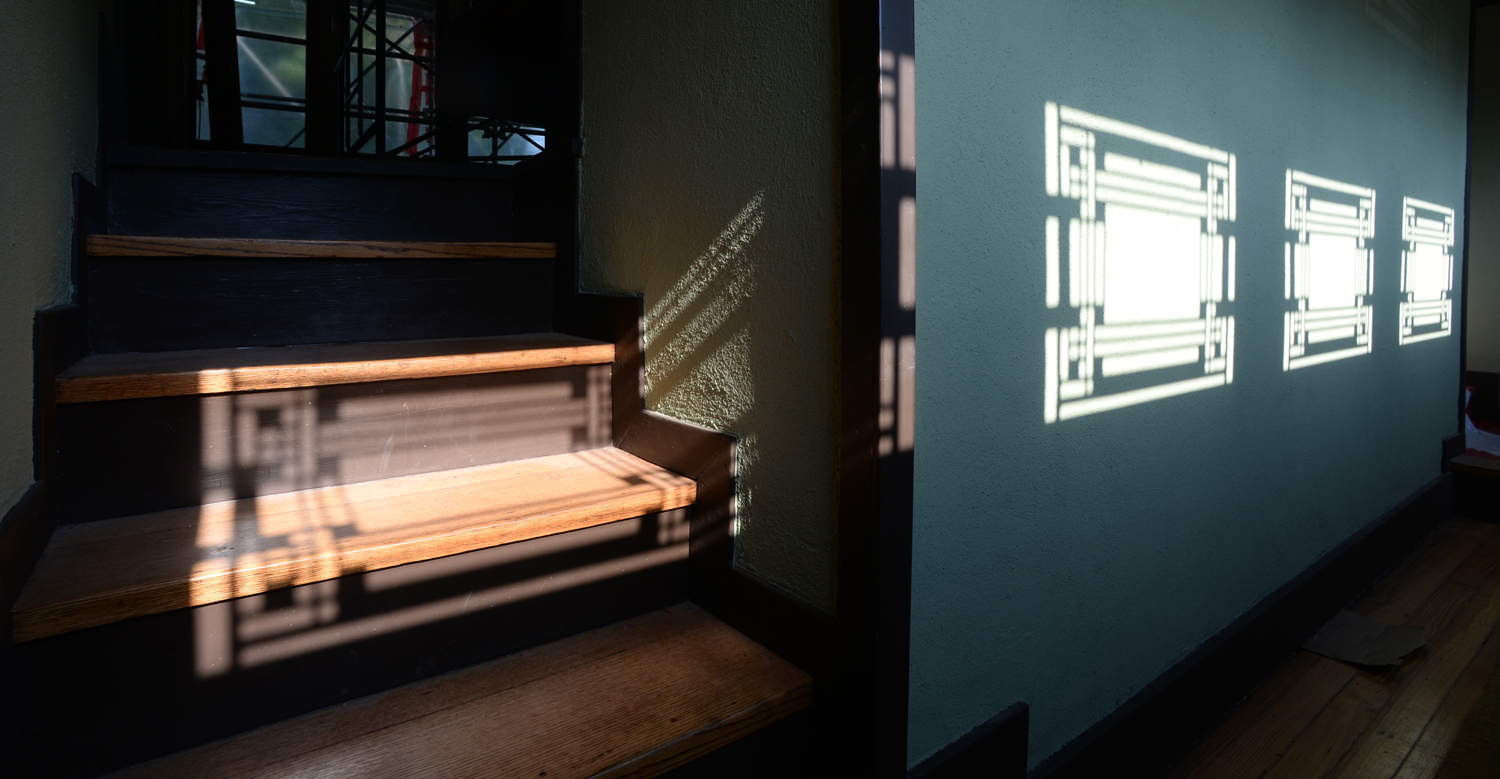
I stopped at the Hardy House late this afternoon and again saw his intuition projected on the stairs and entryway wall. The patterns are from the seven windows in the entryway. I credit Robert McCarter for pointing out that the floor plan of the house is articulated in these windows: the public spaces (two-story living room and the dining room below) are the square in the middle…bisected by a rectangle that includes the bedrooms at each end of the house (at left and right). He makes this point in “Frank Lloyd Wright” London: Phaidon Press, Ltd., 1997.
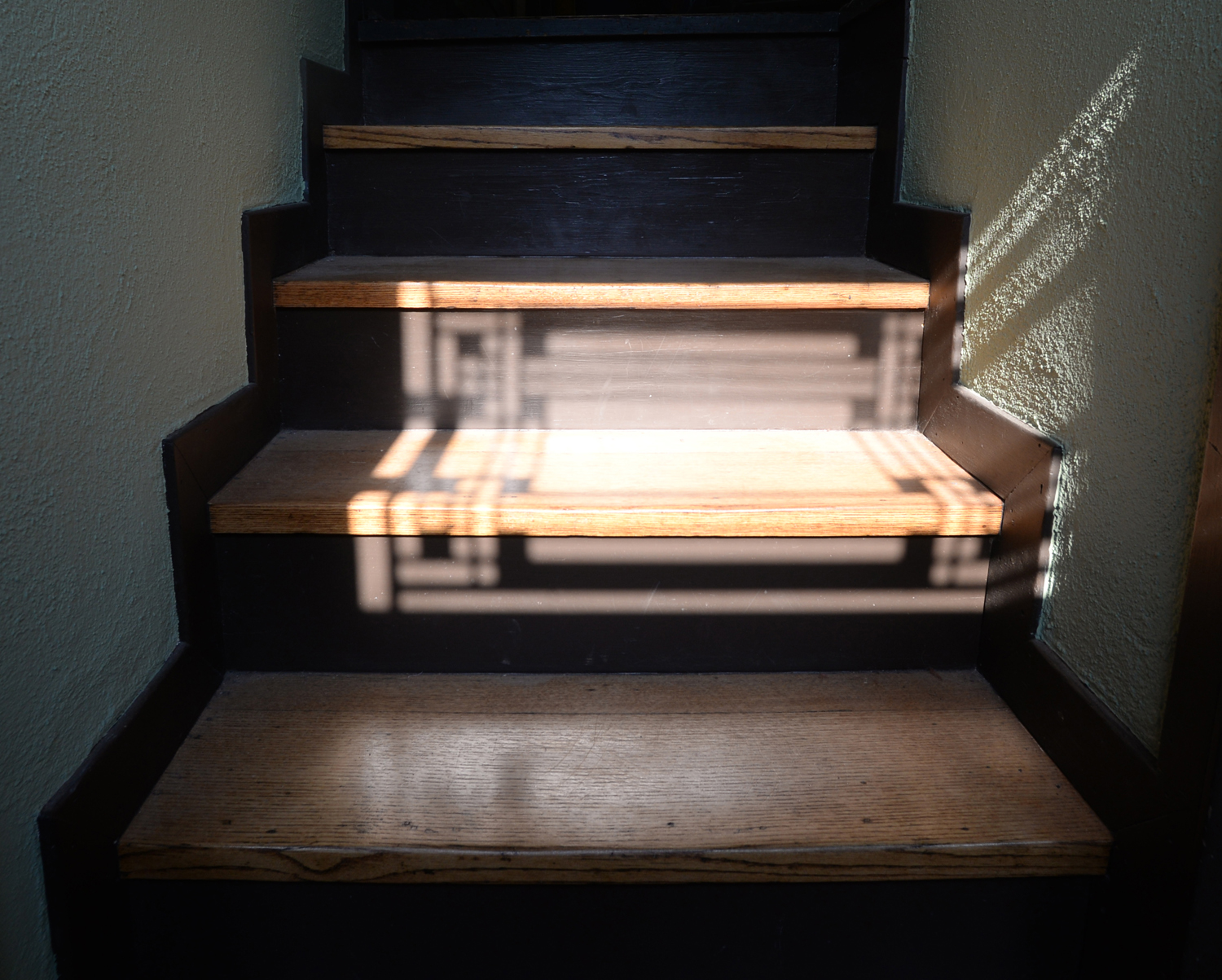
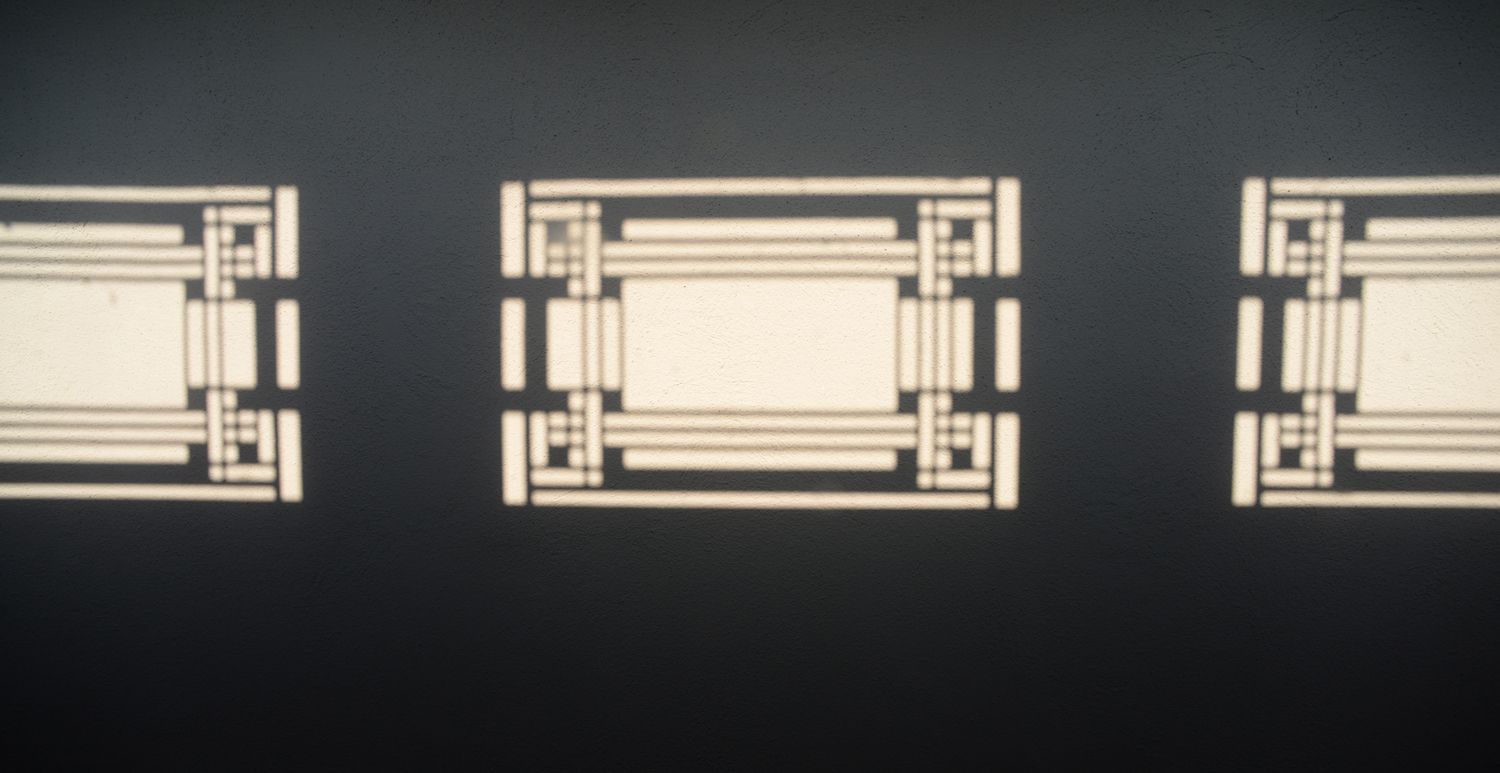
Genius, indeed!
Photos and text (c) Mark Hertzberg
The Hardy House is a construction zone again after a two-year respite.
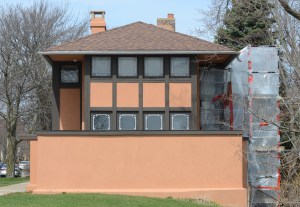
The east side of the house is sheathed in scaffolding, and scaffolding again fills the two-story living room as it did several years ago while plaster was repaired and the house was repainted.


The living room and the dining room are walled-off in construction workers’ heavy plastic, diminishing the view of Lake Michigan from the living room balcony:
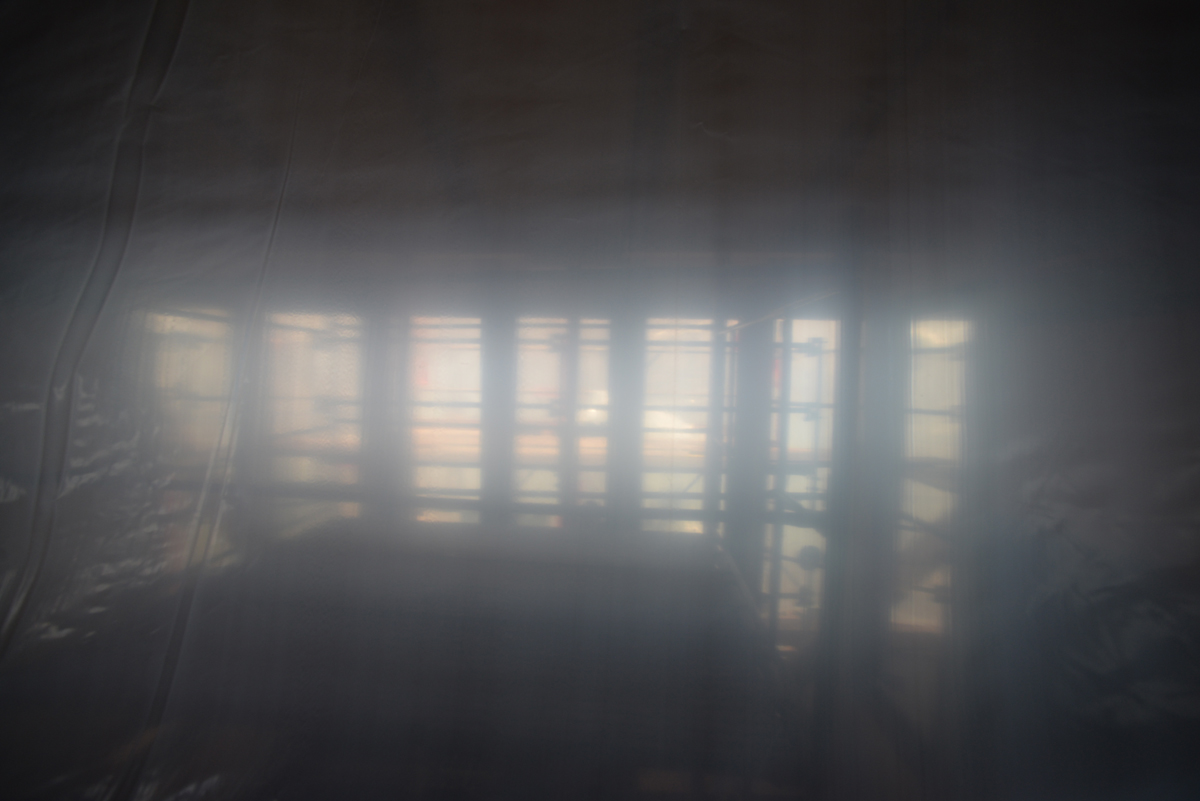
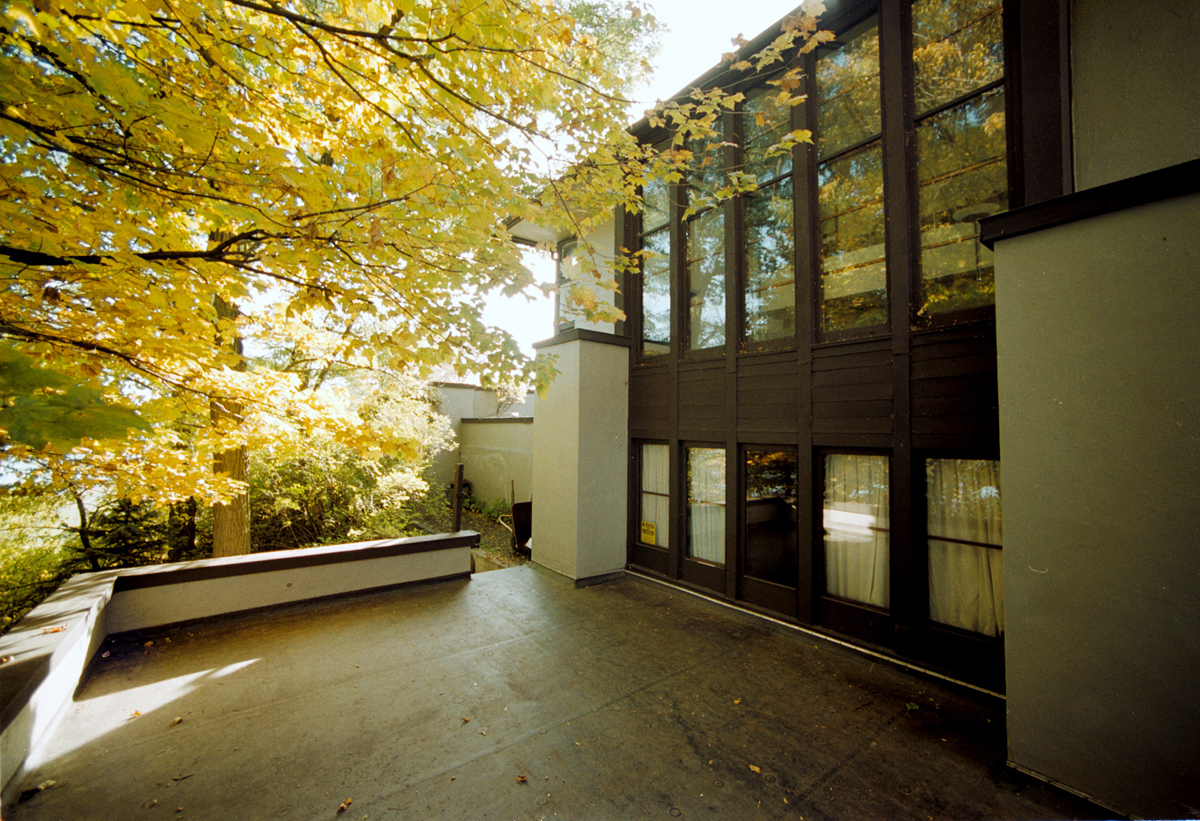
The living room and dining room windows are being replaced, which may sound routine, but the work also entails rebuilding structural elements of the house above and below the windows. It will not be known how much needs to be rebuilt until workers begin the reconstruction. The center dining room windows lead to the dining room terrace, whose rubber membrane flooring (shown in a 2002 photo, below) needs to be replaced, as well.
The four square panels between the living room windows (above the panels) and the dining room windows (below the panels) were originally stucco, as shown in this 1906 photo taken as the house neared completion:
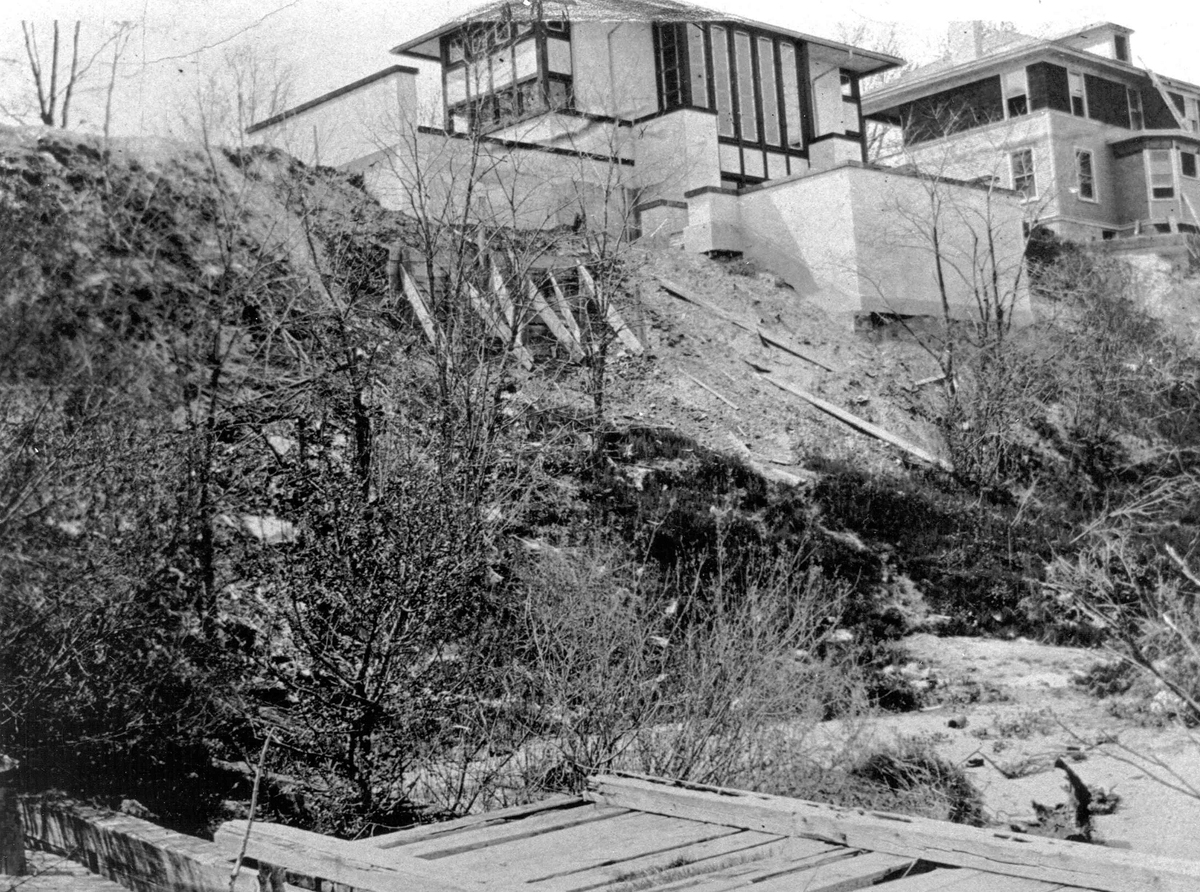
(Photo courtesy of, and (c) Frank Lloyd Wright Foundation)
It is believed that the stucco had cracked because the dining room windows leaked, and the panels were replaced by wood panels when Wright’s leaded glass living room windows were replaced with plate glass windows in 1947, concurrent with the rebuilding of the dining room terrace to create for a recreation room below.
The dining room now serves as a construction office for the workers from Bane & Nelson contractors:

It is impossible to estimate how long the work will take, but Bane & Nelson has a deadline of finishing in time for tours during the 2015 Frank Lloyd Wright Building Conservancy meeting in Milwaukee and Racine in early October.
Words and photos (c) Mark Hertzberg, except historic photos, (c) Anne Sporer Ruetz
One of the most important finishing touches is coming to the Hardy House. It was built in 1904-06 with two wood gates, which we see in Anne Sporer Ruetz’s snapshots of her friends. Anne grew up in the house; her parents were the second owners (1938-1947) after Hardy lost the house at sheriff’s auction.
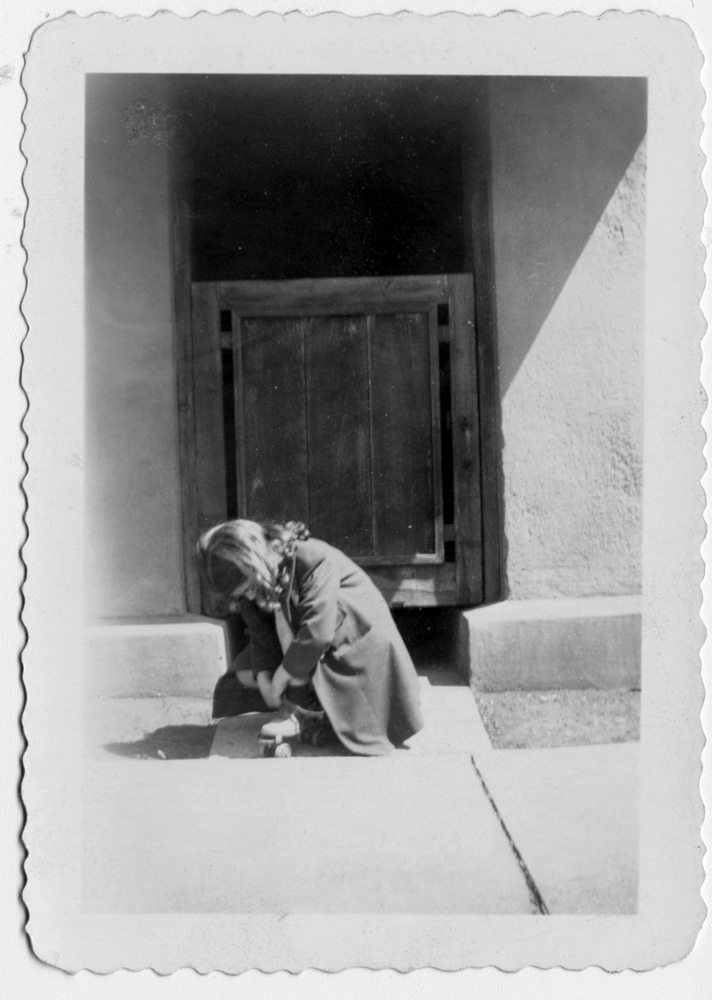
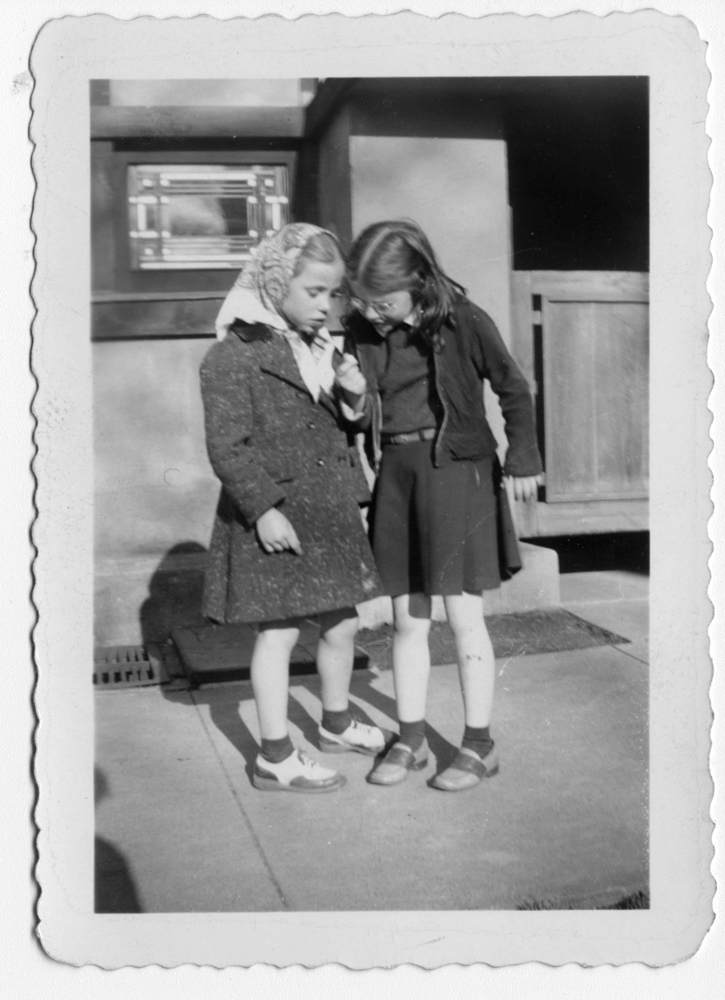
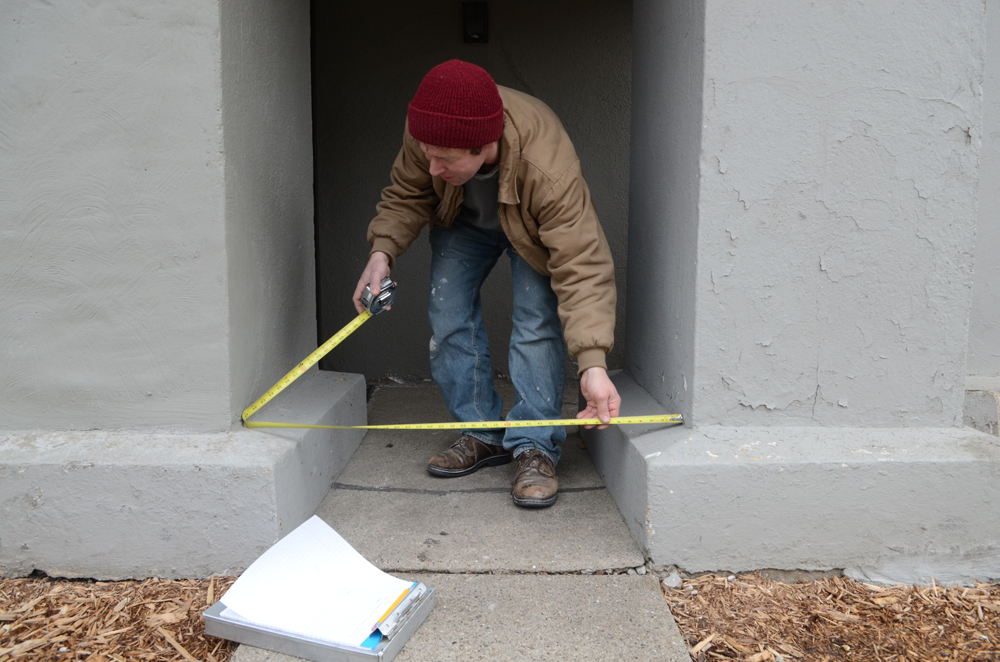
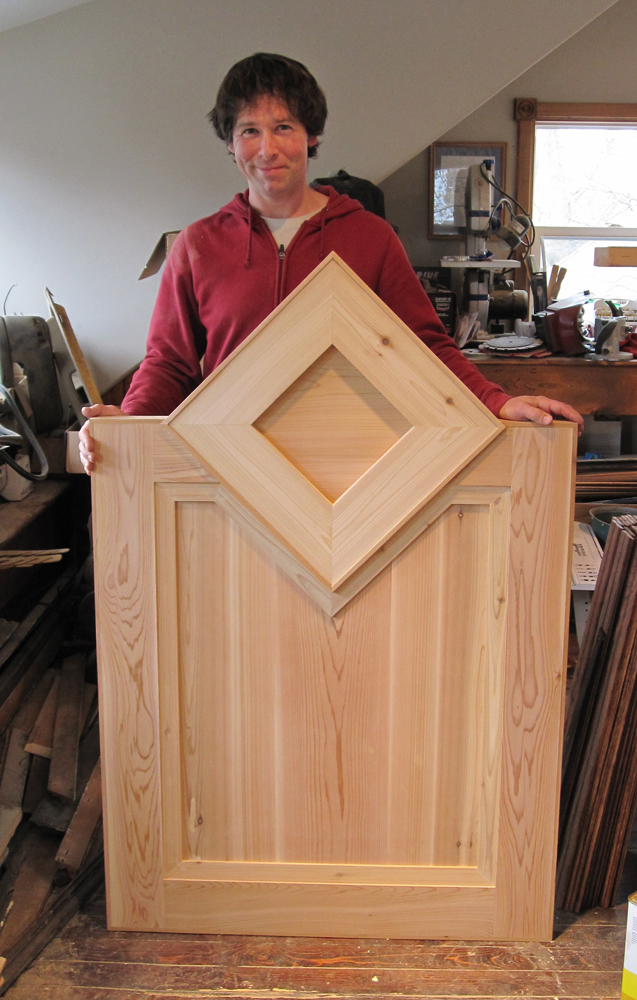
New gates, based on the unrealized design by Wright on one of his drawings, are being built by Chad Nichols, the master carpenter who has done much of the work at the house. Chad measured the openings for the gates in January, 2013:
He first made a model based on the design built for the house, before it was decided to use the unrealized design:

There is nary a spare clamp to be found in his workshop as he now completes the red cedar gates. It was decided to wait until the house rehabilitation was almost completed before making the gates:
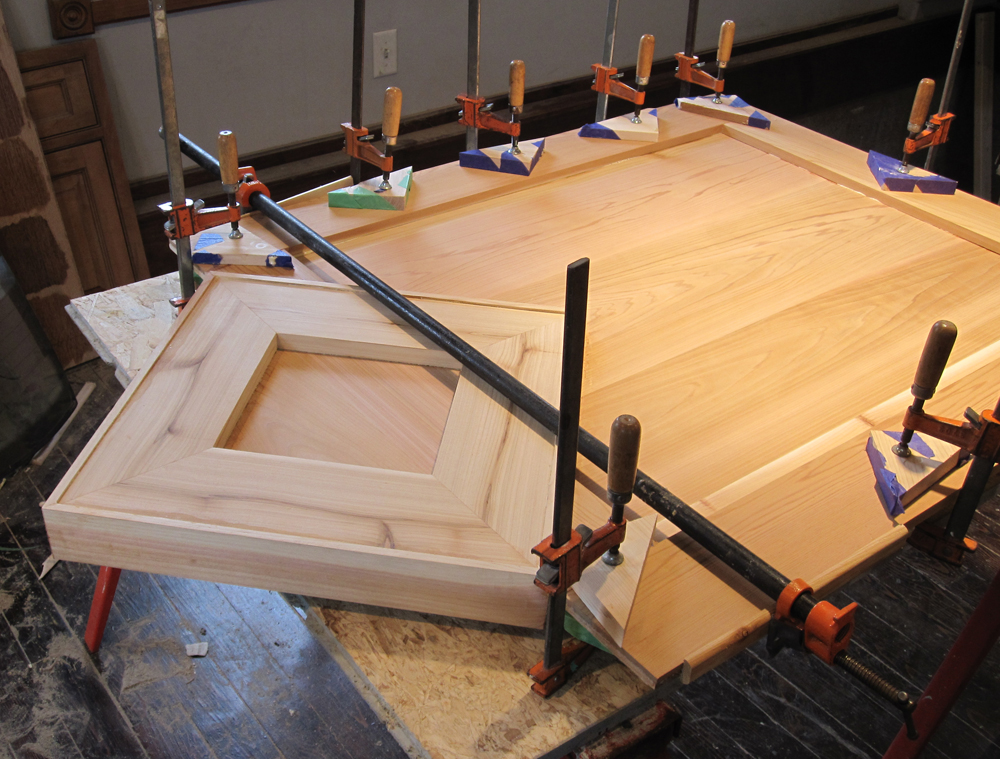
The gates will be stained before they are installed, probably next week. Chad proudly invited me to his workshop today to see what they look like:
 Wright in Racine