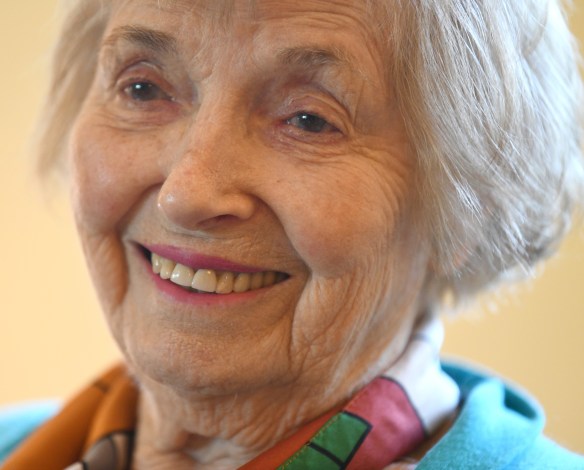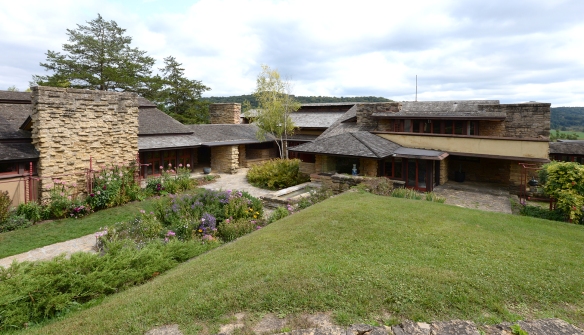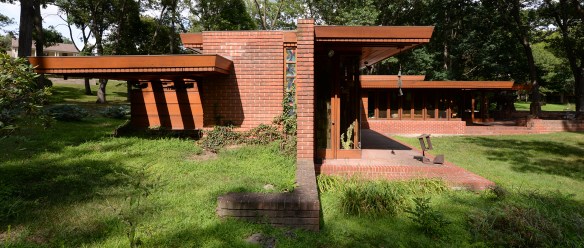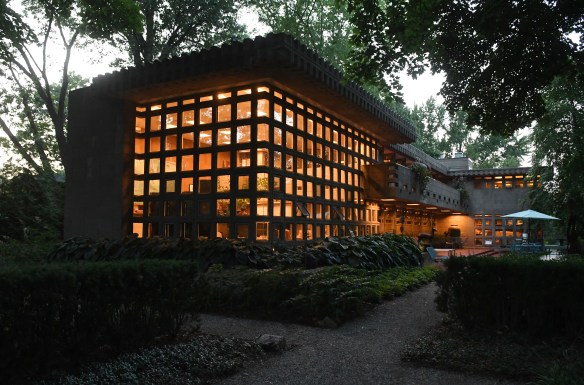
The Marvelous Minerva Montooth

© Mark Hertzberg (2021) except as noted
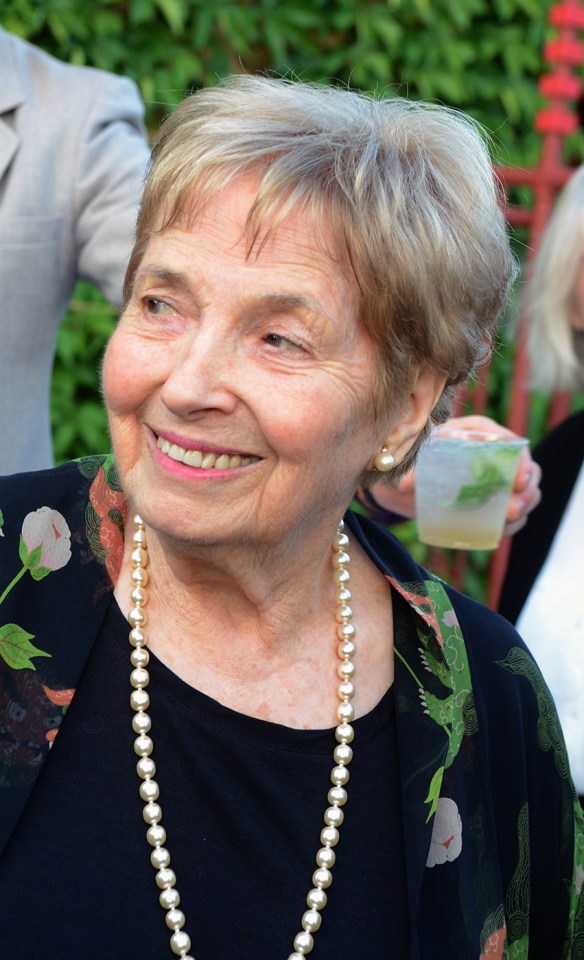
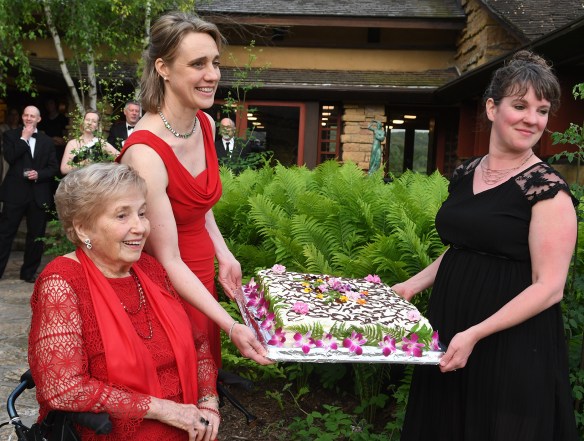
2015 Wright Birthday Taliesin 017.JPGMinerva Montooth at the 2015 Wright birthday celebration at Taliesin.

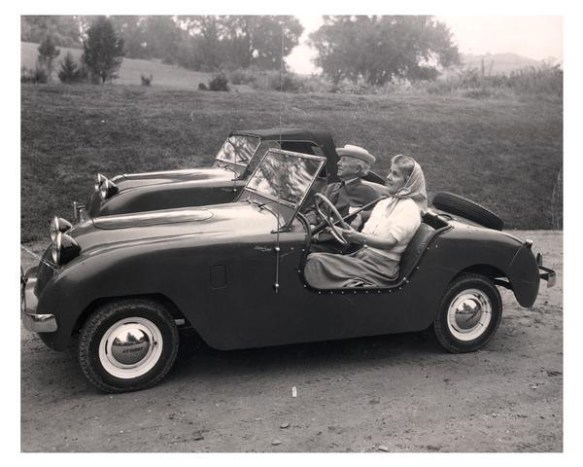
Frank Lloyd Wright not only upended the world of architecture, he also untied Minerva Jane Houston’s tongue and eventually convinced her to marry a “Greek god.” If you know Minerva, now Minerva Montooth, you would be gobsmacked that she describes herself as having once been “pathologically shy.” Let her explain, “We (she and her twin sister, Sarah) didn’t speak to anyone in grade school, high school, college who was one day older. We’d have a fight when we went to the restaurant for lunch who would speak to the waitress.” Then she met Olgivanna and Frank Lloyd Wright at Taliesin in 1949. They had driven up in their just-delivered diminutive red Crosley Hotshot roadster. Mrs. Wright was at the wheel. “The minute I met them it was like a thunderbolt, I lost my shyness at that moment. If I can talk to Frank Lloyd Wright, I can talk to anybody!” 
Crosley Hotshot.jpg

The Wrights in their Crosley Hotshot Courtesy of  Wisconsin Historical Society

Not only did Minerva talk to Frank Lloyd Wright, but Wright then invited her and her future husband, Charles Montooth, to dinner with them at the dining table at Taliesin. What was for dinner? Wright had ordered ham and eggs. As students of the Wright know, ham and eggs or not, dinner with the couple was not always just dinner. It would often be followed by entertainment. “Afterwards we watched television, which was pretty new, in the loggia. Helen Hayes. They knew her. Mr. Wright said, ‘She is not made for that screen. She is bigger than that!’”
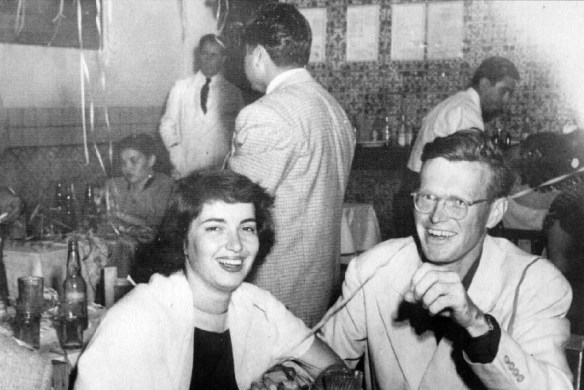
1952 Honeymoon.jpgMinerva and Charles celebrate Mardi Gras on their honeymoon in Mexico. Courtesy of Minerva Montooth

But we have gotten ahead of ourselves. The story of Minerva’s journey to Taliesin is as interesting as her first meeting with the Wrights. Minerva graduated from Northwestern University in 1945 with a degree in English, “everybody’s copout degree.” A native of tiny Rushville, Illinois (population 2,682 in 1950), she moved to New York City to work as a specialized librarian for an advertising agency. Their offices were on 44th Street, overlooking Fifth Avenue. Minerva was hospitalized with pneumonia in 1947, so her sister Sarah, who was dating Charles, invited her to accompany her to “recuperate in the sun” for two weeks at Taliesin West. The Wrights were not there at the time. 

The change in scenery would lead to a change in life. “The beauty of the desert, the ambience of Taliesin West. I had never seen anything like it. It was quite a shock to go from that ambience (midtown Manhattan) to the desert and the fantastic architecture. After I got to Taliesin, I completely forgot about Northwestern!”
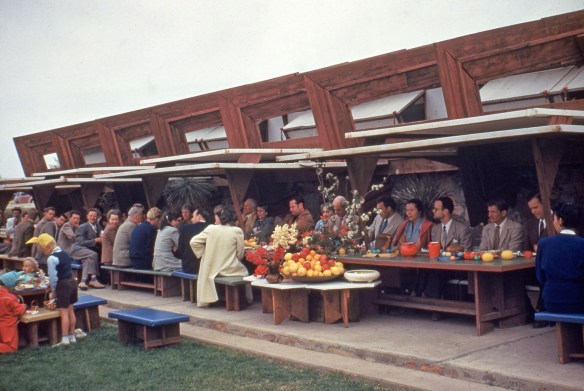
1947 Easter 002.jpgEaster at Taliesin West, 1947. Photographer unknown. Courtesy of The Frank Lloyd Wright Foundation Archives (The Museum of Modern Art | Avery Architectural & Fine Arts Library, Columbia University, New York). All rights reserved.

She knew Charles from childhood (he also grew up in Rushville). Their grandparents and their parents were friends. “I knew him in kindergarten. He was in fourth grade, one of those untouchable Greek gods! That’s my first memory of him.”
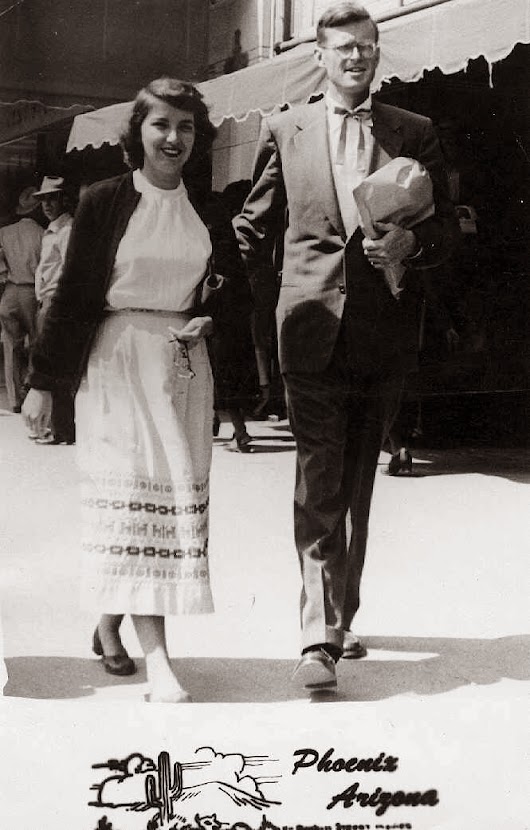
1632336947615blob.jpgMinerva and Charles strolling in Phoenix during State Fair time, shortly after their honeymoon. Courtesy of Minerva Montooth

Charles and Minerva did not start dating until the next year after Sarah fell in love with another man when she enrolled at the University of Chicago to do post-graduate work. “Charles started going with me. I guess I was second choice!” And so began the trips to Arizona to see Charles. By this time Minerva had answered a plea from Rushville to help alleviate a post-war teacher shortage (even though she had no teaching experience or training) and moved home, so she had traditional school vacation periods to see Charles. “He was always inviting me.” Mrs. Wright added her to the roster of Fellows so they would not forget to invite her to social functions, such as the famed “beautiful” Easter celebrations.
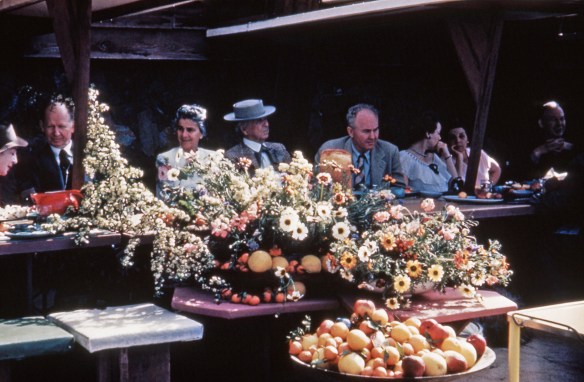
1947 Easter 001.jpgEaster at Taliesin West, 1947. Photo by Lois Davidson. Courtesy of The Frank Lloyd Wright Foundation Archives (The Museum of Modern Art | Avery Architectural & Fine Arts Library, Columbia University, New York). All rights reserved.
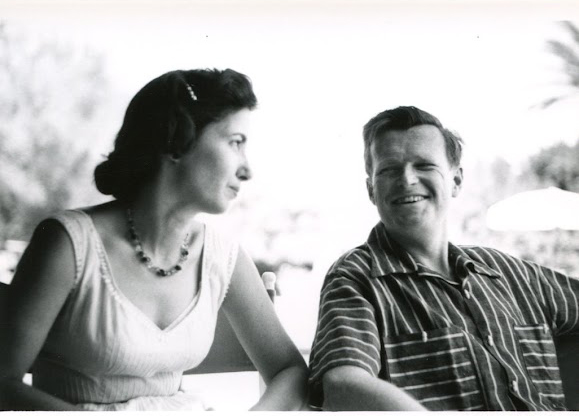
1632336912488blob.jpgThe Montooths at a party hosted by Mrs. Price at the Price House. Courtesy of Minerva Montooth

By Christmas 1951 the Wrights wondered why Minerva kept spurning Charles’s offers of marriage. She had no answer. Then they said, “‘Well, you can always get divorced.’ I was always astounded by that.” But Charles didn’t ask her again for awhile. She was back in Rushville when he finally proposed. Mr. Wright offered to host their wedding. He said it should be in the cabaret or theater at Taliesin West because Charles and she had helped build it. Her parents were “horrified” because “in those days you didn’t have a destination wedding, You were always married in a church.” The setting may have been unusual, but otherwise they had a “pretty conventional” wedding with a Presbyterian minister. The wedding reception was a bit less conventional than it would have been in Rushville. “I sat next to Mr. Wright at the dinner reception and a movie.”

Charles built them a small house in Scottsdale in which they lived for 10 years and raised three children. They were not formally in the Fellowship, but no matter. “We spent every single day going out to Taliesin West. The roads were terrible. We were lucky we had two cars because one was always getting a flat tire. Charles had his office in Scottsdale. I would spend the day at Taliesin West. I just joined in whatever activities were going on. We were in the chorus during chorus rehearsal at 7 a.m. every day. The children….they grew up in the back seat of the Plymouth station wagon. We practically lived at Taliesin.” I asked Minerva what color their car was. Need I have asked? It was red.
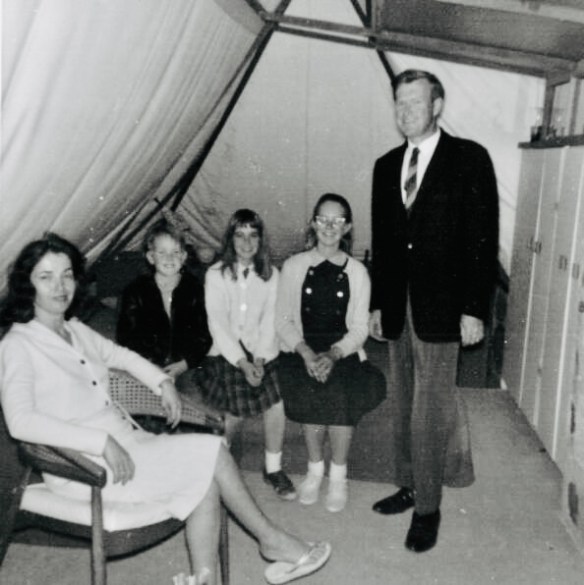
1962 Tent.jpgThe Montooths in the desert tent Charles preferred to an apartment. Courtesy of Minerva Montooth: “Taken in 1962 at Taliesin West by Dorothy Liebes, a famous fabric artist visiting Mrs. Wright.”

The commute came to an end when Charles got restless and wanted to move to Taliesin West in 1962. Mrs. Wright gave them a three bedroom apartment. “Charles hated it. ‘This isn’t desert living. I want a tent.’” And so they moved into a desert tent and Minerva went to work “right away” as an assistant to Mrs. Wright. “Probably for the first I was really responsible for Mrs. Wright’s well being.”
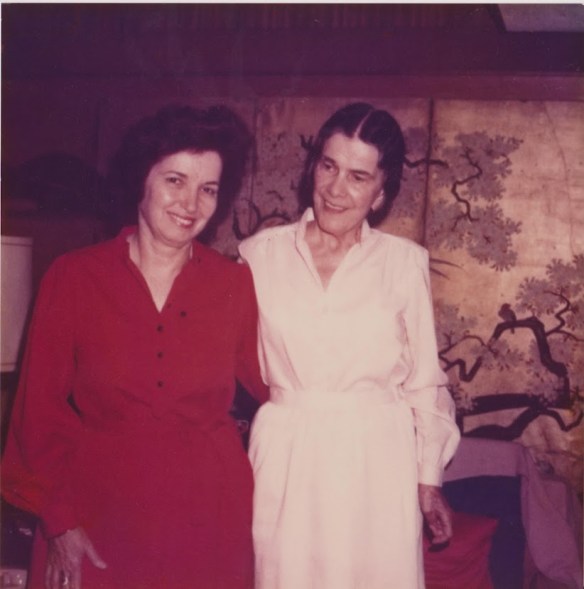
1632405469769blob.jpgMinerva and Mrs. Wright in an undated photograph. Courtesy of Minerva Montooth

Minerva’s feet were not to be planted in the desert sands or Wisconsin hills. Her responsibility for Mrs. Wright’s well being included trips to Japan, South Africa and “so many trips to Europe.” Bruce Brooks Pfeiffer and Tom Casey were along on some of those voyages. Some of the trips were Wright-related, others were leisure.

1632404278196blob.jpgRome, 1972…Bruce Brooks Pfeiffer is seated left foreground; Mrs. Wright left rear, David Dodge, Minerva, and Joseph “Dr. Joe” Rorke. Courtesy of Minerva Montooth.

“The trip to Japan was in response to a request from Wright enthusiasts who sent a ticket hoping she would be able to stop plans to destroy the Imperial Hotel. The trip to South Africa was inspried by an invitation to speak to the University of Durban students who wanted her to speak on the Imperial Hotel. The title of her speech was ‘The Tragedy of Progress.’” (The hotel was demolished in 1968).

Minerva became known as an unofficial photo historian of life at Taliesin. She “loved” photography, “Charles wasn’t interested in photography.” The one photo he took on their honeymoon in Mexico and it was double-exposed. They took their honeymoon in Charles’s pickup truck, planning to travel on a newly completed highway from Texas into Mexico. But the highway was far from finished. “We went through farmers’ fields. One time we went on the railroad tracks! It was pretty primitive.” Many of Minerva’s photographs, including their wedding photos, were lost in the 1980s in one of the floods following “desert downpours” that tore through Taliesin West.

Halfway through our hour-long conversation it was time to ask a touchy question. Many people are of the opinion that the Fellowship was divided into two camps in the 1950s: Mr. Wright’s, with an emphasis on organic architecture, and Mrs. Wright’s, with her devotion to Gurdjieff, the Russian philosopher and mystic. I asked Minerva about such a schism. 
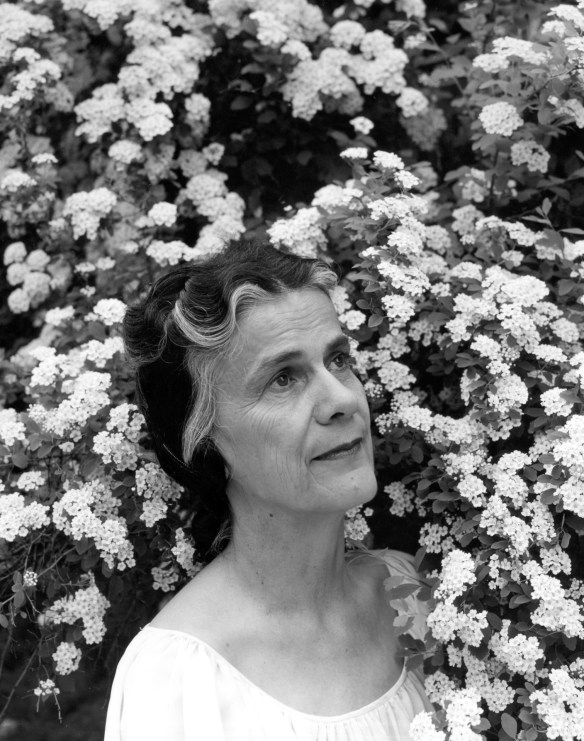
6106.0165.jpgMrs. Wright at Taliesin in an undated photograph. Courtesy of The Frank Lloyd Wright Foundation Archives (The Museum of Modern Art | Avery Architectural & Fine Arts Library, Columbia University, New York). All rights reserved.

She answered quickly. “I never thought of it that way. I always thought of Mr. Wright in the terms of the fable about the blind men and the elephant. Each believed what he had felt. Mrs. Wright was kind and generous, and sweet and charismatic and oh, my gosh, the Fellowship could not have existed without her. I never had any trouble getting along with her. She was very careful of Mr. Wright’s health at restaurants, and she would get a reputation that way!” Was there a schism? “I don’t think it’s true. She worshipped the ground that Frank Lloyd Wright walked on. His main failure in personality was that he was extremely jealous of her activities. He thought it was terrible she had published a book with her name. Did he think she was trying to ride his coattails? He apparently thought she should not have written a book on her own.”

One of Minerva’s regrets is not having gone from their home in Scottsdale to Taliesin for Mr. Wright’s funeral in 1959. She says that Mrs. Wright was “frail, not herself,” before her death in 1985. “I was grateful they got to escape their mortal realm.” 

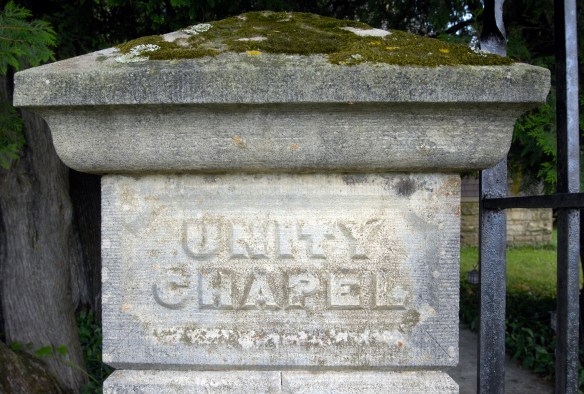
Controversy followed Mrs. Wright’s death because of her wishes to have Mr. Wright’s remains disinterred from their resting place at Unity Chapel near Taliesin, and brought to Taliesin West to be co-mingled with hers. Some people have passed judgment on Mrs. Wright, assuming she did so out of jealousy about Wright’s relationship with Mamah Borthwick, and their graves being near each other at Unity Chapel. Minerva disputes that assertion, “OH, NO!” She says that Mrs. Wright told Minerva “many times” that the Wrights “were so poorly treated in Wisconsin that he should be in Arizona,” and that was her sole motivation. “Mrs. Wright never mentioned any jealousy about Mamah. She had promised a real headstone for her grave.”
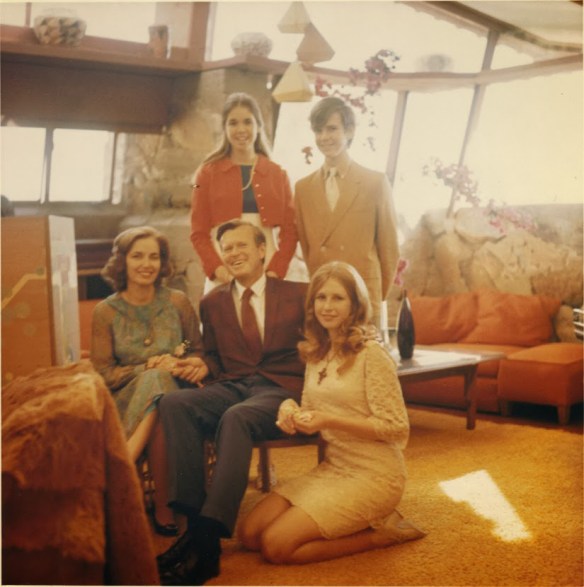
1972 John Hey T West.jpgJohn Hey took this photograph of the Montooths in 1972 at Taliesin West. Courtesy of Minerva Montooth
2005 Prairie School 002.JPG

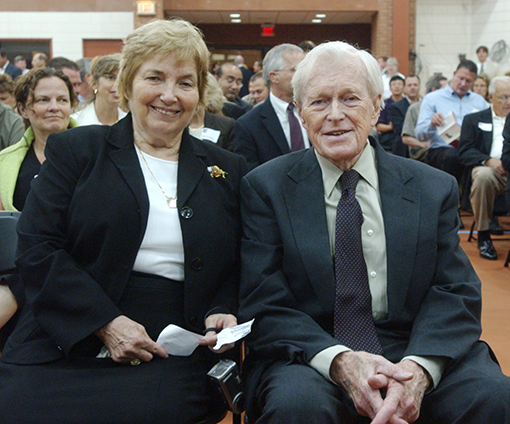
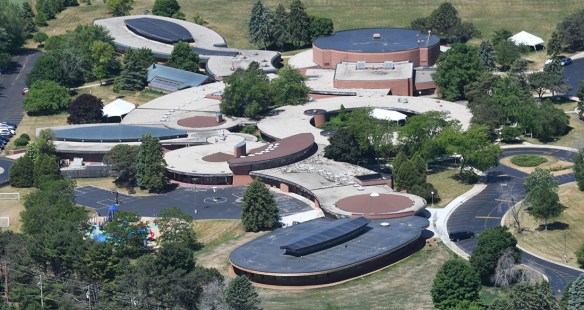
Minerva and Charles at The Prairie School in Wind Point in 2005. The occasion was the dedication of the addition to the Johnson Athletic Center, designed by Charles with Floyd Hamblen. Charles designed the entire campus, except for the building at the bottom of this 2021 aerial photograph, beginning with a semi-circular classroom building in 1965. The semi-circular building, which was finished into a circular one later, is the second building from bottom.
Prairie School Aerial 6.16.21 001.jpg

Hundreds of people have gotten to know Minerva as their gracious host at the annual black tie celebrations of Frank Lloyd Wright’s birthday held at Taliesin until just a few years ago.
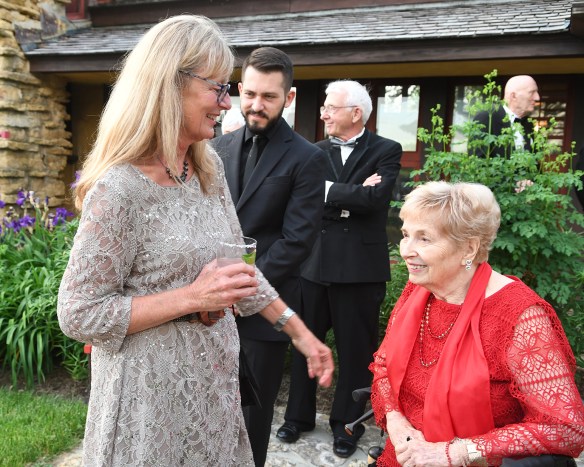
2019 Wright Birthday 003.jpgDixie Legler Guerrero and Minerva at the 2019 birthday celebration.

A reception at Taliesin – often also featuring numerous gate-crashing mosquitoes – was followed by dinner at Hillside, served by the students, and then by a musical program in the Hillside theater. Dessert was Mr. Wright’s favorite birthday cake, a delicious one from from Mrs Wright’s recipe for a yellow sponge cake, iced with fresh strawberry sauce and cream, covered with a drizzle of dark chocolate and nuts, decorated with edible flowers. A presentation cake, exhibited to the guests, was surrounded by an abundance of fresh flowers.

Wright 150th Taliesin 052.jpgThe 2017 birthday cake at Hillside.

2019 Wright Birthday 006.jpgThe 2019 birthday cake at Taliesin.

“John Hill, Cornelia (Brierly) and I all went together after they (the Wrights) died. There wasn’t anybody else to do it. It was quite a job.” I was surprised to hear Minerva then tell me, “I’ve never been a planner. Nor is it my nature to be organized. Cornelia was organized.” 

Balderdash, Minerva. You deserve lots of credit for these celebrations, as well as for the invitations to events when students would unveil their box projects in the Hillside drafting room. You have made myriad contributions to life at the two Taliesins, to the Fellowship, to the Wrights’ legacy, and you brought untold numbers of outsiders, like me, into the Taliesin circle. You are richly deserving of your title as a Taliesin “Legacy Fellow.” Thank you for your grace, your hard work, and your friendship!
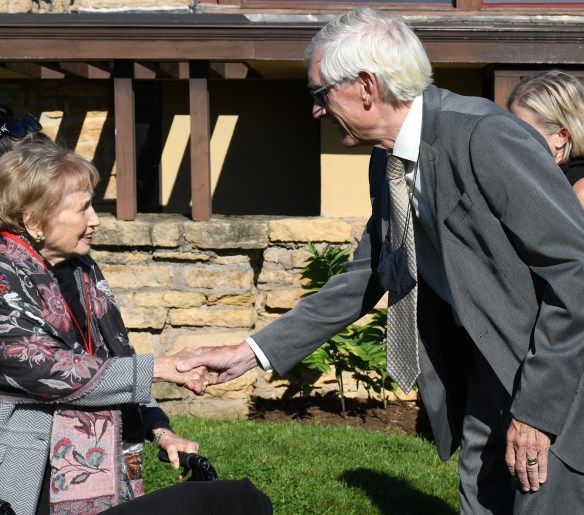
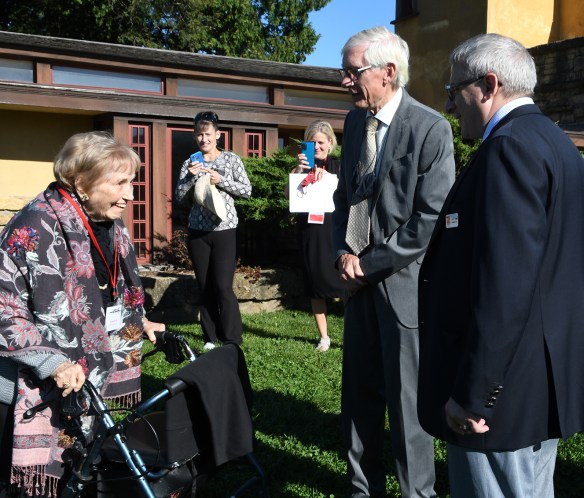
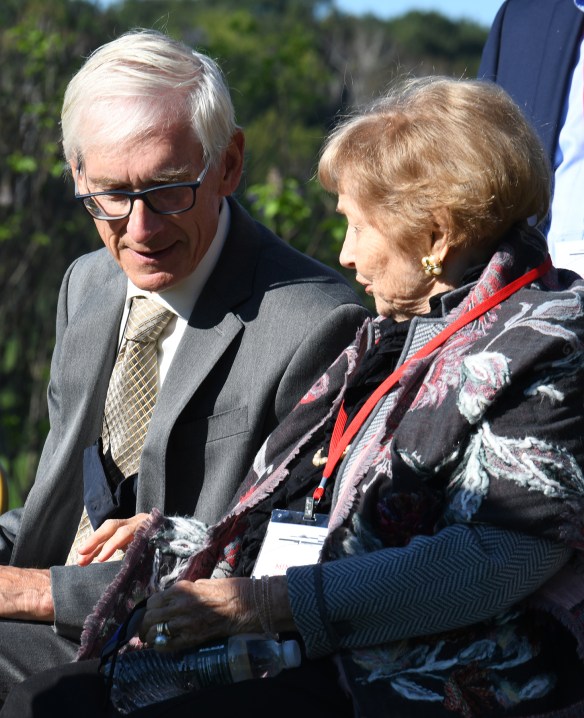
2021 Taliesin UNESCO World Heritage Site 067.JPGWisconsin Gov. Tony Evers meets Minerva at the UNESCO World Heritage Site plaque unveiling at Taliesin September 15, 2021.
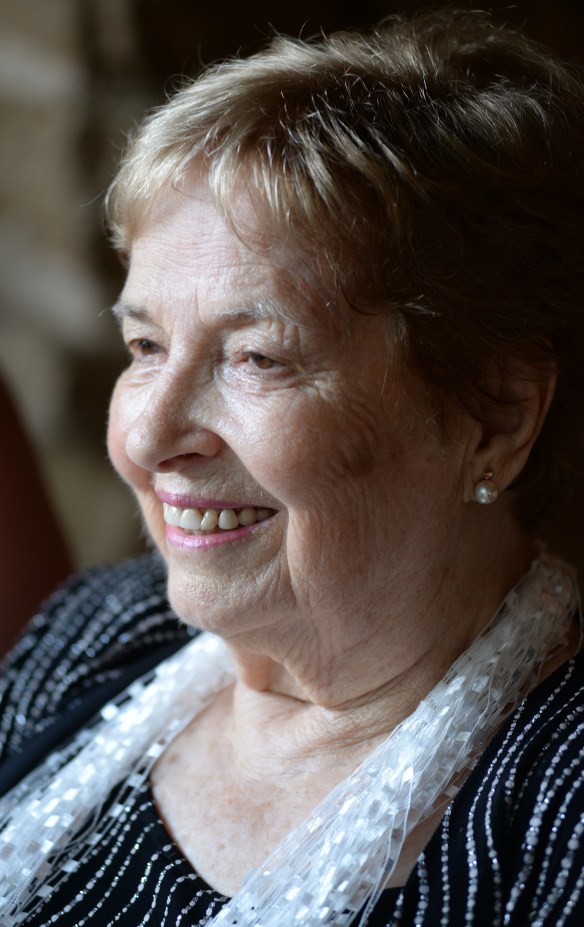
2016 Minerva Montooth 6.11.16 005.JPGMinerva at the 2016 birthday celebration.

2021 Minerva Montooth 8.29.21 002.JPGAugust 29, 2021

I asked Minerva to check this profile for accuracy. She asked me why I wanted to “take space to write about a nobody.” I replied that she is far from “a nobody.” Indeed. Renee LaFleur, Minerva’s assistant interjected that her daughter, Olivia, tells everybody, “MY MOM WORKS FOR MINERVA MONTOOTH!” I also asked Keiran Murphy, historian extraordinaire of Taliesin, to weigh in. She wrote me, “I would say that she embodies the best of the social dynamics of the Taliesin Fellowship. She has this skill at remembering the details about everyone and remembering their particulars. In addition, she’s very good at putting people together at a table in order to engender conversations.”

Case closed, Minerva!

2019 Minerva Montooth Fifi 9.25.19 009.JPGMinerva and Fifi, May 19, 2019

–30–
UNESCO Plaque Celebration

© Mark Hertzberg (2021)

Taliesin UNESCO World Heritage Site 002.jpg

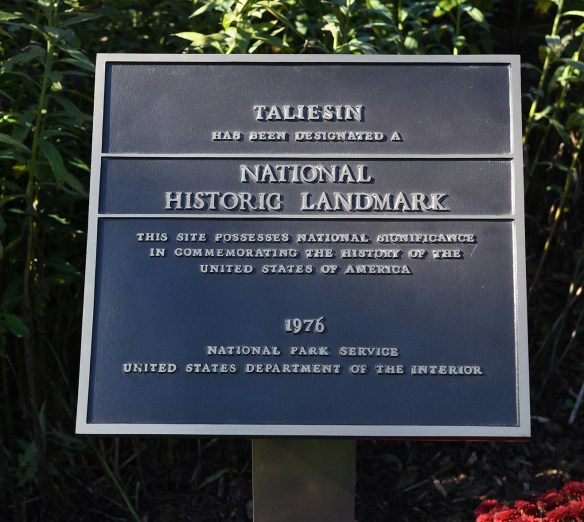
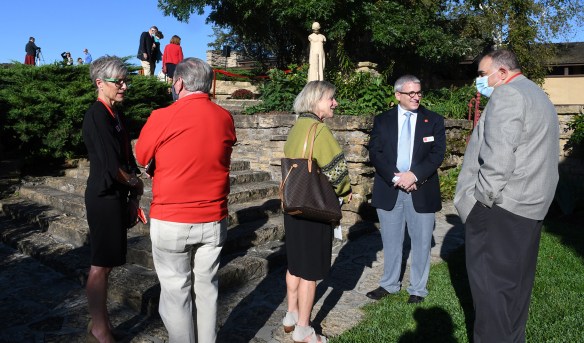
The early morning fog burned off in time for two ceremonies at Taliesin Wednesday September 15, one to cut a ribbon for the restored Tea Circle, the other to unveil two plaques marking Taliesin’s place in architectural history. One plaque notes Taliesin’s designation as a National Historic Landmark in 1976, the other notes it as one of eight Wright sites collectively named UNESCO World Heritage Sites in 2019. The latter marked years of effort by many people with the Frank Lloyd Wright Foundation and the Frank Lloyd Wright Building Conservancy in particular. Wisconsin Gov. Tony Evers and Anne Sayers, Wisconsin’s Secretary of Tourism headlined the event.

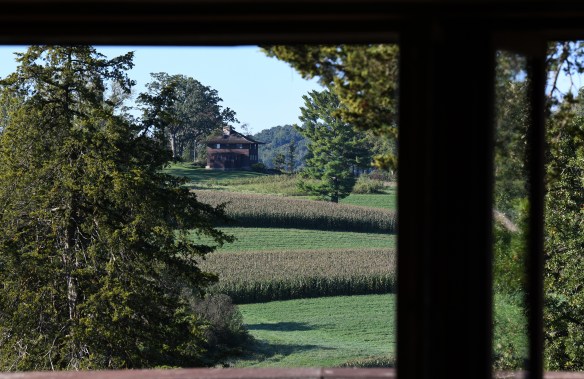
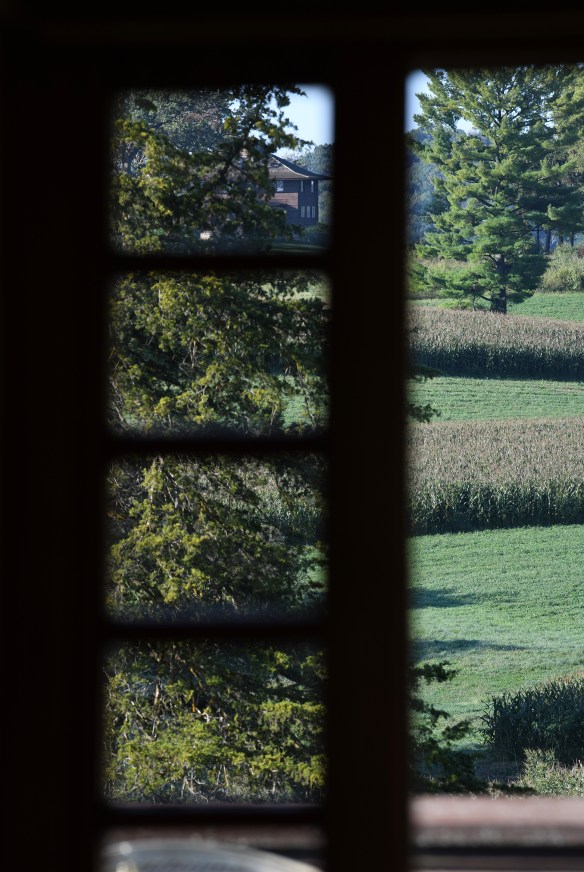
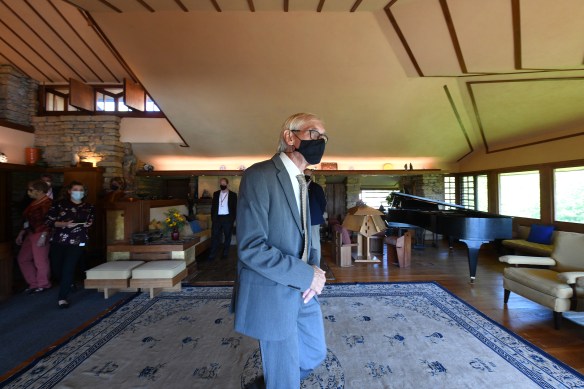
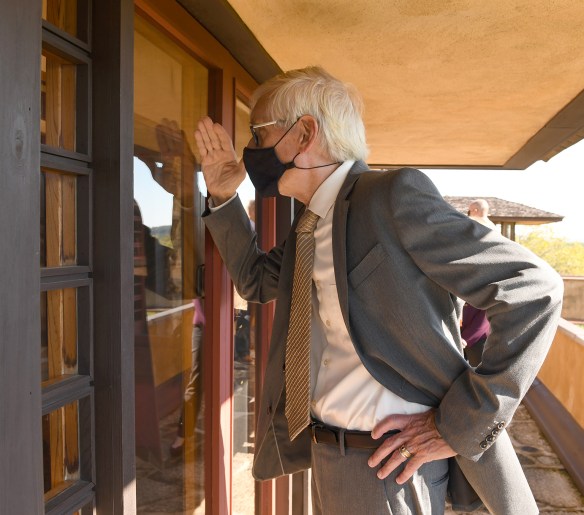
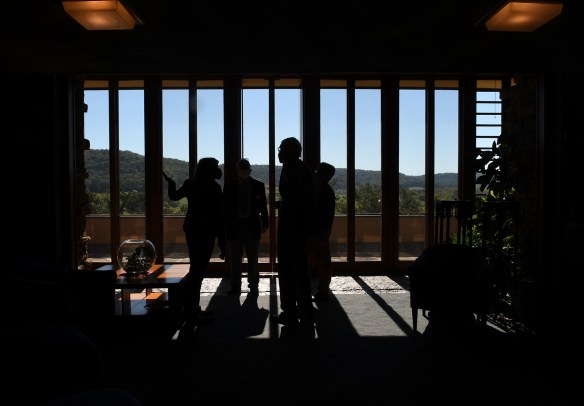
First, I will show you two photos I took wandering through Taliesin before the event, showing the view of Tan-y-deri from Mr. Wright’s bedroom and studio and one I took in the Blue Loggia:

Taliesin UNESCO World Heritage Site 013.jpg

Taliesin UNESCO World Heritage Site 019.jpg

Taliesin UNESCO World Heritage Site 021.jpg

Kimberley Valentine, left, Carrie Rodamaker and Stuart Graff, center, greet guests before the ceremony:

Taliesin UNESCO World Heritage Site 012.jpg

Taliesin UNESCO World Heritage Site 032.jpg

Taliesin UNESCO World Heritage Site 046.jpg

Taliesin UNESCO World Heritage Site 049.jpg

Gov. Evers was introduced to Minerva Montooth shortly after his arrival (look for a profile story about Minerva and my history of photographs of her on this website soon):

Taliesin UNESCO World Heritage Site 081.jpg

Taliesin UNESCO World Heritage Site 083.jpg

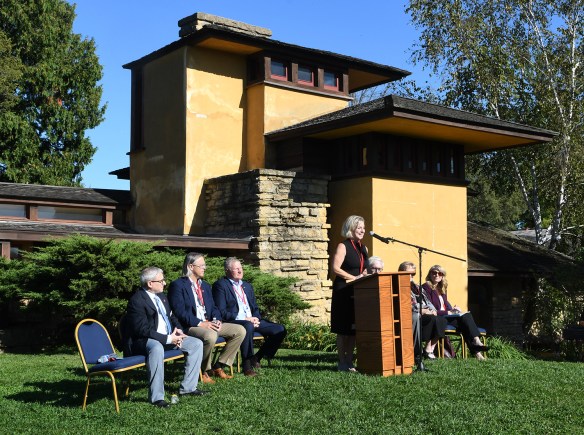
Carrie Rodamaker, CEO of Taliesin Preservation, led the ceremonies in front of the Belvedere:

Taliesin UNESCO World Heritage Site 100.jpg

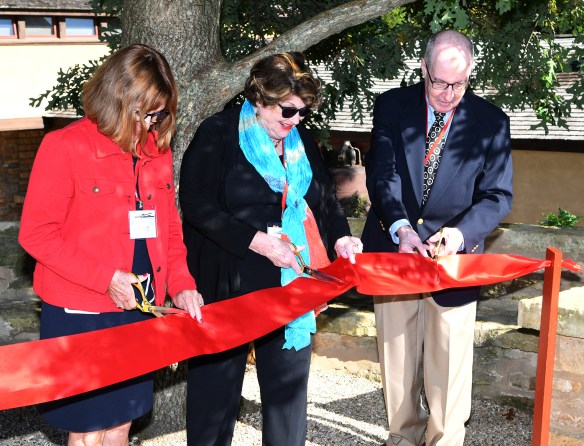
There was a break in the middle of the speeches for Phillis Schippers, left, Gail Fox, and Sid Robinson to cut a red ribbon at the Tea Circle:

Taliesin UNESCO World Heritage Site 104.jpg

Then the two plaques on the crest of the hill were unveiled:

Taliesin UNESCO World Heritage Site 160.jpg

Taliesin UNESCO World Heritage Site 162.jpg

Gov. Evers and Secretary Sayers then toured Taliesin:

Taliesin UNESCO World Heritage Site 193.jpg

Taliesin UNESCO World Heritage Site 175.jpg

Taliesin UNESCO World Heritage Site 215.jpg

Taliesin UNESCO World Heritage Site 229.jpg

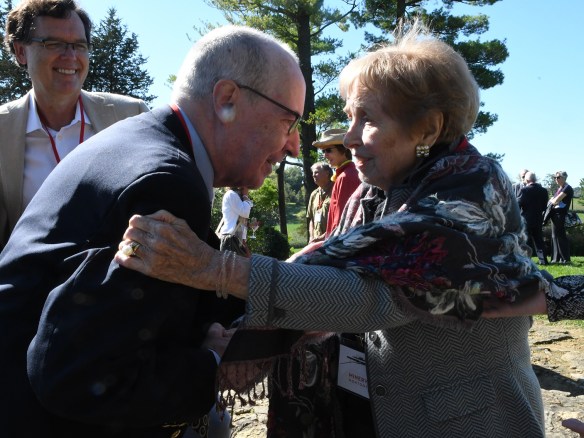
Sid Robinson and Minerva greeted each other:

Taliesin UNESCO World Heritage Site 242.jpg

Taliesin UNESCO World Heritage Site 172.jpg

Taliesin UNESCO World Heritage Site 173.jpg

— 30 —


Wright Through My Lens

All photos © Mark Hertzberg (2021)

I had not been to many Frank Lloyd Wright sites outside of Racine in more than two years until a week ago. I had a gracious lunch invitation from Minerva Montooth for Sunday, and a last-minute photo assignment in Sparta, Wisconsin (west of Spring Green) Saturday, so I overnighted in Spring Green. I have always enjoyed challenging myself to see new things at familiar Wright sites on return visits. These are some of the many fruits of last week’s visit.

I photographed at the famous cantilevered Birdwalk terrace from below:

LR Taliesin 8.29.21 109.jpg

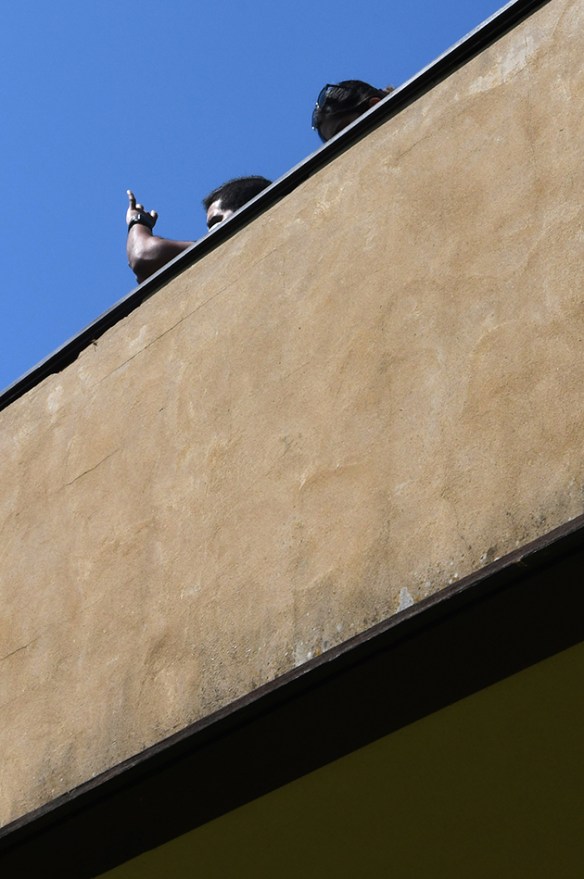
I noticed visitors taking pictures above me while photographing the Birdwalk:

LR Taliesin 8.29.21 066a.jpg

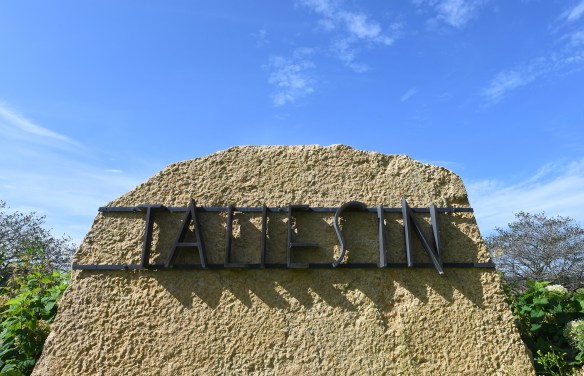
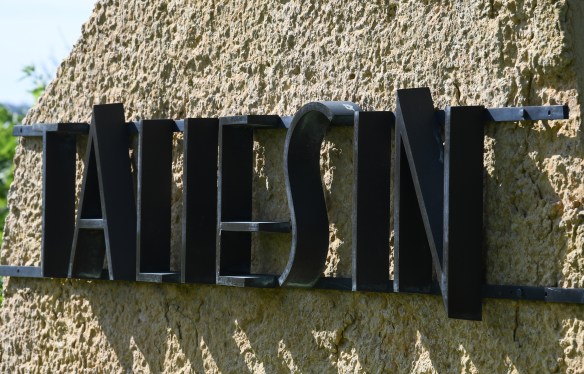
I do not plan my photo visits for a particular time of day / lighting…I shoot what is there when I am there. I explored Taliesin and the grounds of the newly-restored Wyoming Valley School Cultural Arts Center in wonderful evening light Saturday, before dinner with Keiran Murphy and “Mr. Keiran.” I visited both again in Sunday’s morning light. I saw the familiar sign for Taliesin in a different way, thanks to the sharp angle of the morning light:

LR Taliesin 8.29.21 005.jpg

LR Taliesin 8.29.21 002.jpg

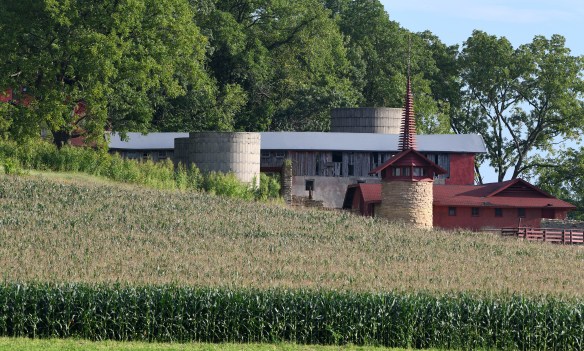
The first thing I saw at Taliesin Saturday as I drove onto the grounds was the corn crib, dramatically lit by evening light:

LR Taliesin Corn Crib 8.28.21 001A.jpg

LR Taliesin Corn Crib 8.28.21 002A.jpg

LR Taliesin Corn Crib 8.28.21 017.jpg

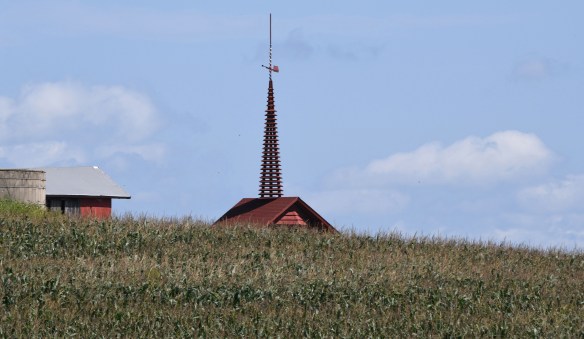
Sunday morning I saw something different with a long lens as I drove up:

LR Taliesin Corn Crib 8.29.21.jpg

I used a powerful zoom lens to photograph Romeo and Juliet and Tan-y-deri from a distance both days:

LR Taliesin Romeo Juliet Tan-y-deri 8.28.21.jpg

LR Romeo Juliet Tan-y-deri 8.29.21.jpg

I continued to explore with the long lens:

LR Taliesin 8.28.21 009.jpg

LR Taliesin 8.28.21 010.jpg

LR Taliesin 8.28.21 011.jpg

LR Taliesin 8.28.21 012.jpg

LR Taliesin 8.28.21 014.jpg

LR Taliesin 8.28.21 015.jpg

LR Taliesin 8.29.21 028.jpg

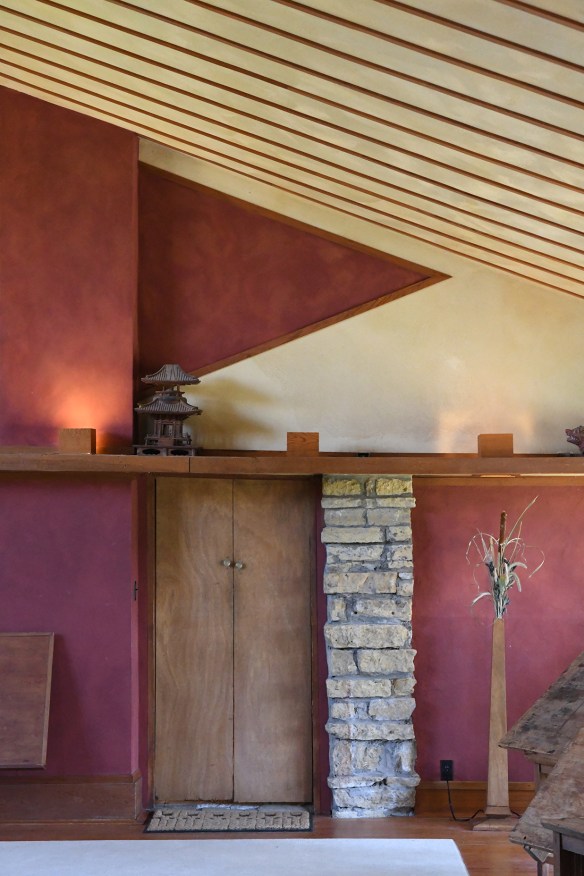
I sat on the floor to photograph through one of the fireplaces inside Taliesin:

LR Taliesin 8.29.21 068.jpg

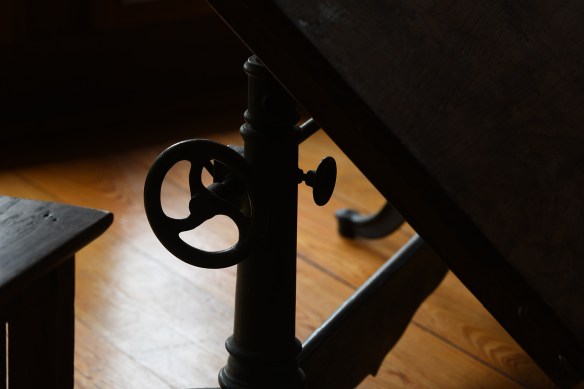
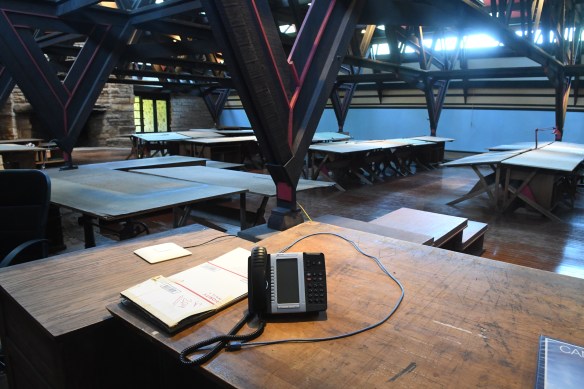
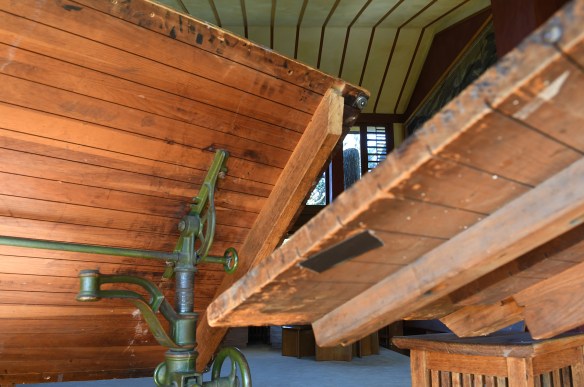
I explored Wright’s office – with its own cantilevered balcony – and the original drafting room:
LR Taliesin 8.29.21 053.jpg

LR Taliesin 8.29.21 051.jpg

LR Taliesin 8.29.21 058.jpg

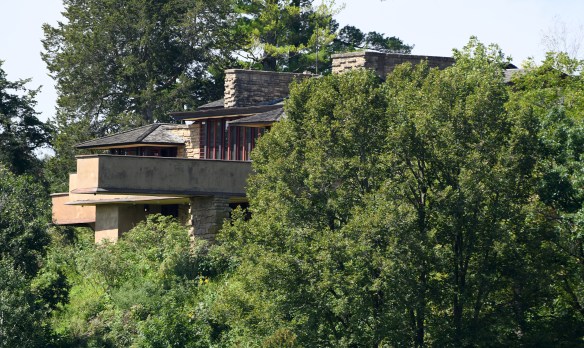
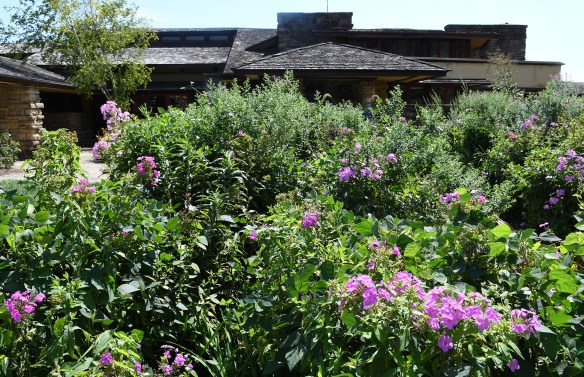
I photographed Taliesin itself with long and short lenses:

LR Taliesin 8.29.21 006.jpg

LR Taliesin 8.29.21 018.jpg

LR Taliesin 8.29.21 024.jpg

LR Taliesin 8.29.21 021.jpg

LR Taliesin 8.29.21 062.jpg

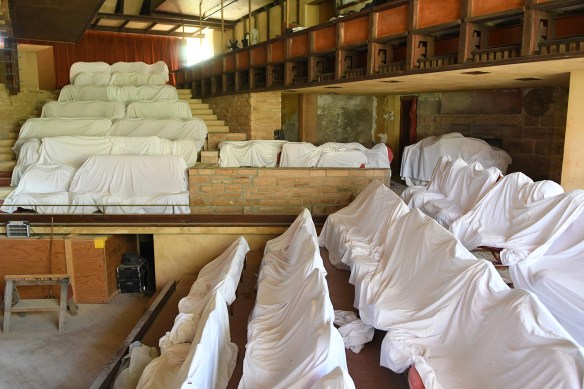
Going to Taliesin means also exploring Hillside Theatre and the drafting room. The theatre is currently being restored.

LR Hillside Theatre 8.29.21 003.jpg

LR Hillside Theatre 8.29.21 005.jpg

LR Hillside Theatre 8.29.21 010.jpg

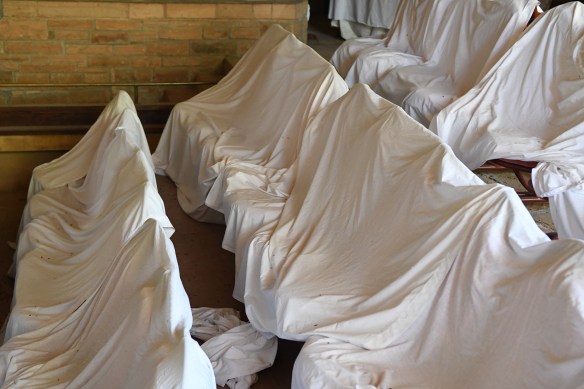
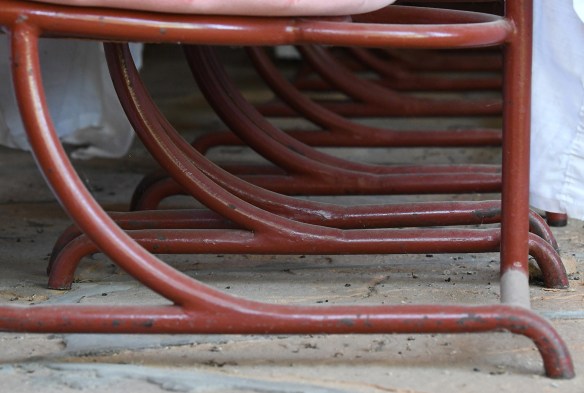
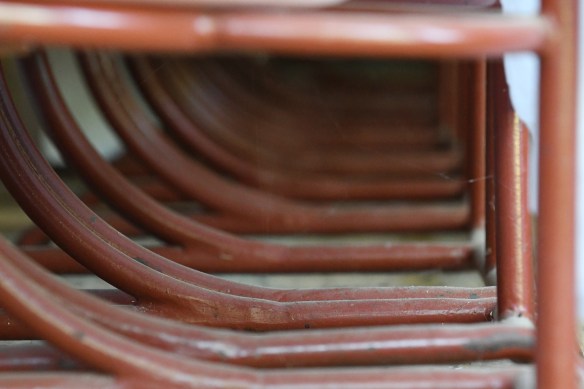
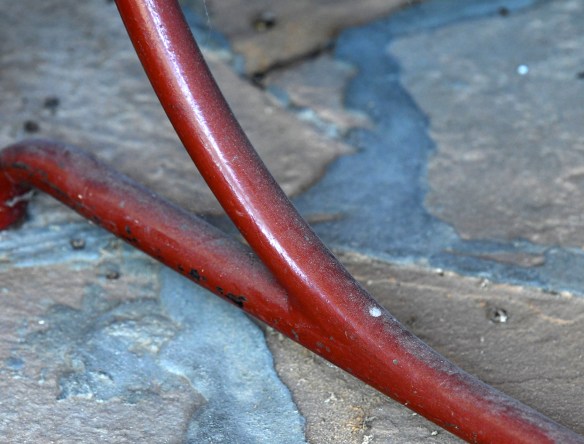
After photographing the ghost-like seats with the sheets covering them I looked for photos under the seats:

LR Hillside Theatre 8.29.21 013.jpg

LR Hillside Theatre 8.29.21 014.jpg

LR Hillside Theatre 8.29.21 015.jpg

LR Hillside Theatre 8.29.21 016.jpg

LR Hillside Theatre 8.29.21 017.jpg

I also looked up:

LR Hillside Theatre 8.29.21 020.jpg

LR Hillside Theatre 8.29.21 018.jpg

LR Hillside Theatre 8.29.21 019.jpg

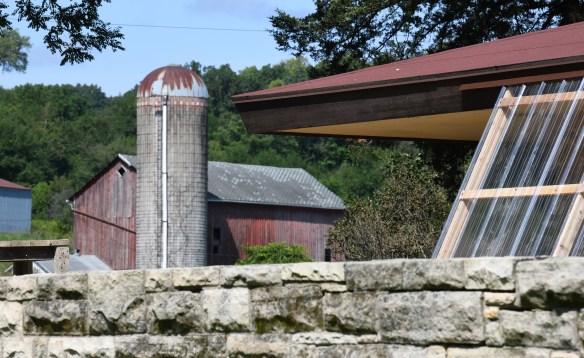
Outside is a view of the theatre and nearby farm:

LR Hillside Theatre 8.29.21 025.jpg

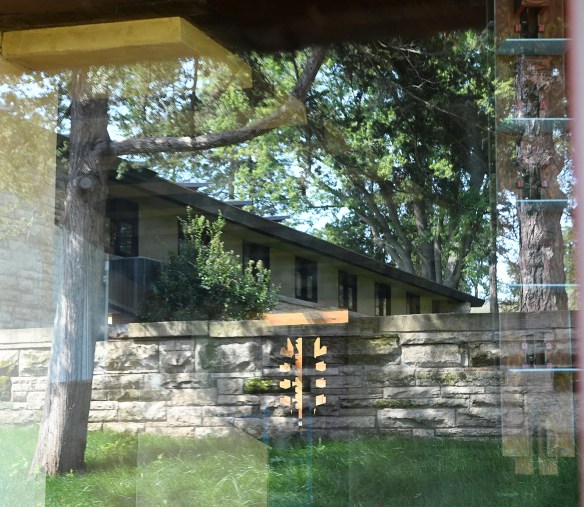
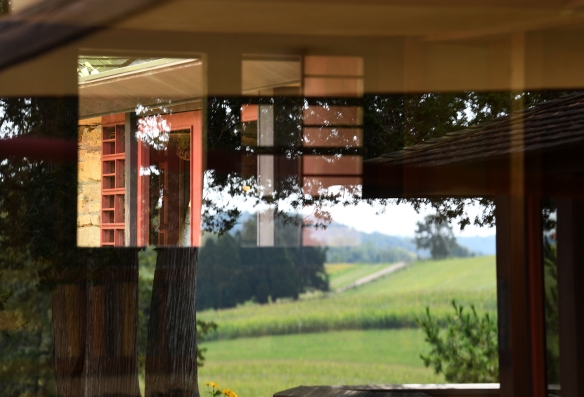
Then I went to explore the silent drafting room, first reflected in the theatre’s windows:

LR Hillside Drafting Room Aug 2021 001.jpg

LR Hillside Drafting Room Aug 2021 008.jpg

LR Hillside Drafting Room Aug 2021 007.jpg

LR Hillside Drafting Room Aug 2021 013.jpg

LR Hillside Drafting Room Aug 2021 012.jpg

LR Hillside Drafting Room Aug 2021 010.jpg

LR Hillside Drafting Room Aug 2021 017.jpg

LR Hillside Drafting Room Aug 2021 018.jpg

And, Hillside itself:

LR Hillside 8.29.21 005.jpg

LR Hillside 8.29.21 008.jpg

LR Hillside 8.29.21 009.jpg

LR Hillside 8.29.21 010.jpg

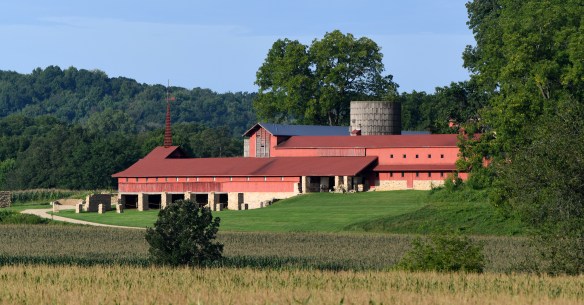
I photographed Midway Barn from the road, on my trips between Taliesin and Wyoming Valley School and once from Hillside:

LR Midway  Barn 8.29.21 001.jpg

LR Midway  Barn 8.29.21 002.jpg

LR Midway  Barn 8.29.21 004.jpg

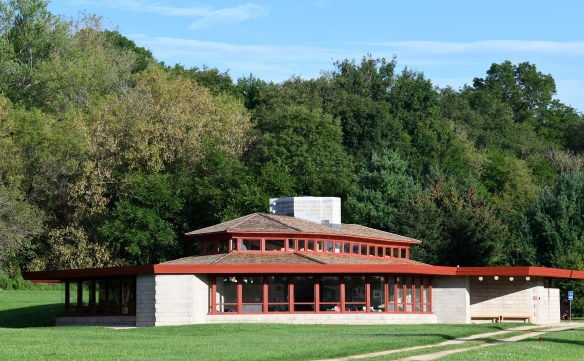
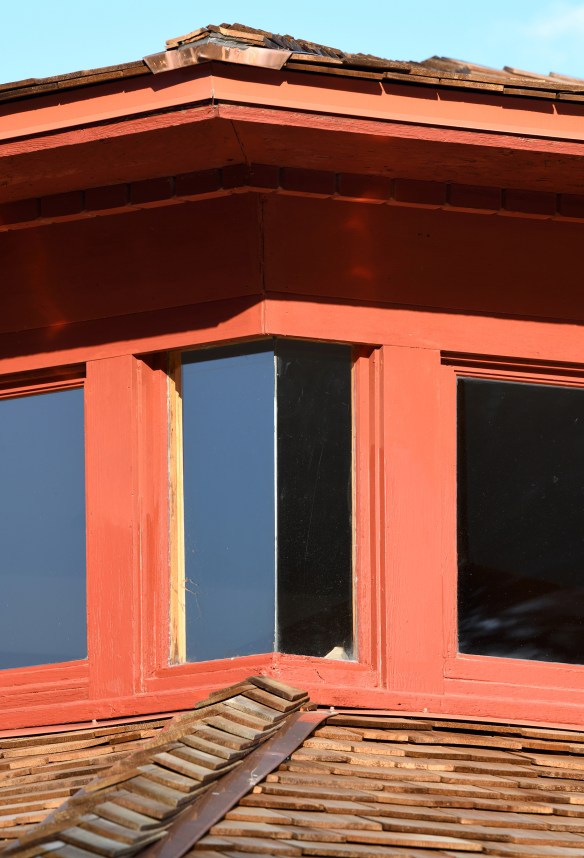
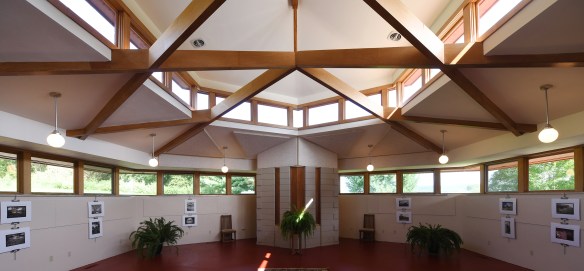
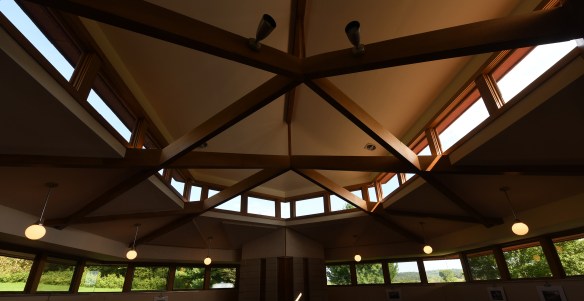
The last set of photos is of the Wyoming Valley School, now known as the Wyoming Valley School Cultural Arts Center. One of the only upsides of the pandemic is that the restoration of the school was able to proceed without having to work around visitors. Many of the changes are structural and not visible. Perhaps the most visible change is that the bricks inside now approximate their original natural color…the yellow of recent years was painted over with a grayish tone.

LR Wyoming Valley School Aug 2021 020.jpg

LR Wyoming Valley School Aug 2021 005.jpg

LR Wyoming Valley School Aug 2021 002.jpg

LR Wyoming Valley School Aug 2021 023.jpg

LR Wyoming Valley School Aug 2021 008.jpg

LR Wyoming Valley School Aug 2021 009.jpg

LR Wyoming Valley School Aug 2021 015.jpg

LR Wyoming Valley School Aug 2021 010.jpg

LR Wyoming Valley School Aug 2021 011.jpg

LR Wyoming Valley School Aug 2021 012.jpg

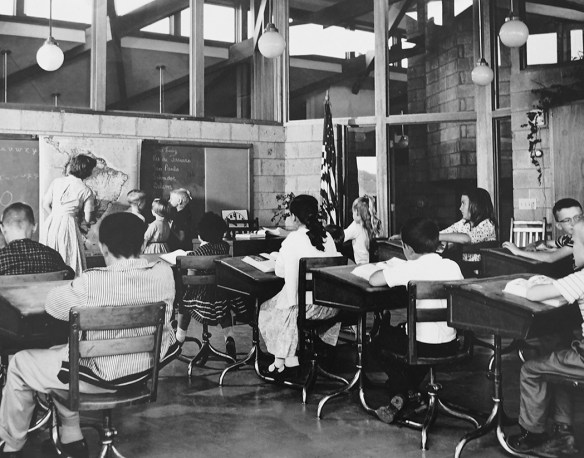
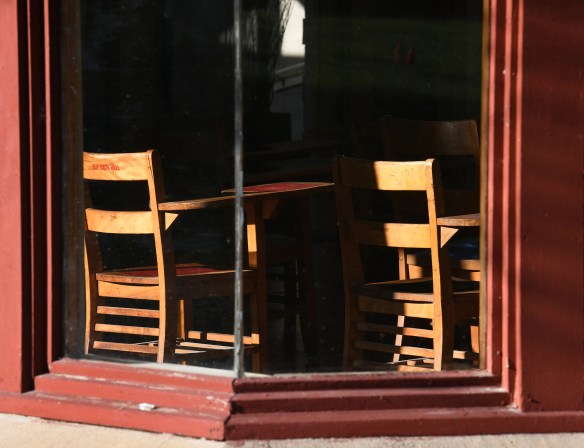
The desks in the classroom today are not original, but I enjoyed photographing them through the mitered glass in the evening light nonetheless. This historic black and white photo shows the original desks.

LR Wyoming Valley School Aug 2021 024.jpg

LR Wyoming Valley School Aug 2021 018.jpg

LR Wyoming Valley School Aug 2021 019.jpg

LR Wyoming Valley School Aug 2021 025.jpg

Robert Hartmann’s wonderful 1960s black and white photos of Taliesin and the school still hang on the walls. His photos documenting the construction of Riverview Terrace are in the rear of the dining room at the Visitors Center.

LR Wyoming Valley School Aug 2021 028.jpg

LR Wyoming Valley School Aug 2021 029.jpg

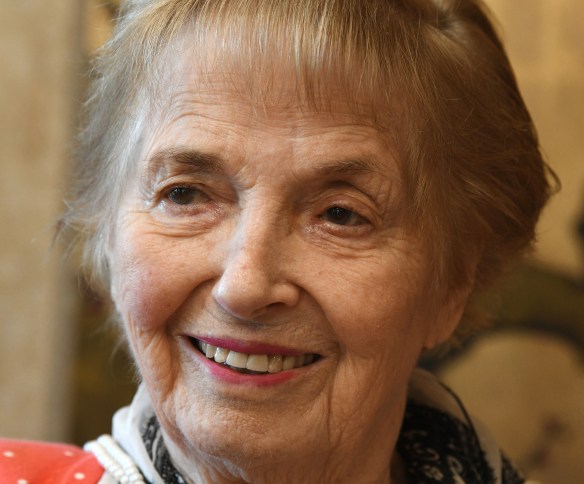
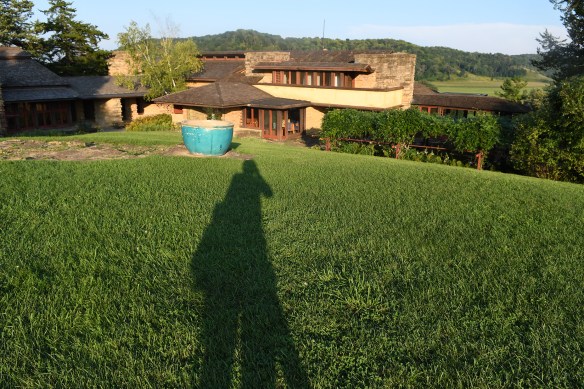
I leave you with a photo of the Marvelous Minerva Montooth and my Taliesin selfie. Technical notes: I do no “post processing” on my photos…I do not sharpen them or increase the color saturation. What I shoot is what I get. I sometimes open the midtones a bit and do a bit of dodging and burning in…nothing that could not be done in a traditional chemical darkroom. I use two camera bodies, one has a DX or crop frame sensor, the other is FX or full frame (equivalent to what would be recorded on a 35mm piece of film). The lenses used are: 14-24mm (used on the FX body); 17-35mm (on the DX body);  a 70-200mm on the FX body, and a 200-500mm, used on both bodies. When the 200-500 is on the DX body, it is approximately the equivalent in 35mm terms of a 350-750mm lens. I thank John Clouse for selling me that lens recently…I had a wonderful time exploring Taliesin and Wyoming Valley School with it!

LR Minerva Montooth 8.29.21 002.jpg

LR Taliesin Selfie 8.28.21.jpg

30-


Happy Birthday, Mr. Wright

Photos © Mark Hertzberg

There is a small gathering to mark Frank Lloyd Wright’s birthday (June 8)  at Taliesin this evening, in lieu of the big celebrations of pre-pandemic years. My wife and I have been privileged to have been invited by Minerva Montooth to those lively evenings. We stopped to see Minerva Friday on our way to Minnesota. I honor Wright’s birthday this year with a photo taken yesterday of Minerva’s smile and the seemingly ever-present gleam in her eyes.

DSC_4044.jpg

DSC_4056.jpg

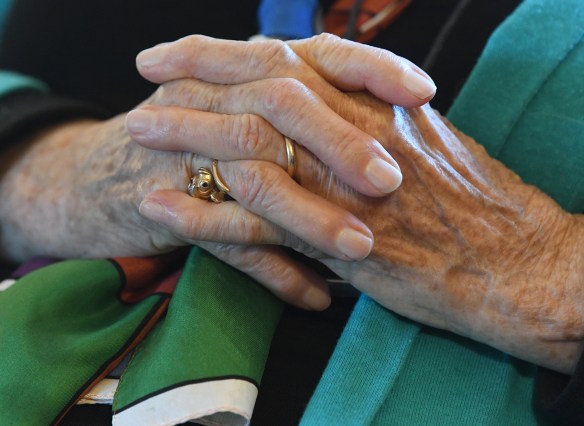
Thank you, Minerva, for yours and Charles’s friendship, and for all you do to keep Wright’s legacy – Mr. Wright to you and the Taliesin family – alive for the World of Wright. You are always stylish when we see you, with a lovely scarf! We love you!

Revisiting Drennan’s “Death in a Prairie House”

Contemporary photos of Taliesin and text © Mark Hertzberg (2021)

Taliesin 9.8.17 018.jpg

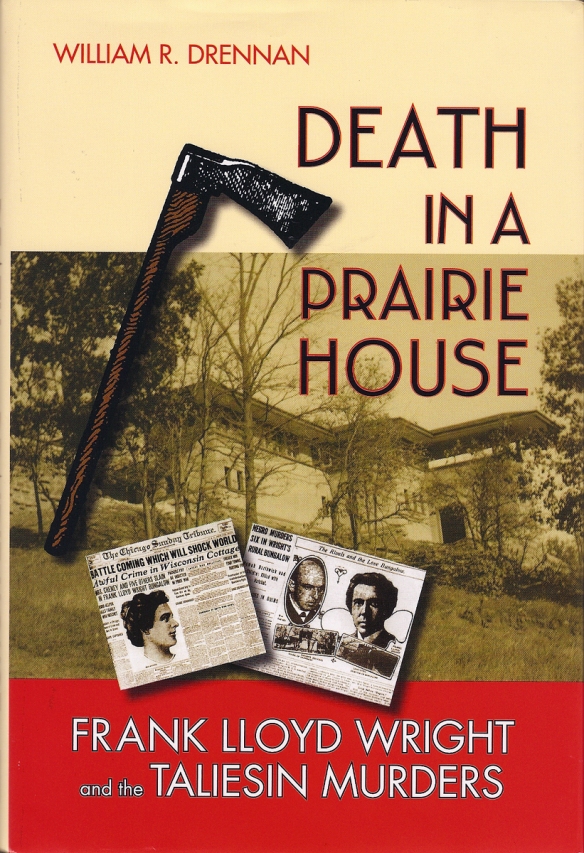
The late Prof. William R. Drennan’s 2007 Death in a Prairie House: Frank Lloyd Wright and the Taliesin Murders (Madison: Terrace Books) is again a topic of discussion on Facebook’s “The Wright Attitude” group. The book has many fans, as evinced by its continuing sales in Frank Lloyd Wright gift shops, 14 years later. 

Drennan cover.jpg

A group member recently posted about excitement about having bought the book. Other group members wrote how much they liked the book. I was sent a review copy of the book when it was published. I read it eagerly, and did, indeed review it on my website, but, likely to the consternation of the author and publisher, I panned it. I was taken to task about my review by one of Prof. Drennan’s acquaintances, but I stand by my critique now, 14 years later. After I commented on the Facebook thread that the book is replete with inaccuracies, I was asked to elaborate on my assertion. That is the genesis of this article.

I sent my 2007 review to a Wright scholar before posting this update. I wanted to get a sense whether it was a fair review, considering that Prof. Drennan has died and cannot defend his work. I was told it is an accurate review. In fact, it was pointed out that I missed a significant shortcoming in the book, Prof. Drennan relying on inaccurate floor plans of Taliesin I, rather than Wright’s own, so that his positioning of the victims at the time of the massacre is inaccurate.

The scholar wrote me of having summarized inaccuracies in a 14-page memo between the printing of the hard and soft cover editions. Evidently some changes were made, but not many. The scholar wrote me last night about one of the points raised:

“The biggest and most notable was that Prof. Drennan didn’t understand Taliesin I. He had the book, Wright Studies, V. 1, in the bibliography but it was obvious the guy hadn’t actually read that book, particularly Anthony Alofsin’s essay on Taliesin I, in which Alofsin identified what he thought was the most accurate Taliesin I floor plan. Prof. Drennan relied on the plan that Storrer created, and the drawing created for In the Nature of Materials. Neither of them showed a garden (with a parapet – just to the south of the living quarters.”

Because the book keeps on selling and presumably is taken as fact by many readers, I am reprinting my review below. 

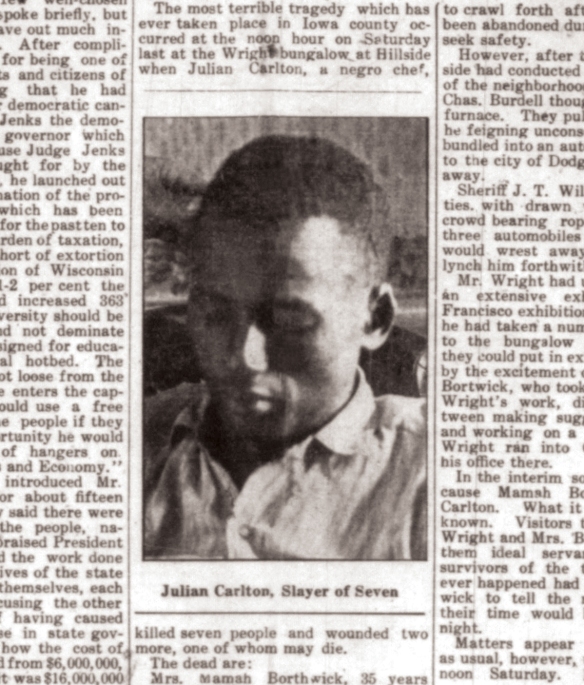
I was taken aback that a manuscript from a university professor, with many supporting end notes, had so many shortcomings. I am still taken aback by its popularity given its shortcomings. I have one new observation. Sloppy writing and sloppy editing, which should have addressed the sloppy writing, weaken the book significantly. As a journalist it drives me batty that Prof. Drennan did not follow common style of using a person’s full name on first reference and last name only on subsequent references. Wright is referred to alternately as Frank Lloyd Wright, Frank (!), Frank Wright (!), and Wright. Julian Carlton is referred to as both Carlton and Julian. Wright’s partner at Taliesin is Mamah Borthwick Cheney, and then Mamah Cheney and Mamah. One of the victims of the attack is alternately Herbert Fritz and Herb Fritz. In 2007 I did not catch that Prof. Drennan also misspelled Alfonso Iannelli’s name (as Ianelli).

Talesin 9.18.19 003.jpg

***

The 2007 review, with slight revisions:

Death in a Prairie House tells a riveting crime story, although the certain motive for the crime still remains a mystery. Prof. Drennan’s account of the brutal attacks weaves together conflicting eyewitness accounts and contemporary newspaper stories. Julian Carlton massacred Mamah Borthwick, Frank Lloyd Wright’s lover; her two children; and four others at Taliesin on August 15, 1914.  Carlton, who was a servant at Taliesin, drank muriatic acid as searchers closed in on his hiding place after the murders. He died in jail several weeks later, before he could be tried, so there has never been a definitive record of what happened, and why. There still is not.

Carlton.jpg

Literally the first half of the book (84 pages) takes the reader through Wright’s parents’ unhappy marriage, and divorce; and then through Wright’s escape from his work and his own marriage, when he and Borthwick went to Europe in 1909. These chapters of Wright’s life set the stage for the building of Taliesin for readers who know little about Wright; they are familiar for readers who have pored through any number of other books about the him. 

Prof. Drennan writes in the Prologue about the “outrage” in Spring Green that Wright’s paramour was living in his “love cottage.”  He ends the Prologue asking, “What could Frank Lloyd Wright have been thinking?”  I expect that kind of question from a television news anchor, but not from a scholar at the beginning of a book. Readers can form such questions on their own, rather than have them spelled out for them. The book is extensively footnoted (168 pages of narrative are followed by 35 pages of end notes), but it is weakened by conjecture and by errors. 

Prof. Drennan asserts that Wright designed the Charnley House in Chicago. That is subject to speculation, with many scholars of the opinion that Wright was executing Louis Sullivan’s ideas, rather than his own. Prof. Drennan incorrectly writes in a photo caption that Richard Bok’s “Flower in the Crannied Wall” sculpture at Taliesin was executed by Alphonso Iannelli at Midway Gardens. On the last page, he writes that Wright’s daughter, Iovanna, had his body disinterred from its grave at Taliesin, cremated, and his ashes mixed in with those of Olgivanna Wright, his third wife, at Taliesin West, in Arizona. That did happen, but it was done as one of the dying Olgivanna’s last wishes, according to her physician, not on Iovanna’s whim, as the author implies. Prof. Drennan relies heavily on Brendan Gill’s biography of Wright (Many Masks: A Life of Frank Lloyd Wright, New York: De Capo Press: 1998), a book that some Wright scholars say is based on too much speculation. 

Although Ed Gein (said to be the inspiration for the character of Norman Bates in Psycho) and Jeffrey Dahmer are better known and notorious mass murders in Wisconsin, Prof. Drennan opines that Carlton’s killings were more significant in the annals of Wisconsin crime. When he finally begins his account of the murders, it is with the admonition that “so much remains a mystery; there are no definitive answers to motive, logistics, time.”  He writes, on page 101, regarding a suggested timeline of the murders [and inaccurately perpetuates the myth that Carlton was serving soup], “And yet it must be true.” However, he hedges in the next sentence, “Or at least something like it must be true…” 

Not only are the three dozen pages of endnotes are cumbersome to read but there are no indicators in the text that send you to the end notes. Prof. Drennan writes in one on page 189 that since writing the narrative, he has reason to believe that he may not be correct in his description of some of the layout of the house. Why didn’t he correct the manuscript rather than cast doubt on his writing in an endnote that takes up more than a full page?

Prof. Drennan sometimes introduces facts and ideas without explaining their context. For example, on page 35 we are introduced to William Winslow. The reader does not learn for another page that Wright’s first realized independent commission, the spectacular Winslow House, was built for his “neighbor” Winslow [and were they really “neighbors?”]. The reader is never told what an important house the Winslow House is. Prof. Drennan does not explain Wright’s ideas about the Prairie style until page 38, several pages after we have been told about his new style of architecture. He gives us the pronunciation of “Mamah” and “Cheney” only on page 41, 34 pages after we first read her name. He does not acknowledge that she dropped her married name in favor of her maiden name (Borthwick) except in a single photo caption. We are told that Wright learned of the murders in a phone call from “Frank Roth in Madison.” We never learn who Frank Roth was, or why he was charged with calling Wright with the news.

There is a paucity of illustrations. The book, most notably, does not include floor plans of the house which would help the reader visualize where the murders took place, as Carlton laid his hatchet into his victim’s skulls. A photograph of the living room at Taliesin refers to the “Wrightian” hearth. That implies that it is in the style of “Wright.” Who, but Wright, would have designed it? There are hard-to-read reproductions of newspaper accounts of the massacre and fire, but no photographs of the ruins of the house.

Prof. Drennan’s thesis is that Wright’s work became “markedly (and understandably) more insular, more labyrinthine, even more fortress-like” after the fire and murders at Taliesin. Therefore, he continues, “the slaughter at Taliesin may well have exerted a significant influence on American residential design throughout the remainder of the twentieth century.”  It is a dramatic theory, but it is not accurate. 

Wright did not abandon the Prairie-style because of the murders. He wrote in his Autobiography that he was frustrated by both his work and marriage, when he closed a chapter in his career in 1909 and left for Europe. Wright had published a short article, “A Fireproof [my emphasis] House for $5000” in the Ladies Home Journal in 1907, seven years before Carlton burned Taliesin down. Many of the homes he designed after the murders did not have prominent front doors, as Prof. Drennan points out, but neither did many of the ones he designed before the murders. 

Prof. Drennan describes the Freeman House, a concrete block home designed in Los Angeles in 1924 as “aggressively vertical, thumbing its nose at Emerson’s old hunger for the horizontal line.” The site for the Freeman House allows for nothing but an “aggressively vertical” design. The concrete used in the five Los Angeles homes represented an evolution in Wright’s design work, not a reaction to the crimes. He designed his landmark concrete Unity Temple and the brick Larkin Administration Building a decade before the fire and murders at Taliesin. They are as fortress-like from the outside, and fireproof, as Prof. Drennan asserts Wright’s post-1914 designs became. Finally, the Usonian homes designed after the 1930s, as well as Fallingwater and Wingspread, are no less organic and inviting than Wright’s Prairie-style work.

Should there still be any doubt about whether or not Wright significantly changed his designs after August 15, 1914, consider that when he rebuilt the smoldering Taliesin, he again used stucco and wood. In fact, the studio at Taliesin II (as Wright’s rebuilt home was referred to), burned down again, in 1925.

Death in a Prairie House succeeds in giving the reader probably every possible scenario of the massacre to consider. It falls short of its promise in other respects.

***

Taliesin Old Drafting Studio 004.jpg

Taliesin Drafting Room 001.jpg

***

Looking over the book in 2021 I credit Prof. Drennan for giving readers the possibility that Julian Carlton was from Alabama, not Barbados as was often written, until Paul Hendrickson painstakingly documented that Carlton was from Alabama in his 2019 book Plagued by Fire. 

The original poster on The Wright Attitude wrote: “…even though I’m sure it’s puffery, it was in the biography/architecture/true crime category so who could resist?” And then, “Is it lurid? I kinda hope so.” Yes, Prof. Drennan’s book is wildly popular. I know how hard it is to write and research a book about historic events. As an author I do not like to denigrate another author’s work, but my advice is still to spend your money on any number of other books about August 15, 1914, that awful summer day at Taliesin.

Taliesin 6.8.19 033.jpg

Taliesin 6.8.19 003.jpg

Meet “The God-Almighty-Joneses”

© Mark Hertzberg, Simon Evans, and Georgia Lloyd Jones Snoke (2021)

It is understandable, perhaps, that they were sometimes referred to by ‘the others’ in the Valley as ‘the God-Almighty Joneses.” Maginel Wright (Frank Lloyd Wright’s younger sister), in The Valley of the God-Almighty-Joneses, written with Tom Burke (1965).

Meet the Evans Family-15.jpg

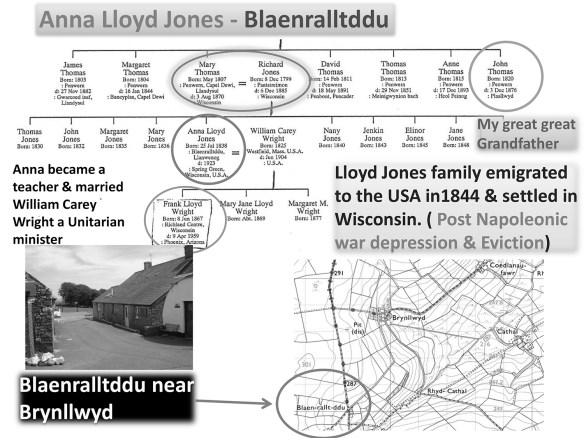
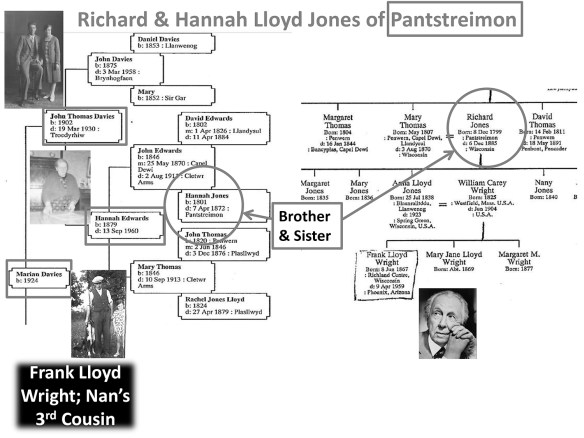
Frank Lloyd Wright’s Welsh heritage has been well documented, but we now have the opportunity to eavesdrop on new correspondence between two living descendants of those “God-Almighty-Joneses.” They are Georgia Lloyd Jones Snoke of Tulsa, Wright’s first cousin, twice-removed, and her distant cousin Simon Evans, who lives in Wales. Nan, who is referred to on some of these slides, is Mrs. Evans.

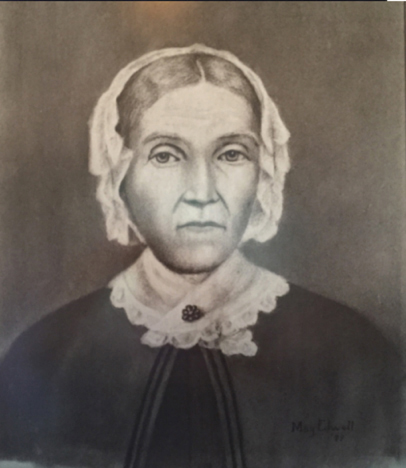
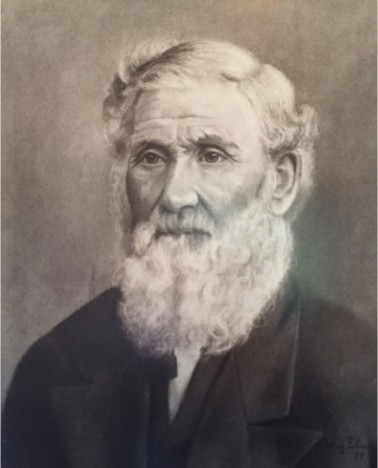
The Joneses set foot in America when when Mary Thomas Jones (Mallie) and Richard Jones sailed into New York on December 8, 1844, according to a family history written by Jane Lloyd Jones in October 1870. Mallie and Richard settled in Spring Green in 1856 and then across the river at Hillside in 1863. Family members did not add their mother’s surname of “Lloyd” to their names until they got to America. They were “Jones” in Wales. They left Wales from New Quay for Liverpool, where they sailed for New York.

Mallie Jones.jpg

Richard Jones.jpg

I have cogitated for weeks how to present this fascinating history. Rather than edit and paraphrase as I originally intended to do, I have decided it best to copy the whole of the current email correspondence between Evans and Snoke, and many of the illustrations in the slide presentation that Evans has painstakingly put together. He lives near the family homesteads in Wales, so his presentation is geared to research he did for his family there. This is a lengthy post, but stick with it…there is a special nugget for fans of PBS television shows, near the end.

Lo Res Meet the Evans Family-9.jpg

This Wright genealogical adventure started when I was researching my book about Penwern, the Fred B. Jones summer estate on Delavan Lake, Wisconsin. Wright designed four buildings for the estate, the main house, the boat house, the gate lodge, and the stable, between 1900 – 1903. One of the important questions I sought to answer was the origin of the name of the estate because there is no definitive documentation about that. It had been written in at least one previous book that “Penwern” is Gaelic for “great house” but that assertion is inaccurate. In fact, “Penwern” is a Cornish or Welsh, not Gaelic, and can mean “near the swamp” or “at the head of the alder tree.” A local botanist has told me that alder trees are native to Delavan Lake. 

Jack Holzhueter, a specialist in Wisconsin history, whose areas of interest include Wright’s life and work in the state, was of inestimable help when I worked on the book between 2013 and 2019 when it was published. He introduced me to Snoke. She and I corresponded many times, and she reinforced the idea that the name is seemingly an Anglicization of Pen-y-Wern, the name of Wright’s maternal ancestral home. That notion was also suggested to me by architects and Wright scholars Brian A. Spencer and Tom Heinz.

Snoke and her husband, Ken, traveled to Wales in 2004 and photographed the Pen-y-Wern cottage where Wright’s grandmother Mallie grew up. Holzhueter suggests that perhaps Wright got his American client Jones – not related to Wright’s Jones family – to honor Wright’s maternal family by naming his estate “Penwern.”

Pen-y-wern  Llandysul, Wales-2.jpg© Ken Snoke
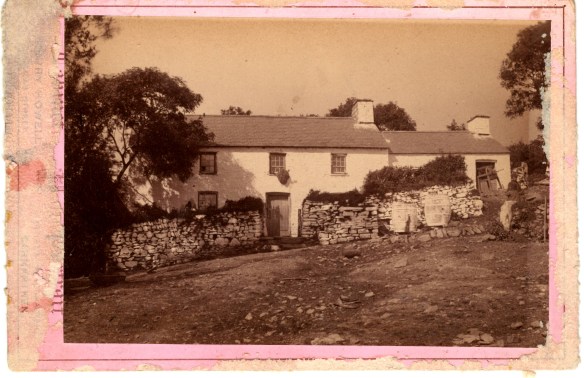
Family accounts differ whether another cottage named Pantstreimon was Richard Jones’s home, or Richard and Mallie’s home before they emigrated. The photo is from cousin Chester Lloyd Jones’s 1938 book “Youngest Son.”

Photo 1 from attic.jpg

I put my research into the Jones / Wright family history aside when my Penwern book was published in June 2019, but I have posted many articles about Penwern and Pen-y-Wern to this website. A welcome surprise landed in my email Inbox on November 25, 2020, asking me to approve a comment on one of those Penwern blog posts. That email brings us to this blog post:

Hi guy’s,

I’m Simon Evans, a distant Cousin of Georgia’s; still living in Wales; and I absolutely loved your article about ‘Penwern’. My great great grandfather on my father’s side was John Thomas, Mary Thomas’ little brother; he set up farm a mile down the valley called Plasllwyd, and survived the destitution and impoverishment of that period; he died a few years after Mallie.

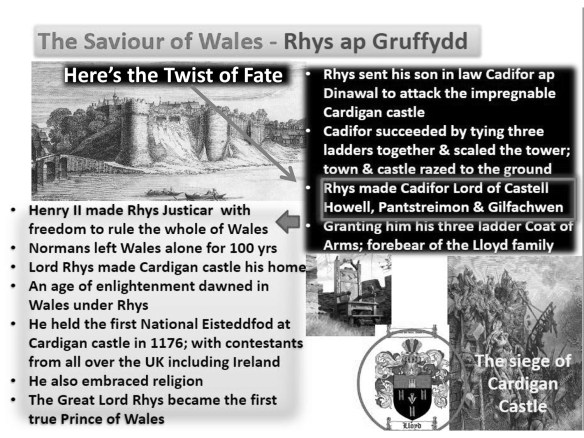
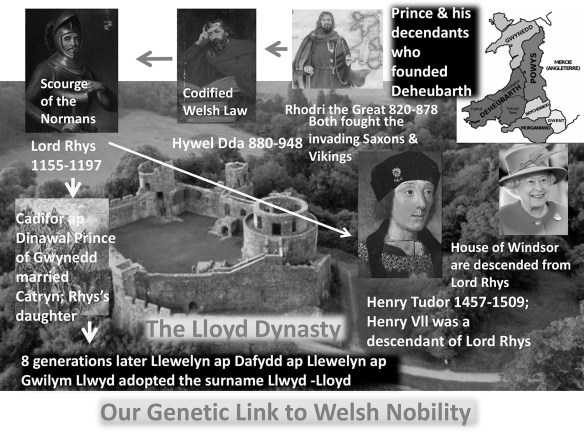
I’m double linked to Georgia since, on my mother’s side my great great gran was Hannah Jones, Richard Jones’ sister. Pantsreimon, the farm next to Penwern, was one of the original strongholds of the Lloyd dynasty; they were the ruling Cast of West Wales for Centuries; Anna was obviously proud of this heritage, hence her use of the Lloyd name.

I put Simon and Georgia in touch with one another, and so, here we are. You may need more than one cup of coffee or tea to follow these threads! The boldfaced portions of these emails are as written by the correspondents.

Georgia Snoke to Simon Evans, November 30, 2020

Back atcha!  To properly introduce myself, I am the great granddaughter of the Reverend Jenkin Lloyd Jones.  He and his wife Susan were BIG in Unitarian circles and for all I have read about him, he was a ancestor to revere.  He had two children, a daughter Mary who never married, and my grandfather Richard who married the Georgia for whom I am named.  She was an absolute GEM!  I am so proud to bear her name.  They, in turn, had three children, Richard Jr., Jenkin (my dad) and Bisser (a “Florence”—my grandmother’s mother’s name—who became “Bisser” when two year old Jenkin couldn’t say “Baby Sister”.  She was “Bisser” all her life.)

While Rev. Jenk preached from the pulpit, my grandfather and his progeny preached through a newspaper (CAREFULLY distinguishing between editorial opinion and newspaper fact!  They’d have been appalled by today’s press.)  They left Wisconsin for the new, raw state of Oklahoma in the late 19 teens when the children were between 9 (Aunt Bis) and 13 (Uncle Dick).   All three returned to Wisconsin for college and were great friends with their dad’s cousin Frank, visiting Taliesin frequently on weekends.

My Uncle Dick went into the business side of newspapering and was also president of the American Newspaper Publishers Association; my dad was editor and publisher of the Tulsa Tribune (and syndicated in 140 newspapers), as well as national president of the U.S. Chamber of Commerce and the ASNE (American Society of Newspaper Editors.  Upon Uncle Dick’s death, Aunt Bis stepped into his shoes as president of the Tulsa Tribune Company.  My two brothers, Jenkin and David, worked full time for the Tribune—Jenkin ending as editor and David as a longtime columnist—and I became a weekly columnist after a few years as a television newscaster. 

I go into all this detail to reiterate the difference between newspaper writers and historians… And much of the secondary research I have done comes from “amateurs” who wrote down what they had been told as children.  There may be gaffs, but the core is there… Blessings, (distant) cousin Georgia

Simon Evans, On Nov 29, 2020

… I’m not a historian; however, it’s been my hobby since I retired nine years ago; having spent forty years at the forefront of driveline technology in the automotive industry; I retired back to the family farm in Ceredigion; it’s been the family home since 1860; but you’ll see from the family tree; my family’s been in these parts for ever.

I remembered my grandparents telling stories about our extended family; and being the only remaining link to the past; I owed it to my grandkids to research its’ voracity, and get it written down for posterity. Well, word got out, and I was asked to give a talk to the community group. 

It ended up being a two-hour Power-Point presentation; and it went down a storm!! 

Other Historical Societies heard about it; so, I’ve been busy for the past two years, giving the talk here there and everywhere it seemed; my favourite venue had to be the Great Hall at Lampeter University; the third oldest University in the UK; that really had atmosphere. 

The Power-Point file is nearly 300MB; not exactly email size; but what I’ve been doing is to break it up into smaller segments in PDF format and to get under the email Limbo limit. 

The two files I’ve attached here are: A fun file I created for the Grandkids showing them that their timid little Nan was a distant cousin of our queen; it gets across quite succinctly, the huge influence the Lloyd family had in these parts. 

The other one is a file I prepared for our Parish Council for their annual Walk for Life initiative; they were going to walk the Aber Loop and wanted me to highlight places of interest along the way; the walk goes quite close to Blaenralltddu; but it’ll give you a taste of the amazing history that lurks in the shadows of a non-descript little backwater of West Wales. 

I’ll have to do a bit of massaging on the other elements to make them attachment size; please bear with me. 

However; the attached is a taster; enjoy. 

Georgia Snoke 29 November 2020:

I am absolutely cock-a-hoop with your information, and I embrace you and yours as cousins. 

 I was very fortunate to have had two splendid Welshmen, one a descendant of Mallie’s family, provide an enormous amount of research to our branch.   One was John Jenkins (sadly deceased) and one was Ifan James, a Mallie descendant.  Ifan gave three days of his life to Ken and me in 2004 and took us all over “our” part of Wales.  I am enclosing an excerpt of those days in the “Black Spot” for your amusement.

Again, so MANY thanks for your extraordinary offerings.  What a joy to “meet” you, Cousin!

Georgia Snoke 29 November 2020:

Dear “Cousin” Simon:

What a wonderful Thanksgiving gift to receive your email.  I am very excited about “meeting” you and look forward to all you may share about the Lloyds.  Our family has always known that Richard and Mallie were “Jones” in Wales, but the family story is when they reached Wisconsin there were so many Welsh Joneses they took their mother’s maiden name as a prefix.  For certain sure, I, for one, claim the Lloyd name with pride and sign my passport Georgia Lloyd Jones Snoke.  Some in that second generation (my great grandfather’s–the Reverend Jenkin Lloyd Jones—) wrote the two names with a hyphen; some used periods, some (the eldest) merely used Jones.  But most of us in communication now use the Lloyd as well as the Jones.

A wonderful cousin named Jix (Richard) Lloyd Jones did considerable research on the Lloyds.  I have created a gigantic book filled with various essays—his included—but, like my own essays, I can’t always be sure his facts are accurate.  None of us speak Welsh these days.  He died about three years ago.  What a wonderful, wonderful man!

We Ll-J’s would treasure any information you wish to share.  In fact, I am the “editor” of the annual Unity Chapel newsletter and I would love to include anything you wish to impart.  With full credit to you, of course.

And if you are interested, I would be more than happy to send you a little booklet that I have put together for the next generations.  All I need is your address.

My husband and I have visited Wales several times, always with a stop at Alt-y-roden (sorry about the spelling.  I don’t have my notebooks in front of me.) Pant-y-Dafaid, Blaen-yr-allt-ddu, etc.

In fact, one of the funniest coincidences of my life occurred far from Wales.  My husband and I were getting ready to take a ship to the Mediterranean.  It was disembarking from Cadiz.  We had come a day early, so husband Ken took the rental car to its home and I started unpacking in our cabin.  Over the intercom came an invitation to passengers already on board to join in a luncheon buffet—which sound much more fun than unpacking.  So there was this little lady from Tulsa, Oklahoma standing in line when the two gentlemen behind me introduced themselves to one another.

“Hello.  My name is David…”  “Hello, MY name is David…”  So I, who had a brother named David, quipped over my shoulder, “David is a great name.  Dewi Sant would be proud.”

There was a pause, and then the “David” with the British accent said, “Dewi Sant?  What you you know of Dewi Sant?”  Blush!  So I turned to them, introduced myself, and explained that I didn’t really know much about Dewi Sant—just that he was the patron saint of Wales and I only knew that because some of my ancestors came from Wales.

From the fellow with the British accent.  “Oh. That’s interesting.  Where did they settle?”  “Wisconsin.”  “Where in Wisconsin?”  “Ummm…south central Wisconsin.”  Then came the coup de grace:

“Have you ever heard of the Valley of the God-Almighty Joneses?”  By this time I was gaping.  “That’s my FAMILY!  My great-grandfather was the Reverend Jenkin Lloyd-Jones!”  “Oh yes, yes, yes.  He was the uncle of Frank Lloyd Wright.”  And it turned out that this particular David (Barnes) was one of the Lindblad expert guides to the Mediterranean, but he was Welsh and had written his doctoral thesis about religious dissenters in Wales. A whole chapter was devoted to my Lloyd ancestors.  Later, I asked David if I could get a copy of his thesis to read.  Someone else asked him its title and he said, People of Seion.   I gulped and said, “David, it’s already in my library.”

(Re:  The Valley of the God-Almighty Joneses:  That is a book written by Frank Lloyd Wright’s little sister, Maginel Wright Barney, in which she chronicles the stories passed down through the family of Wales and Wisconsin.  The title has become affixed to the Valley where the Lloyd-Jones’ Unity Chapel is and the whole family inhabited.)

Long story short, David has remained a friend and about three years ago we hired him to take Ken and me, my niece and nephew, and our daughter for a week’s trip to Wales.  What a glorious time!

As I say, that was a truly amazing exchange.  Just as it is wonderful that you’ve contacted Mark and I will have a chance to learn yet more from you.  I hope you are willing.

On November 29 I wrote Georgia, asking her to summarize the family tree for me:

Richard Lloyd Jones, my grandfather, was named for his grandfather Richard who, with his wife Mallie (Mary Thomas) and their seven children, made the voyage to America.  One of their sons, my great grandfather, the Reverend Jenkin Lloyd Jones was the brother of one of their daughters, Anna Lloyd Wright.   Their sons (Richard and Frank) were therefore first cousins.  Frank built my grandparents’ home, Westhope, in Tulsa.  I knew it well as I stayed there whenever my parents went out of town.

I call Richard and Mallie the first (American) generation.

Reverend Jenkin, Anna Lloyd Wright, and 9 siblings were born.  One, Nany, died as a child) — They made up the second generation.

The third included my grandfather, Richard, and his cousin Frank.

The 4th—my dad, aunt and uncle of the “Jenkin line”

My dad’s kids—me, my two brothers, sundry cousins—5th generation

Our kids and grandkids — 6th and 7th.  Time flies when you’re having fun.

Does that give you the family “tree”?  Of course, the 2nd generation farm families had a passel of kids—which is why the “Aunts” (Nell and Jennie) used their skills as teacher to begin Hillside Home School.  They never married and Margaret survived her two sons and two husbands, but the rest of the family was ore or less awash in kids.  The third generations focussed on education.  They spread far out from Spring Green.  It wasn’t until the death of actress Ann Baxter’s mother (a daughter of Frank) that the family began to coalesce around the abandoned Unity Chapel.  Branch by branch we made re- connection.  Now every five years (except this year) a reunion draws us together.

Hope this helps sort us out, Mark.  Blessings to you!  G…

I have, indeed, made connection with Simon Evans and he is, indeed, a (distant) relative.  Furthermore, he has a gazillion stories to tell about the Lloyds (from whence the “Lloyd” of Lloyd-Jones and Lloyd Wright comes.)  He is a delight, and I’d have utterly missed out had you not given me that nudge.  Thank you, thank you my friend!  Georgia

Georgia to Mark, December 3:

Dear Mark:

I absolutely loved Westhope [the house that Wright designed for her grandfather, Wright’s cousin Richard Lloyd Jones, in Tulsa].  More or less growing up in a Frank Lloyd Wright house spoiled me.  There is a family story that Frank was supposed to design its furniture, too, but the man he sent to oversee its construction spent that money on his family.  It was the Depression.  No one sued, but the only furniture my grandparents’ got was a fabulous desk with crawl through space beneath for us young children.  (It now resides, as I recall, at the Metropolitan Museum in New York.)   When my great grandmother in Eau Claire died, her plush Victorian furniture was brought to Oklahoma.  Aunt Bis always said that the Victorian furniture “softened” the angularity of the architecture.  She saw the house through several different owners and never liked any of their furniture in comparison.

LR Richard Lloyd Jones House 013.jpg

It was my beloved Aunt Bis who really introduced the Lloyd Jones family to me.  As I said to Simon, the Jenkin line in Tulsa, Oklahoma was pretty isolated from other branches.  Aunt Bis saw an article on Elizabeth Wright (FLlW granddaughter), and dropped a note to her.  That introduced us to the Anna line.  But when the mother of Liz’ cousin, actress Ann Baxter, died, the idea of checking on “the dear old chapel” in Spring Green, WI was raised.  There was a 1979 picnic at Tan-y-deri that my dad took Ken, our girls and me to.  From that came the formation of Unity Chapel, Inc.  I’ve twice served as its president as well as multiple times as board member.  Both my girls are on the board today.

Meanwhile, I became hooked on Lloyd Jones history.  I would come to board meetings a couple of days early and spend them in the newspaper archives at the Wisconsin State Historical Society.  That led me to all sorts of other research.  It has been a wonderfully fulfilling episode in my life, and I probably know more about the second generation (my great grandfather’s) than anyone now living.  I came to admire them hugely.  For the most part, they were farm folks, but their drive and curiosity and creativity were astounding.  And even in that second generation you had two extraordinary female educators and an internationally known minister.

Georgia to Mark December 7

Mark:  the first cottage is  Blaen-yr-allt-ddu (my spelling is suspect) where my great grandfather (the Rev.) Jenkin was born.  The family landed in New York a year later.  The plaque on the wall commemorates his birth there, put up by Chicago parishioners following Jenkin’s death.  The cottage has been much expanded since then.


The white cottage continues to puzzle me.  It is charming…and far different from the Pen-y-wern stone (and forbidding-looking) structure whose picture Ken took. The white cottage is identified as Pen-y-Wern in Chester Lloyd Jones’ book, Youngest Son (about his father Enos, last of the 1st generation flock.)  And yet when Ifan James took Ken and me around family structures in 2004, it was the dark and dour tall stone building  he identified as Pen-y-Wern.  And that’s what the sign says!   

Wait!  It was Ifan James who took Ken and me to dark and dreary Pen-y-Wern.  It was his dear friend, colleague, and terrific researcher into Ll-J materials John Jenkins who made corrections for other photos in Chester’s book, but slid right over the i.d. of the white cottage.   John had died by our 2004 visit—a great loss.  As a surmise, he knew Pen-y-Wern as Mallie’s birthplace but never actually saw it.  If Chester identified the white cottage as such, John may have accepted his i.d..  Who knows?  I am so sorry to have totally lost contact with Ifan James.  I don’t even know if he is still alive.

Simon:  When Ken and I, in the company of Ifan, met the couple who owned Pen-y-Wern they were cordial…Their children were not interested in farming.  They didn’t know what the future would bring.  I don’t know if they are still there.  But I wonder if there is a historical society in the area that could identify the white cottage?  Could be worth a try?  As I said, I’ve been puzzled by that photo in Chester’s book for years.

Onward!  G

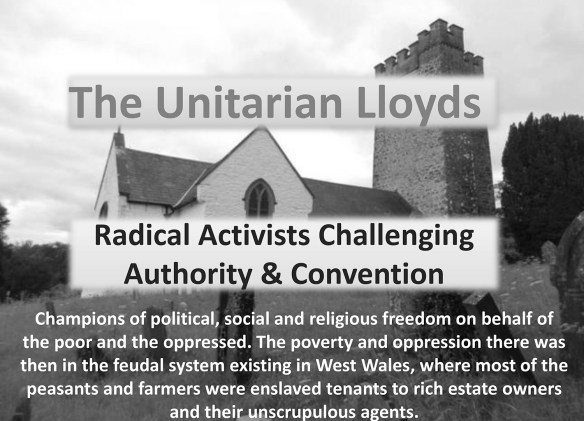
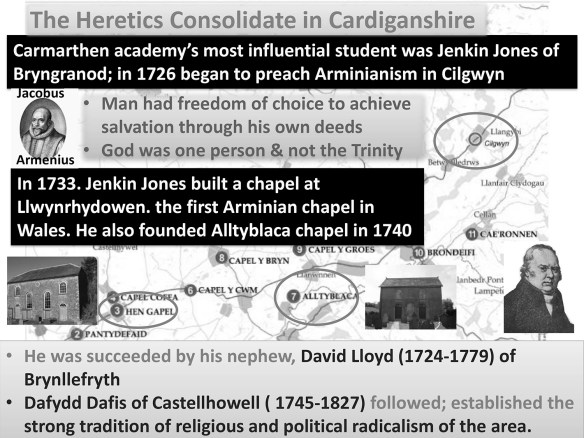
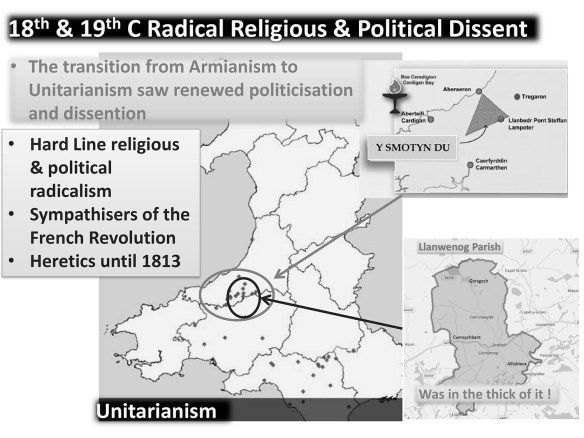
Much of Simon’s presentation touches on the family’s strong ties to the Unitarian religion. Economic hardship and the quest for religious freedom spurred Mallie and Richard to emigrate to America.

LR Unitarian Lloyd's & Beyond-2.jpg

Lo Res Unitarian Lloyd's & Beyond-10.jpg

LR Unitarian Lloyd's & Beyond-4.jpg

Unitarian Lloyd's & Beyond-10.jpg

LR Unitarian Lloyd's & Beyond-12.jpg

LR Unitarian Lloyd's & Beyond-13.jpg

The Rebecca Riots were Welsh resistance to the imposition of tolls on roads in Wales. According to Wikipedia, the ringleaders of the resistance were sent to Australia as convicts, but the toll gates were dismantled in time when it was determined that they were an obstacle to free trade.

There is one more tantalizing discovery…the Royal Family is related to the Lloyds. LR Nan's Ancestral Surprise-4.jpg

LR Nan's Ancestral Surprise-10.jpg

LR Nan's Ancestral Surprise-18.jpg

So, now we have a link between Frank Lloyd Wright’s family and the House of Windsor, the Royal Family of Great Britain (something that the producers of Masterpiece Theater and “The Crown” have overlooked)! What think you, should the Frank Lloyd Wright Foundation, the Frank Lloyd Wright Building Conservancy and Other Things Wright send a post to Buckingham Palace, inviting them to join their ranks or at least send a few pounds and shillings their way? After all, Prince of Charles, you know, the Prince of WALES (!) is keenly interested in architecture!

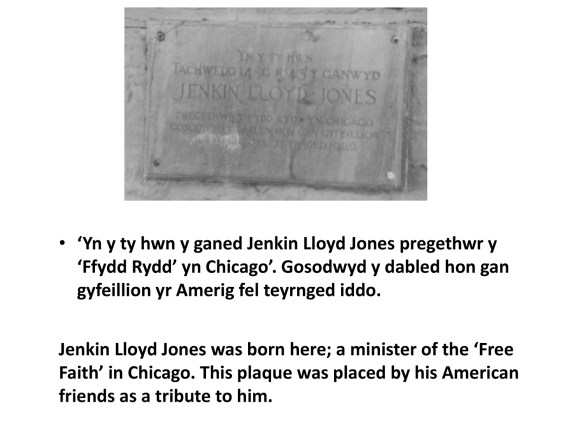
A commemorative plaque was unveiled in 1922 at Jenkin Lloyd Jones’s birthplace:

LR Unveiling Ceremony of Commemorative Plaque-2.jpg

LR Unveiling Ceremony of Commemorative Plaque-3.jpg

LR Unveiling Ceremony of Commemorative Plaque-4.jpg

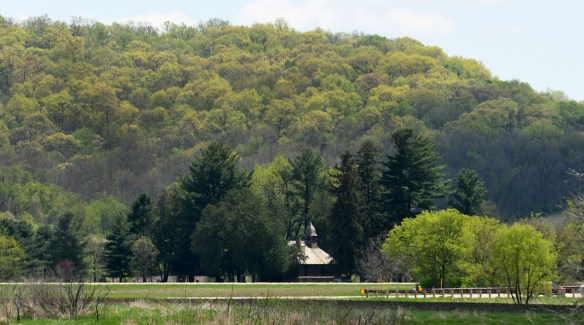
Georgia and Simon have taken us on a remarkable journey. It begins with a couple seeking better fortunes and religious tolerance and ends with their grandson, an architect who spent his summers in the valley of “the God-Almighty Joneses,” whose work is revered to this day. I leave you with photographs I have taken at Unity Chapel, the family chapel across the road from Wright’s beloved Taliesin. I also thank Keiran Murphy for her assistance with this blog post (and countless other projects of mine!). I joke, but am not far off the mark, when I tell people that she likely knows more about Taliesin and Frank Lloyd Wright than he did.

Unity Chapel 5.15.19.jpg

Unity Chapel 017.jpg

Unity Chapel 003.jpg

Unity Chapel 004.jpg

Unity Chapel 008.jpg

Unity Chapel 2012 004.jpg

Unity Chapel 2012 006.jpg

Unity Chapel 2012 012.jpg

Unity Chapel 2012 016.jpg

Unity Chapel 2012 019.jpg

Unity Chapel 2012 022.jpg

Unity Chapel 2018 001.jpg

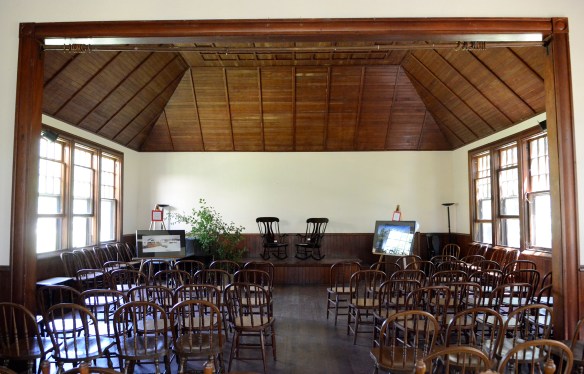
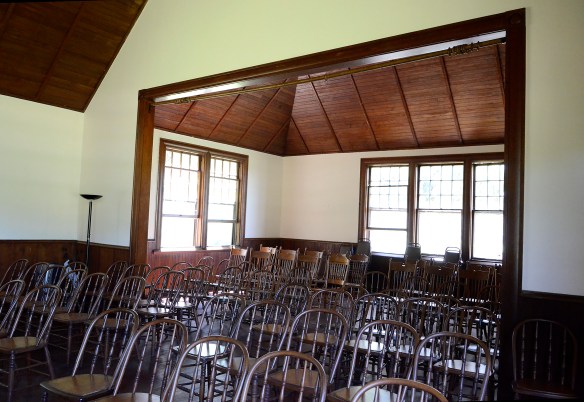
This is where the family gathers every five years for a reunion (when there is no pandemic…2020 was canceled). Perhaps Simon and Nan can join them in the future!

Rainy Day Post #3 – A Wright Potpourri

Photos (c) Mark Hertzberg (2020)

I have promised you one more “rainy day post,” cleaning up pictures that have been waiting on my desktop for the right context to post them in. This is a smattering of photos of Frank Lloyd Wright sites I have visited in one context or another since July 2018. While I shoot literal photos of Wright buildings (“head shots” we called them in the newsroom), I also look for photos of details of Wright’s designs. I am generally not sharing interior photos of private homes. I try to avoid looking at other photographers’ interpretations of Wright buildings before I visit them so that I see the structures through my own eye and lens, rather than possibly copy another photographer’s vision.

The photos are in chronological order, beginning with a wonderful trip to the Detroit area that July two years ago. We were with our good friends Bob and Jeanne Maushammer from Virginia. Jeanne’s exposure to Wright began when she was a teenager, hired to babysit at the Thomas P. Hardy House in Racine for Schuyler and Peterkin Seward, stewards of the house between 1957 – 1963. The Maushammers dutifully chronicle their Wright adventures in a well worn copy of William Allin Storrer’s The Architecture of Frank Lloyd Wright. I will copy and paste Jeanne’s recollections of the Hardy House from my 2006 book about the house at the end of this blog post.

Our first stop was at the Affleck House in Bloomfield Hills, where Dale Gyure graciously gave us a private tour:

Affleck House 009.jpg

Affleck House 018.jpg

Affleck House 026.jpg

Affleck House 029.jpg

Affleck House 032.jpg

We were fortunate to next get a private tour of the Melvin Smith House. The light was not as subtle as the architecture in the early afternoon:

Smith House 014a.jpg

Smith House 020.jpg

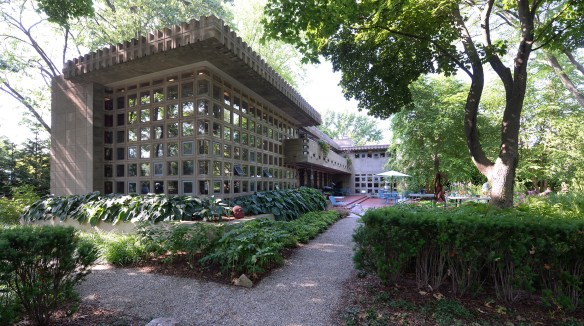
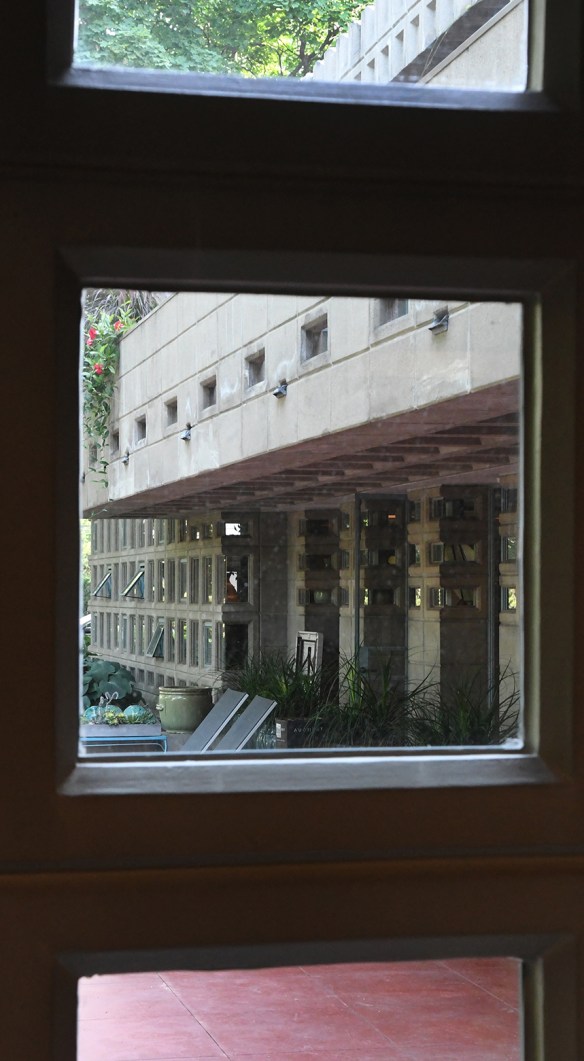
Then we were off to the Turkel House, lovingly restored by our good friends Norm Silk and Dale Morgan. Jeanne has wonderful stories of having seen the then-distressed house ca. 2004 right after a questionable tenant had been evicted. We had bid on a dinner at the house, to benefit the Frank Lloyd Wright Building Conservancy. Norm went above and beyond shopping for us in a Middle Eastern market, and we had a lovely meal in the garden. The Maushammers, Cindy (Hertzberg), and Norm:

Turkel House Dinner 010.jpgWe planned to stay only a couple of hours and not overstay our welcome, but we were like family enjoying the house in the living room after dinner until past 11 p.m.! The light was harsh when we arrived at 5 p.m., and I wondered how it would change through the evening:
Turkel House 001.jpg

Turkel House 032.jpg

Turkel House 044.jpg

Turkel House 046.jpg

Turkel House 011.jpg

Turkel House 016.jpg

Our next adventure was when Bob and Jeanne treated us to a stay at the Palmer House in Ann Arbor:

Palmer House 031.jpg

Palmer House 034.jpg

Palmer House 042.jpg

Palmer House 037.jpg

Palmer House 082.jpg

Palmer House 068.jpg

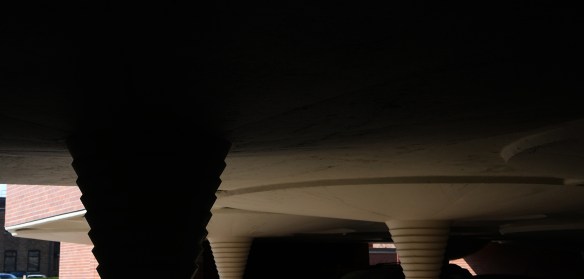
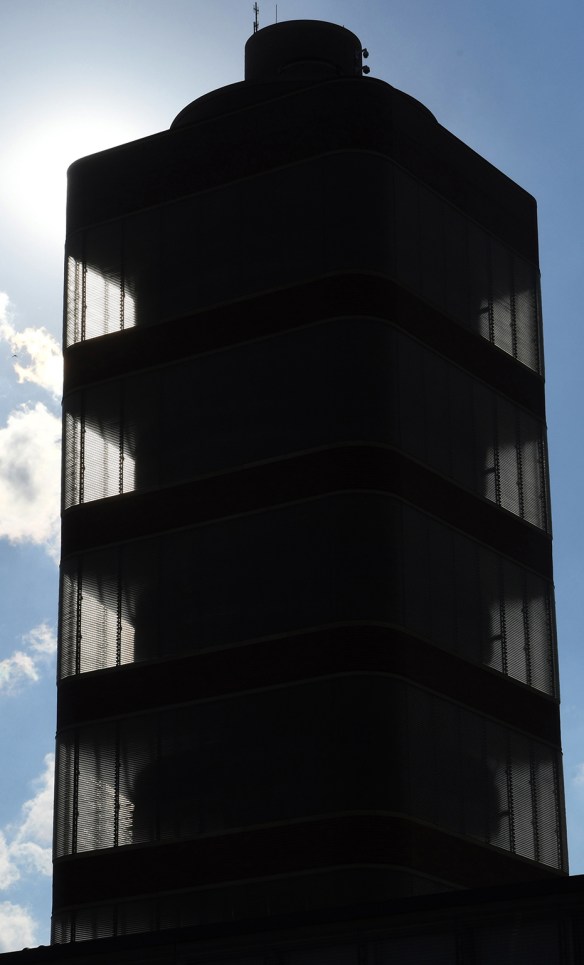
I was then on tour in familiar territory in Wisconsin, helping lead tours for Road Scholar, first in Racine at SC Johnson and at Wingspread. I have visited and photographed these wonderful spaces umpteen times, and always look for a fresh way to see them:

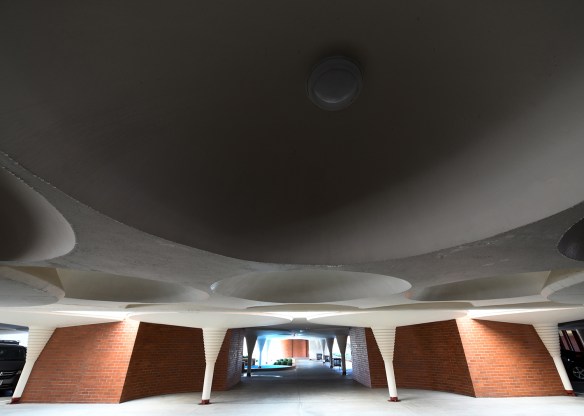
SCJ Carport 2018 003.jpg

SCJ Carport 2018 004.jpg

SCJ Research Tower 2018 .jpg

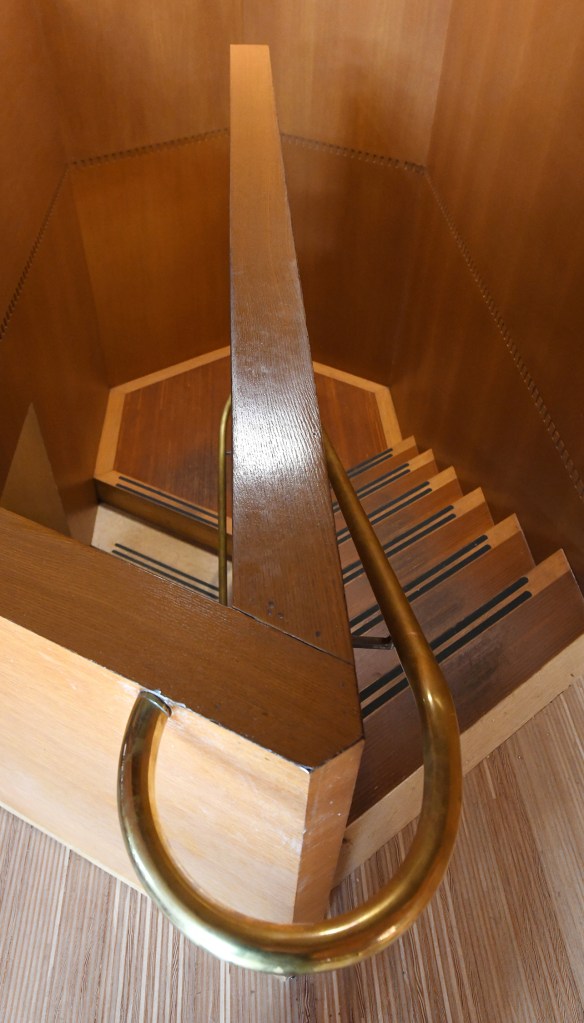
I climbed these stairs at Wingspread countless times before seeing this photo:

Wingspread Stairs 9.23.19.jpg

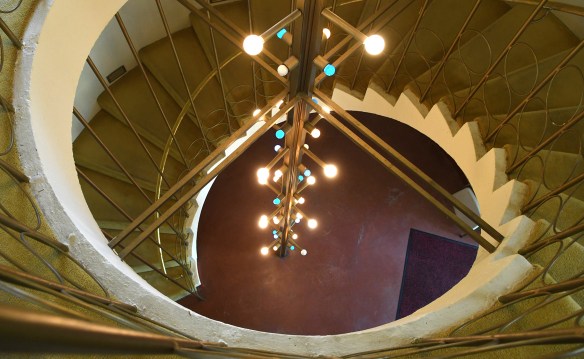
I was then taken, again, by the fixtures at the Annunication Greek Orthodox Church in Wauwatosa (suburban Milwaukee):

AGOC 2018 002.jpg

AGOC 2018 004.jpg

AGOC 2018 007.jpg

AGOC Interior 9.24.19 002.jpg

AGOC Interior 9.24.19 001.jpg

Annunciation GOC002 9.6.18.jpg

After touring Racine and Milwaukee, we take our Road Scholar guests to Madison and Spring Green. First, a detail of the ceiling of Jacobs 1:

Jacobs 1 9.7.18 009.jpg

Then, a light well in Anthony Puttnam’s interpretation of Monona Terrace:

Monona Terrace.jpg

The trip culminates at Taliesin – of course – after seeing the Unitarian Meeting House in Madison and Wyoming Valley School, with lunch at Riverview Terrace. Our introduction to Taliesin is a pause at the dam:

Taliesen Dam 2.jpg

Taliesin.jpg

Taliesin 9.7.19 002.jpg

I finish with Jeanne’s recollection of babysitting at the Hardy House and a “selfie” there:

(From “Frank Lloyd Wright’s Thomas P. Hardy House,” written and photographed by Mark Hertzberg, Pomegranate: 2006):

Jeanne (Weins) Maushammer, who baby-sat for the Sewards, recalls growing up nearby. “The house was well-known to everyone in the neighborhood.  People would go to the 14th Street public beach there and see the house just a short distance away.  It did not look like a private residence.  Visitors from outside the area – even across town – would see two openings that could easily be mistaken for bath house entrances, and try to go in to change their clothes.

“Sometimes when you were driving around with out-of-town folks, they would ask ‘What is that?’  They did not recognize it as a house, because it was so different from the other homes around it, and because it was next to the beach.  Neighbors knew what it really was.  The Johnson Wax complex was down the street from us, so the Hardy House seemed to be appropriate.  My folks often told me of their witnessing the construction of the Administration Building and of seeing Frank Lloyd Wright.  The Johnson buildings were understood and accepted by visitors, but not the ‘beach house.’

“My friends and I used to go down to the beach all the time.  We could not get close enough to the property to get a good look at it.  We always had to look through the trees.  We could not see how it blended into the hill side.  That added to the mystery of it.  From the street, all that people could see was just that box.

“I knew it was a Frank Lloyd Wright house before I first went inside.  What I did not realize was how he proportioned houses to his small frame.  I remember thinking when inside for the first time:  ‘I am 5’4” but wow, these doorways are low.’  It was dark and raining that particular day, so I did not get to appreciate the house’s real beauty.  After I had been there several times and had a chance to explore it, to stand in that living room and on the balcony, and to take in the view, I realized it was incredible.

“My husband has never seen the inside of the house, except in photos, but in our wildest dreams we would like to buy it and come back to Racine.”

Hardy Selfie 9.23.18.jpg


What is in your basement?

Photos (c) Mark Hertzberg 2020

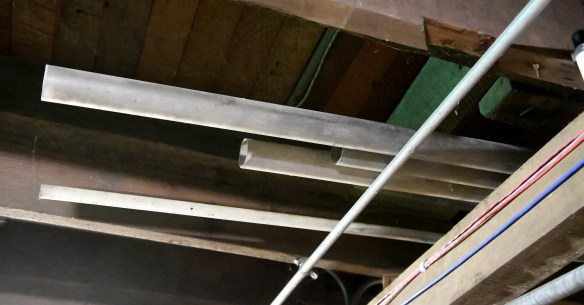
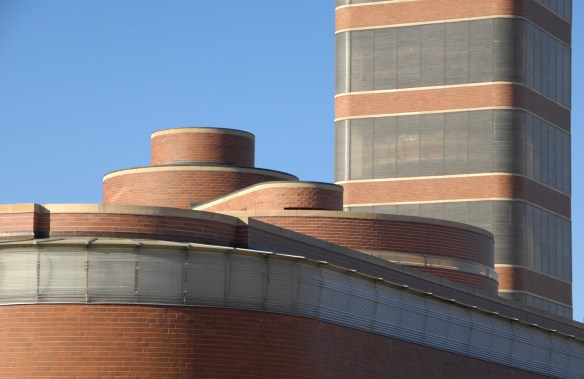
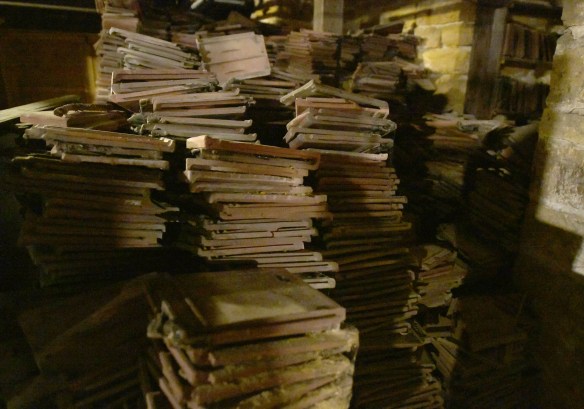
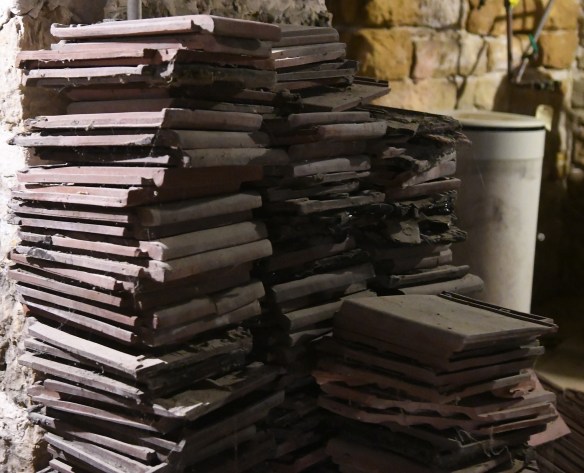
In the case of Frank Lloyd Wright’s Hillside Theatre at Taliesin, there are some Pyrex-glass window tubes and thousands of roof tiles. The window tubes are thought to be related to the SC Johnson Research Tower, designed in 1943/44 and constructed 1947-1950, according to Kyle Dockery, Collections Coordinator for the Frank Lloyd Wright Foundation. The Tower has 17.5 miles of the tube windows (the Administration Building, designed in 1936 has 43 miles of the window tubes).

Hillside Basement Artifacts 002.jpg

Adm Bldg Tower 2010 014.jpg

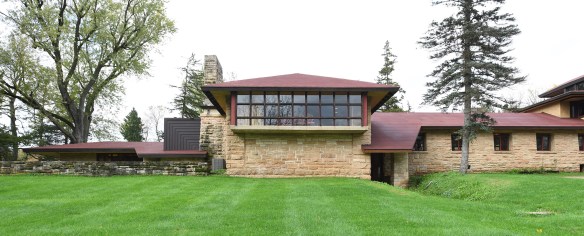
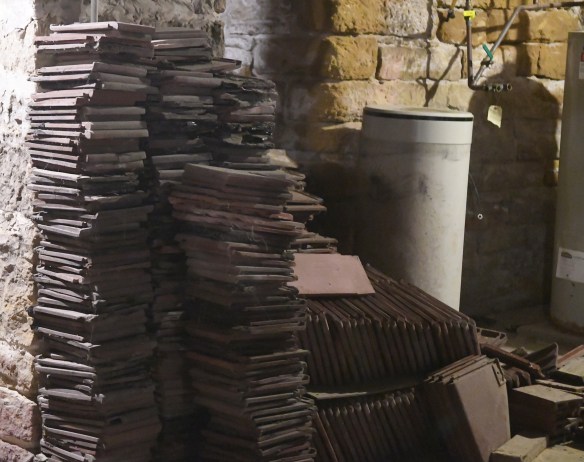
Dockery says there are between 30,000-50,000 clay roof tiles which were made by Ludowici Roof Tiles for the Theatre.

Hillside Theater 2018 016.jpg“They were removed and replaced with the rolled rubber roofing in 1968 after a stack of extra tiles which had been set aside to repair the roof fell over and damaged a truck. The structure of the roof meant that the tiles needed constant maintenance and replacement so plenty of extras were kept on hand.” 
Hillside Basement Artifacts 004.jpg

Hillside Basement Artifacts 003.jpg

Hillside Basement Artifacts 005.jpg

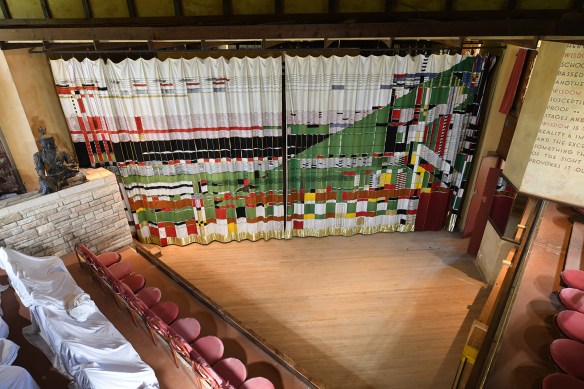
I unexpectedly got to see these generally unseen artifacts in the basement when I was working with Dockery to photograph the newly-restored curtain in the Hillside Theatre in June. A shortcut to the dining room to photograph the curtain from the dining room balcony took us through the basement.

Hillside Theatre Curtain 104.jpg

Hillside’s Restored Theatre Curtain

All photos (c) Mark Hertzberg 2020

Hillside Curtain 6.16.20 010.jpg

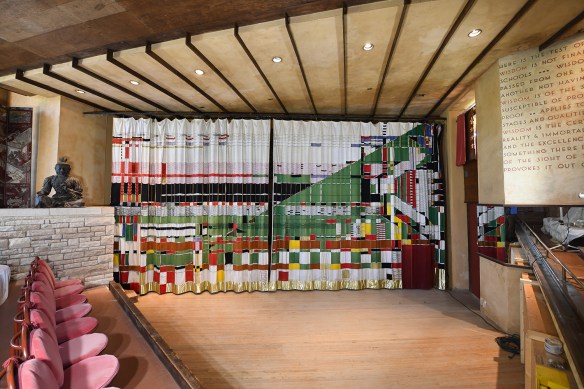
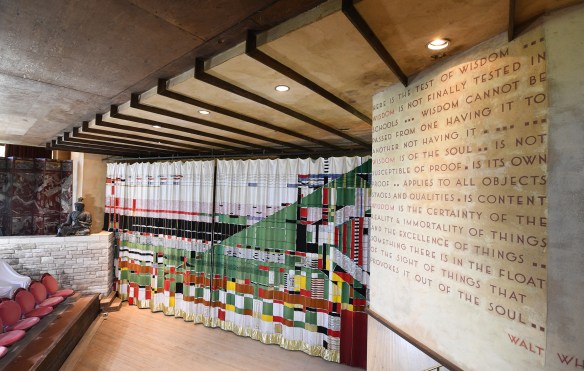
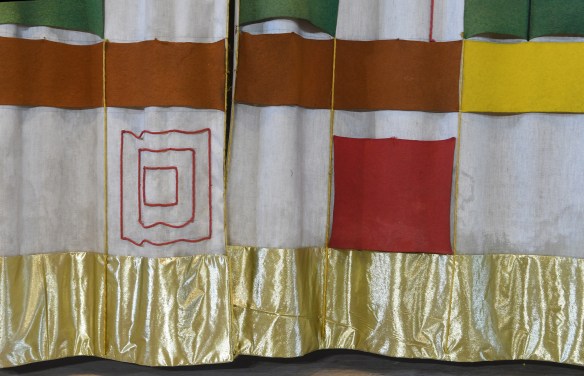
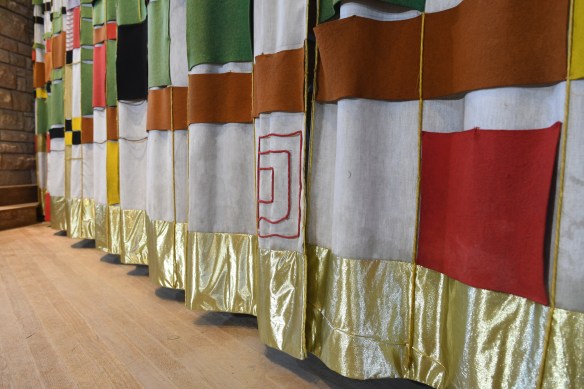
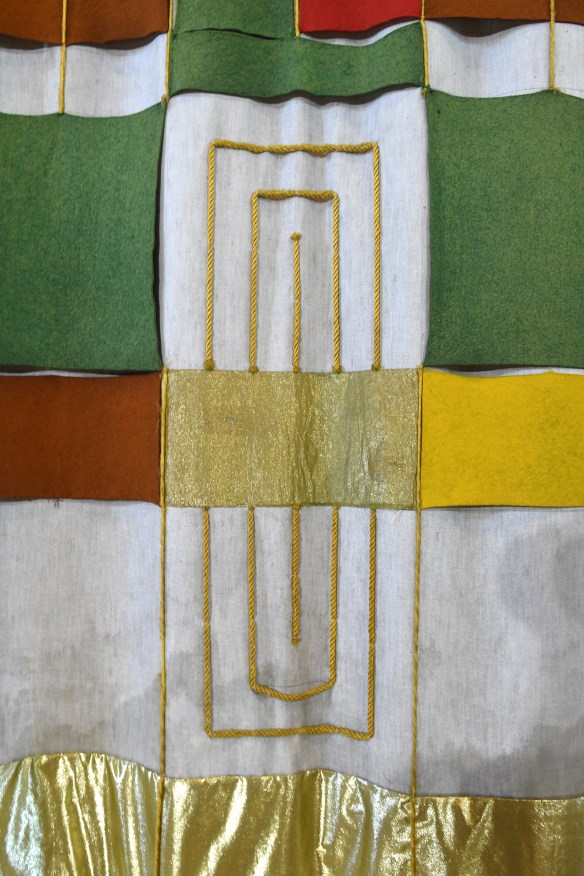
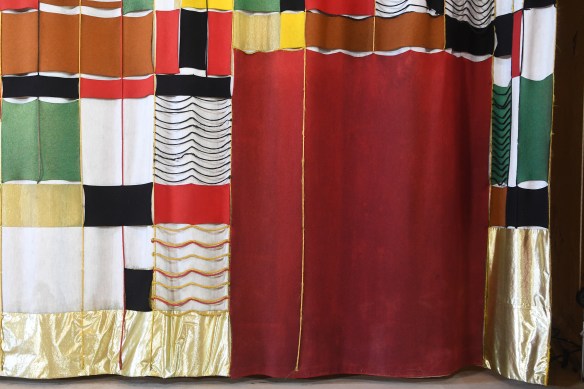
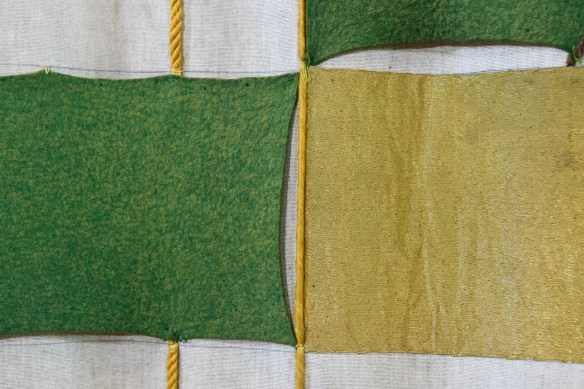
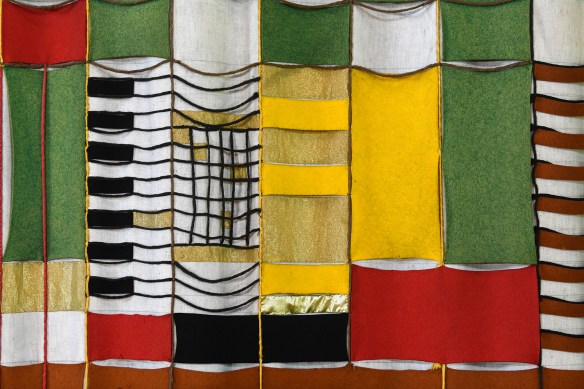
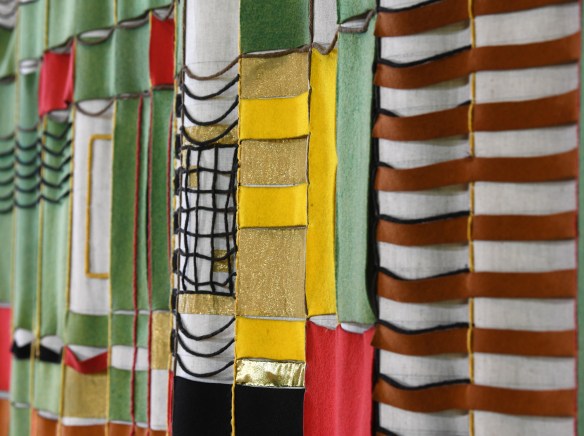
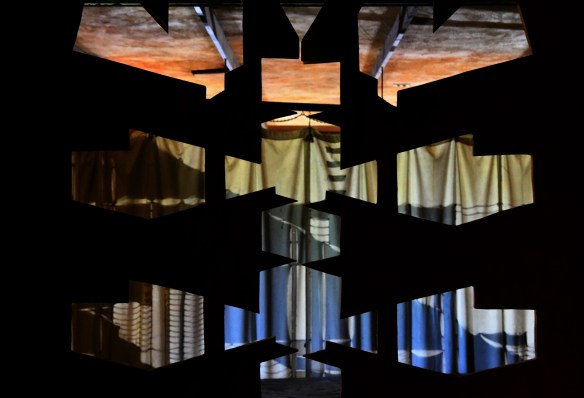
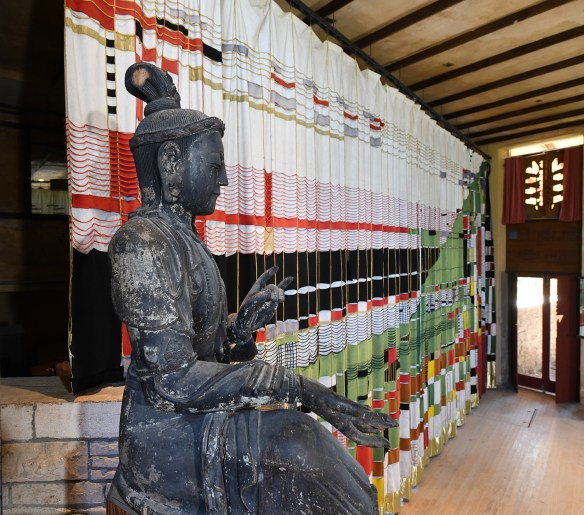
One of the most fascinating things to see at Frank Lloyd Wright’s Taliesin is the stunning curtain in Hillside Theatre. It is dazzling to see, but it really comes alive when docents like the incomparable Cate Boldt describe its intricacies and symbolism to tour guests. I had the privilege of photographing the newly-restored curtain a week ago, at the request of Stuart Graff, president and CEO of the Frank Lloyd Wright Foundation. I worked with Kyle Dockery, Collections Coordinator for the Foundation, and Ryan Hewson, Director of Preservation. Dockery gets credit for lighting the curtain perfectly for me!

Hillside Curtain 6.16.20 024.jpg

I photographed the curtain over two hours, seemingly inside and out…even from the rear, a view few people see. I boiled the take down to 119 images, some of which are below. The description of the work is culled from information from Dockery.

Hillside Curtain 6.16.20 032.jpg

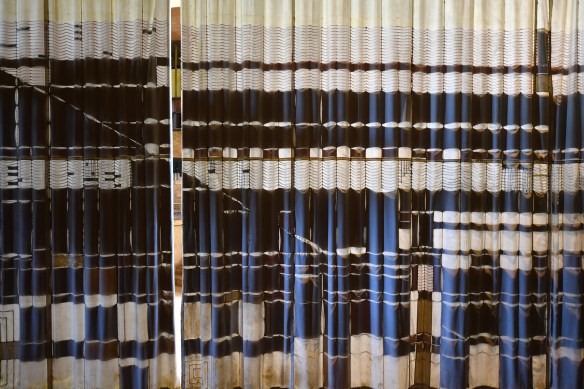
The curtain was designed by Wright in 1952 following the fire which destroyed the first Hillside Theatre and its own Wright-designed curtain. It was restored in early June by a team of three conservators led by Harold Mailand. The work included stabilizing the existing gold lamé and installing new lamé on top of it, restoring the original shimmering appearance while preserving the original material in place.

Hillside Curtain 6.16.20 046.jpg

Hillside Curtain 6.16.20 052.jpg

Hillside Curtain 6.16.20 068.jpg

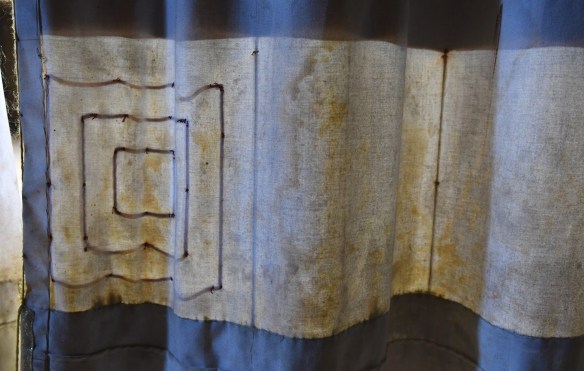
The conservators also addressed such issues as detached felt sections, damaged yarn swags, and water stains. The entire curtain was also vacuumed, in front and back to remove built up dust and dirt, restoring its original coloration, which results in it looking much brighter. 

Hillside Curtain 6.16.20 062.jpg

Hillside Curtain 6.16.20 076.jpg

Hillside Curtain 6.16.20 078.jpg

Hillside Curtain 6.16.20 096.jpg

Hillside Curtain 6.16.20 093.jpg

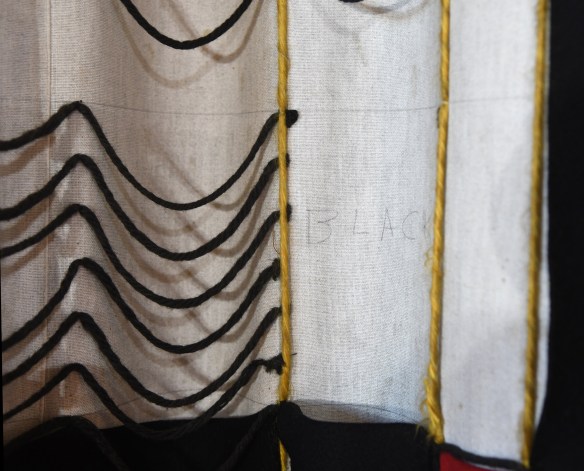
Original pencil marks by the apprentices who made the curtain are still visible:

Hillside Theatre Curtain 074.jpg

The view from backstage: Some water stains are visible

Hillside Curtain 6.16.20 104.jpg

Hillside Curtain 6.16.20 106.jpg

Hillside Curtain 6.16.20 116.jpg

Hillside Curtain 6.16.20 114.jpg

Hillside Curtain 6.16.20 037.jpg

Although Wright designed the curtain, he did not know that apprentices were secretly making it. It was unveiled for his birthday in 1956. He made some alterations, most famously being seen atop a ladder dabbing the top of the white canvas with Nescafé instant coffee.  Mailand has worked with the curtain since 1988. Forthcoming restoration work in the theatre, through a Save America’s Treasures matching grant, will help reduce wear on the curtain, particularly on the left side where it has rubbed against the limestone wall on the side of the stage.

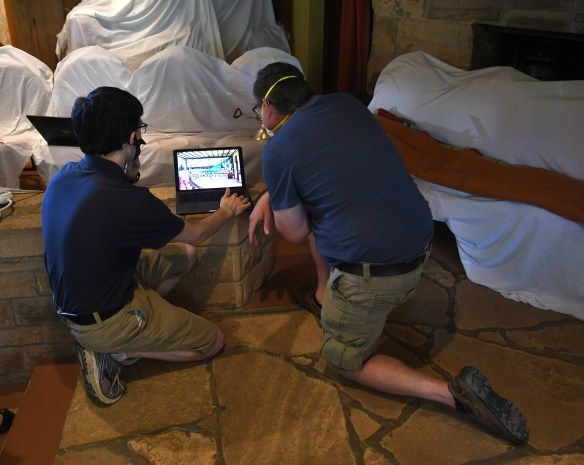
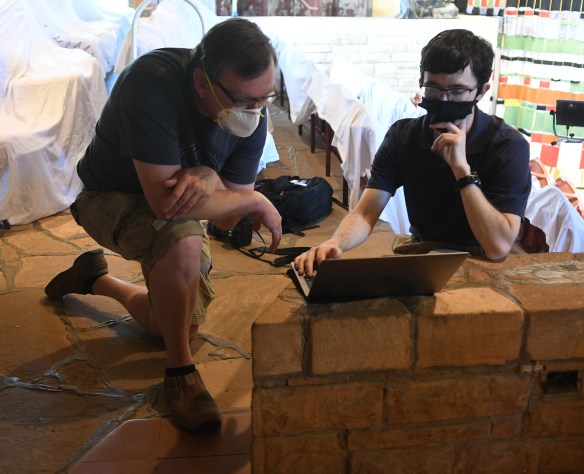
I was able to review photos as I shot them with Dockery, left, and Hewson:

Hillside Curtain 6.16.20 117.jpg

Hillside Curtain 6.16.20 118.jpg

For more information and a video, visit the Foundation’s blog piece:

https://franklloydwright.org/hillside-theatre-curtain-restoration/

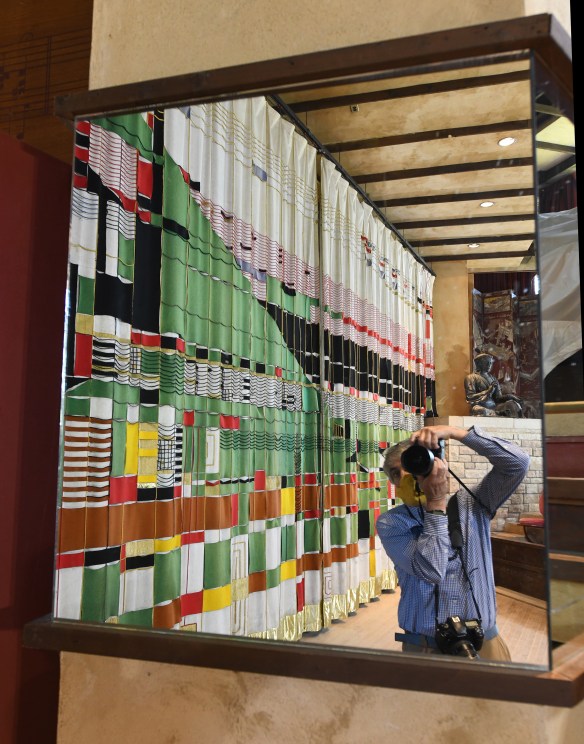
Finally, what’s a photo session at Taliesin without a “selfie,” this one in the mirror at the side of the stage?

Hillside Curtain 6.16.20 119.jpg

Technical information: Nikon D500 camera (crop sensor) with 17 – 55mm lens, and Nikon D850 (full frame) camera with 14 – 24mm and 70 – 200mm lenses.


Hillside Drafting Room, June 2020

(c) 2020 Mark Hertzberg

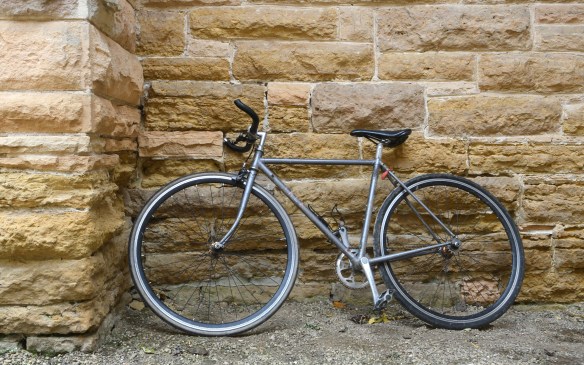
Hillside Home School 2018 Bike.jpgA student’s bicycle outside the Hillside Drafting Room, October, 2018
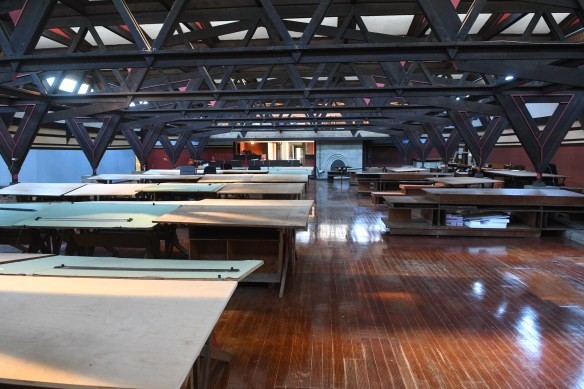
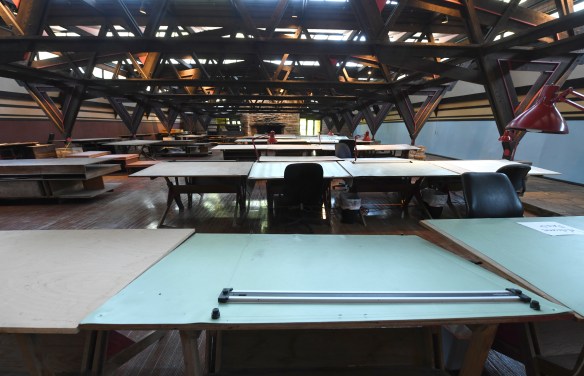
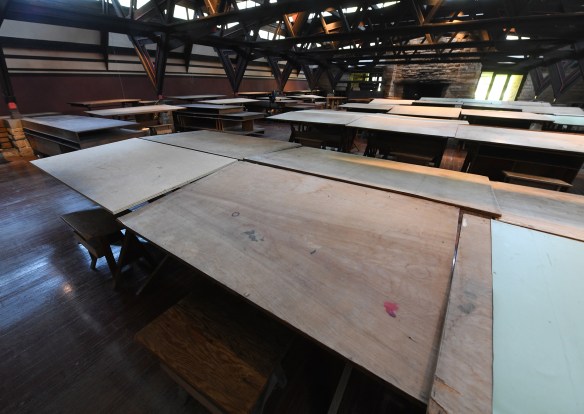
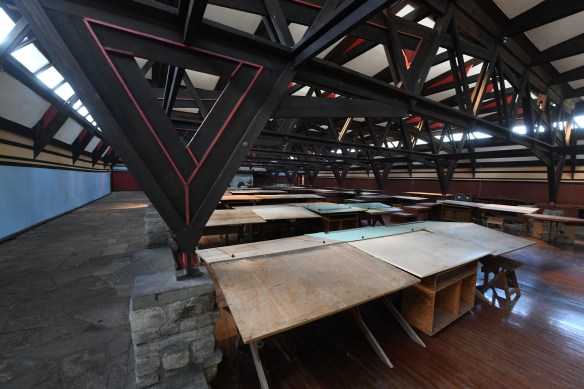
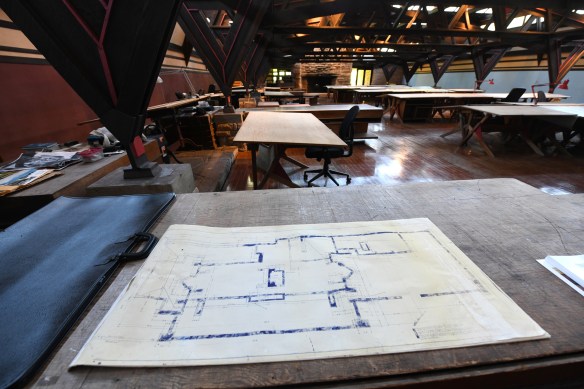
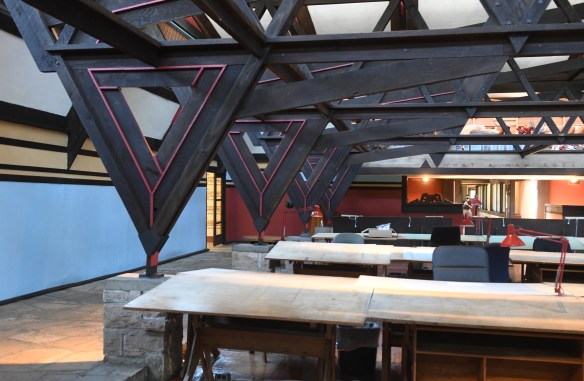
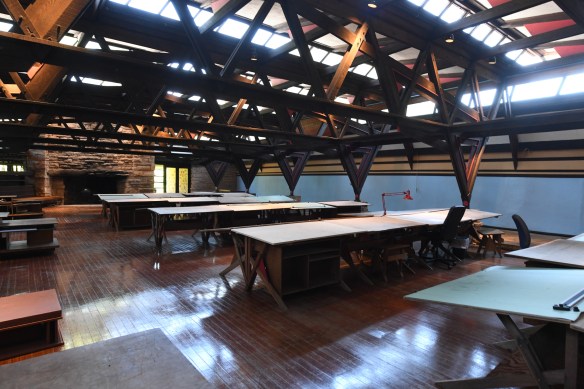
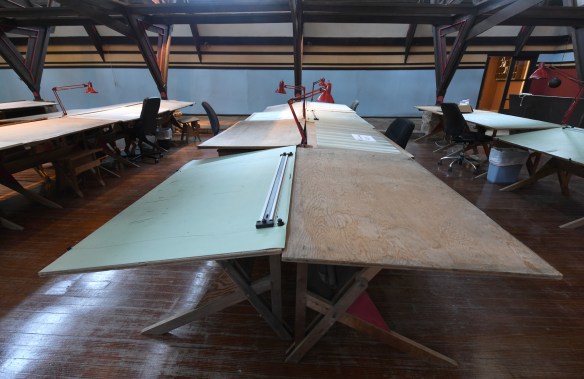
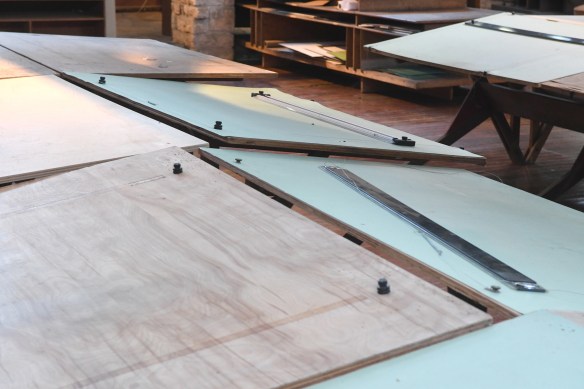
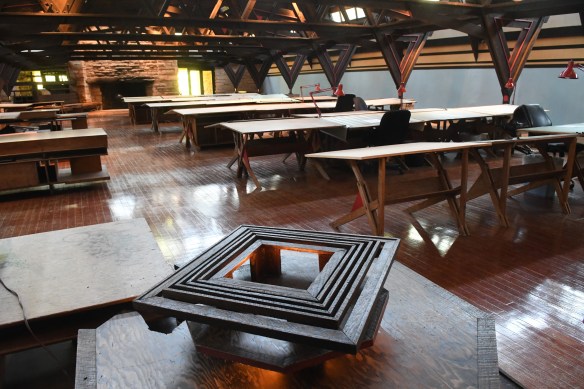
Thousands of words have been written on social media and in architecture journals about the end of the relationship between the Frank Lloyd Wright Foundation and the School of Architecture at Taliesin (SoAT), which was founded as the Frank Lloyd Wright School of Architecture. The School is moving to a new life on a new campus, and the Foundation is committed to new educational programming, bringing the historic drafting room back to life. In the meantime, it is empty, awaiting its next chapter. I photographed the drafting room June 16, 2020.

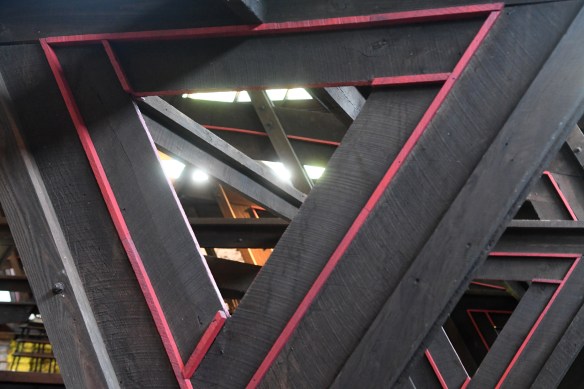
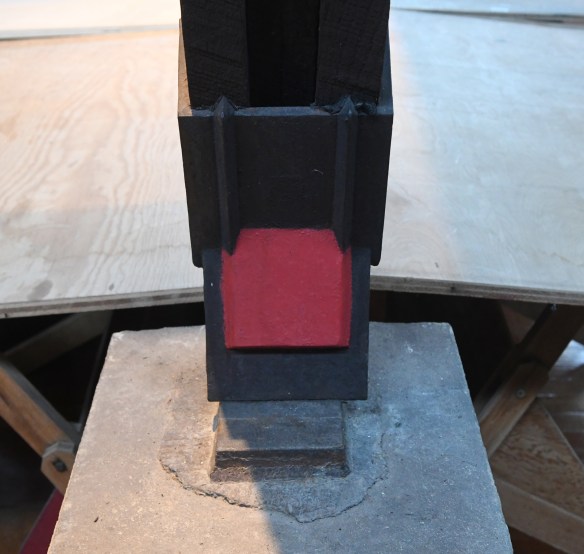
This post is visual only. I am not taking sides in the often acrimonious public debate about why the drafting room has no students this summer. I look at it, and miss the quiet intensity of the students I watched working in there. I look at it and think about the many wonderful buildings Wright and his apprentices and colleagues – and subsequent architects and students – designed here. I have photographed many of them. Now, there is silence. I invite you to study the photos, and reflect on the drafting room’s past and future.

Hillside Drafting Room 6.16.20

Hillside Drafting Room 6.16.20 004.jpg

Hillside Drafting Room 6.16.20 006.jpg

Hillside Drafting Room 6.16.20 008.jpg

Hillside Drafting Room 6.16.20 010.jpg

Hillside Drafting Room 6.16.20 012.jpg

Hillside Drafting Room 6.16.20 013.jpg

Hillside Drafting Room 6.16.20 014.jpg

Hillside Drafting Room 6.16.20 015.jpg

Hillside Drafting Room 6.16.20 016.jpg

Hillside Drafting Room 6.16.20 018.jpg

There is one photograph I saw in the drafting room last fall, which today I regret not taking. Remember that I am a photojournalist. While I have been granted (much appreciated) special permission for photography at Taliesin, I was helping lead a Road Scholar tour and the guests were not allowed to photograph the then-busy drafting room. I saw Aaron Betsky, then Dean of SoAT in a meeting in a conference room. The door was open. I had no inkling that in six months there would a split, but it felt like an important photograph to take. Today it would be an important one for this photo essay, but the photo exists only as a memory of something I saw.