A New Look at That Odd New House in Hyde Park

© Mark Hertzberg (2024)

In print, on a phone, on a tablet, on a television screen…it doesn’t matter what the medium, as modern media constantly bombards us with countless images. We are immune to most of them. Just a small handful of still photographs stop us in our tracks. We were reminded of that recently after the attempted assassination of former president Donald Trump. Such are the moments in history that we remember because of a still photograph. Is that the case in the World of Wright?

There are umpteen photographs of Frank Lloyd Wright’s completed buildings. What sticks in my mind today, however, is an arresting photograph of Wright’s Frederick C. Robie House. It is not another same-old, same-old photo of the house. Rather, it is one of Wright’s ship-like, Prairie-style house at 58th and Woodlawn in Chicago’s Hyde Park neighborhood under construction in the summer of 1909.
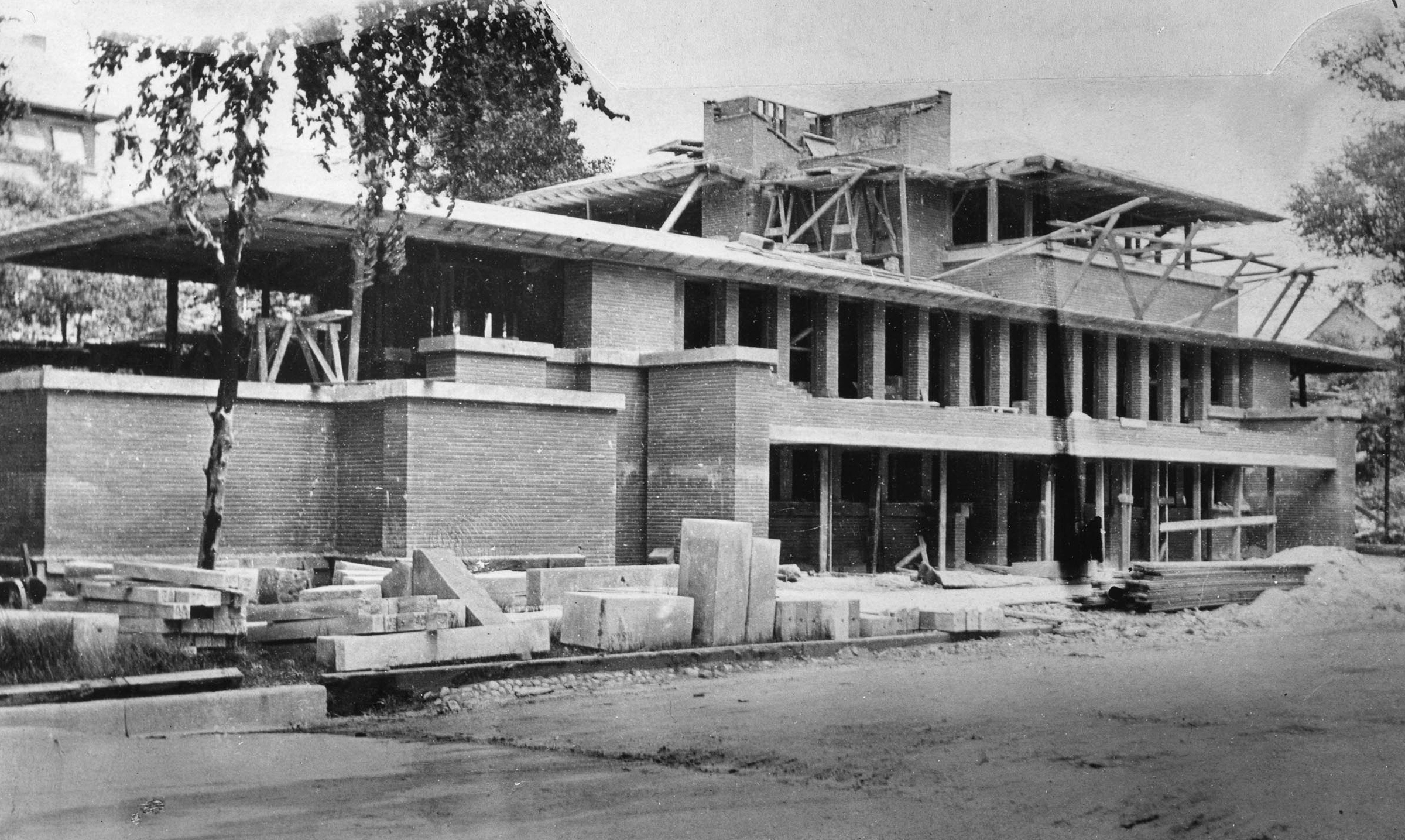
Robie Construction.jpgPhotograph courtesy of Eric M. O’Malley, from his private collection

This photograph stopped me in my tracks when I was reading the latest issue of “OA+D,” the Journal of Organic Architecture and Design. Each issue is devoted to a single topic, in this case the Robie House. Wright scholar Kathryn Smith gives readers a definitive account of the history and architectural significance of the house, “Space was no longer static, but dynamic. It was a revolutionary new idea, and one that would profoundly change 20th century architecture in the decades ahead.” Her article is richly illustrated with drawings from the Wasmuth portfolio, and historic and contemporary photographs. There are about 30 construction photos taken between April 1909 and April 1910, mostly by Harrison Bernard Barnard.

I found this one particularly striking. I was mesmerized. It reminded me of something Wright scholar Jonathan Lipman wrote to me when I was writing my book about Wright’s Thomas P. Hardy House, “One can get a sense of its impact in 1906 Racine by imagining if, instead, a swooping, curved titanium house by Frank Gehry were built on the site a century later.” What, indeed, did people in Hyde Park think when they saw this rising in their neighborhood?

With no television to distract them after dinner, did neighbors regularly stroll after supper, making it a point to pass by the odd house rising at 58th and Woodlawn? Were they struck, as I was by this photograph, or did they murmur in disapproval? Although Wright and Mamah Borthwick (Cheney) would not leave for Europe together until the fall of 1909, had word of their affair traveled from Oak Park to Hyde Park? Was this odd house then a confirmation of prejudices people might have had against a man who was upending social mores? Or were they progressive thinkers, perhaps people who taught at the nearby University of Chicago which opened in 1892, who were excited and intrigued by what they were seeing on that corner lot?

The house had been rising for several months when this photograph from Eric M. O’Malley’s private collection was taken in the summer of 1909. The superstructure of the house is almost complete. We have a sense of what the house will look like, but it is still a mystery in many respects. For example, we see only empty spaces where magnificent leaded glass windows will be installed. I think it is that sense of mystery, of the unknown, that excited me.

Robie was built 16 years after the World’s Columbian Exposition in nearby Jackson Park. Only Louis Sullivan’s Transportation Building had broken the fair’s landscape of one Classical Revival-style building after another. Wright’s Heller, Blossom and McArthur houses are nearby , but are not as startling as Robie would have been in 1909. Rockefeller Chapel nearby at the University of Chicago would not be built until 1928, and it would be a traditional Gothic design, reinforcing the startling design of Robie, perched on its corner lot. Startling and groundbreaking, indeed.

As I thought about this article for a month or more, the photograph of Robie brought to mind one more Wright construction photo. It is of the SC Johnson Research Tower in Racine. The Tower was designed in 1943/44, and built between November 1947 and November 1950. It is Wright’s only realized taproot tower.* This photograph reminded me of a child’s stacking toy when I ran across it in Johnson’s archives when I was writing my book at the Research Tower in 2009. What, then, did people living near 1525 Howe Street in Racine (two miles from my home) think when this began rising above their traditional houses?
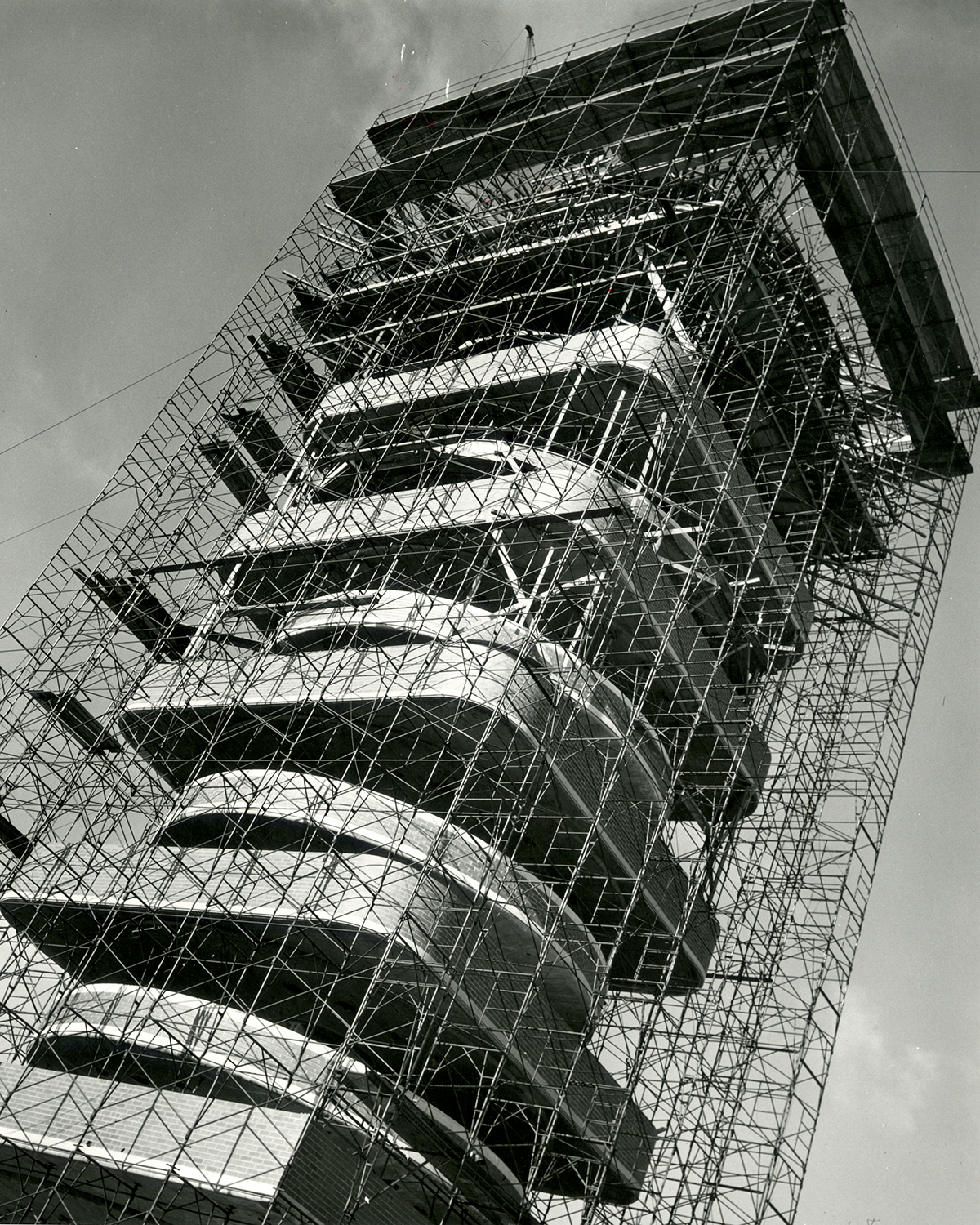
LR Constr. toy.jpgPhotograph courtesy of SC Johnson Archives

Dozens of books have been published with photographs of Wright’s finished work. The late Sam Johnson, whose father H.F. Johnson Jr. commissioned the SC Johnson Administration Building, the Research Tower, and Wingspread, among others (unrealized), remarked to me “The world does not need another book about Frank Lloyd Wright.”** Perhaps it needs one comprised soley of photographs of his buildings under construction.

P.S. I think Eric O’Malley was also dazzled by the photograph…it appears twice in the magazine, the first time as a chapter title page.

Footnotes:

*The late Bruce Brooks Pfeiffer, who wrote the Foreword to my book about the Research Tower, told me that although Price Tower looks like a taproot tower, it is not one because it is tied into the foundation of the adjoining two-story office building. He said Racine was Wright’s only realized taproot tower.

**The context for Johnson’s remark was that I was pitching my idea for a book which became my “Wright in Racine” book (Pomegranate: 2004). The rest of his observation was, “…but it does need one about his work in Racine.” I was elated and treated myself to a Dove ice cream bar after leaving our meeting.

Link to OA+D store and Robie issue of the Journal:
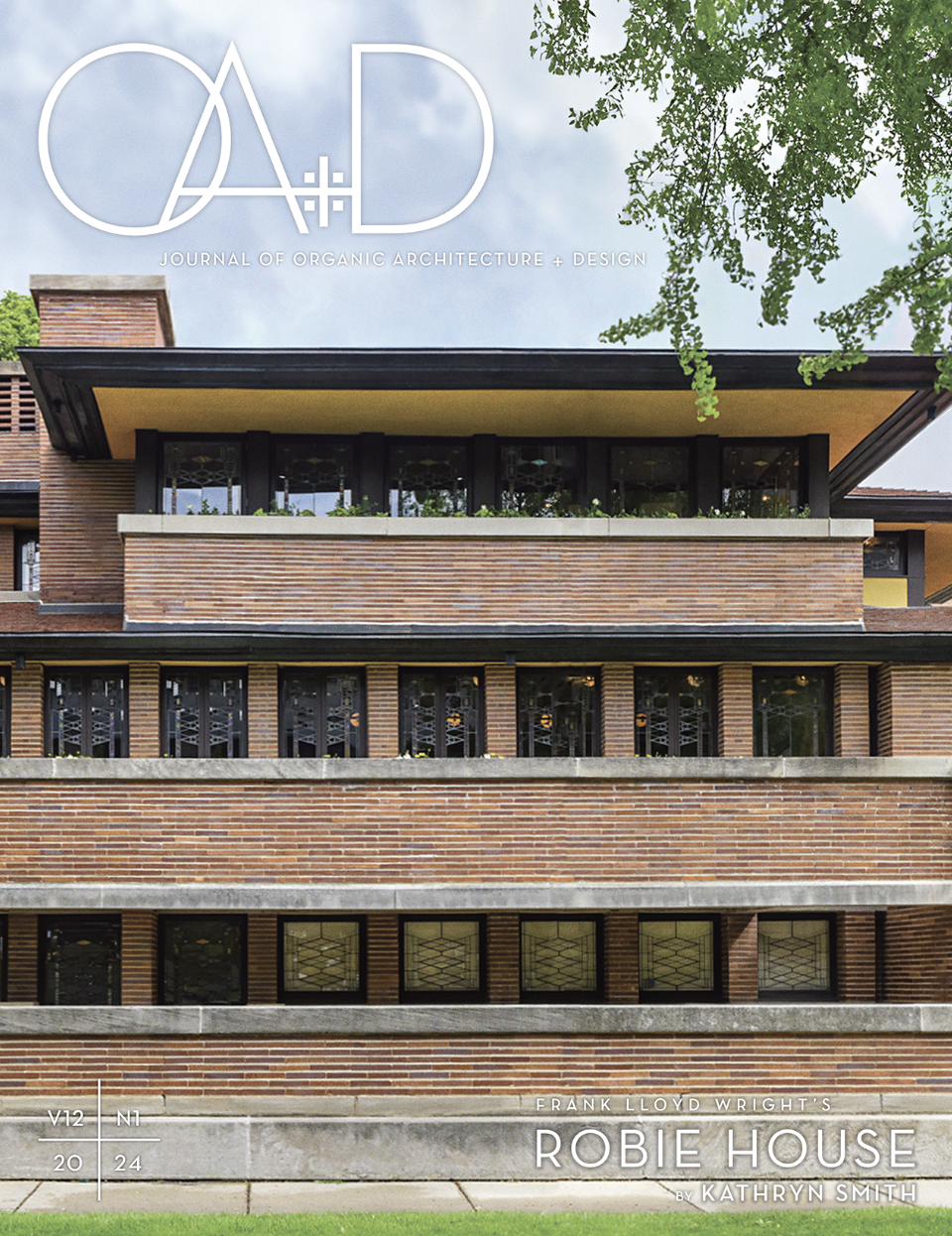
Screenshot 2024-07-25 at 6.00.09 AM.png

https://store.oadarchives.org/product/journal-oa-d-v12-n1

Please scroll down for previous articles on this blog

 

Wright Books: + 1

© Mark Hertzberg (2023)

How many books about Frank Lloyd Wright are enough, or too many?

IMG_1148.jpeg

When I ordered a copy of Jonathan Adams’s new book, Frank Lloyd Wright – The Architecture of Defiance (The University of Wales Press: Cardiff, 2023), I thought of something the late Sam Johnson, then Chairman Emeritus of SC Johnson, said to me when I showed him my “Wright in Racine” photo presentation and told him my idea for a book about Wright’s built and unbuilt work in Racine. Sam’s father, H.F. Johnson Jr. had commissioned Wright to design the SC Johnson buildings and Wingspread, among others, and Sam grew up in Wingspread. My heart sank when he said, “The world does not need another book about Frank Lloyd Wright.” Then he added, “But it does need a book about his work in Racine.”

I do not feel the need to read, much less own, every single book about Wright. So, does the World of Wright need yet another book about him? I would posit that it does need this one. Adams’s book is one of five Wright books I know of being published this year. It is the third in a series of books commissioned in 2016 by the Royal Society of Architects in Wales, exploring the architecture of Wales. It shines a bright light on Wright’s Welsh roots, and the family he grew from.

Much of the Wright history in the book is familiar to those of us in America who have had dozens of books about Wright at our disposal. We are not the primary audience for this book. Forget about the familiar people you correspond with in America about Wright and see at Wright conferences, because Defiance was commissioned and published in Wales, 5500 miles east of Taliesin. Taliesin is, of course, a Welsh word, an homage to Wright’s maternal ancestry in Wales. Wright also gave  Welsh names to the Bradley House (Glenlloyd) in Kankakee, Illinois, and to the Fred B. Jones estate (Penwern) on Delavan Lake, Wisconsin. The latter is particularly important to me; we will get to that shortly.

Many people can recite their Wright knowledge backwards, forward, and inside out, but how much do they know about what may have made Wright what he was? What do we know other than the old saws about his character flaws? We know that Wright’s mother, Anna (nee Hannah) came from Wales as a child with her parents, Mallie and Richard Lloyd Jones. Adams takes us in great detail through their arduous eight month journey from their Welsh homestead to Ixonia, Wisconsin. Their voyage and her pioneer life in Wisconsin molded her, and shaped who she would be as Wright’s mother.

IMG_1147.jpeg

Last year Mary Rogers sent me a copy of her great-grandmother Elizabeth Wright Heller’s book The Architect’s Sister – The Story of My Life (Brushy Creek Publishing Co.: Iowa City, 2019). Heller’s father was William Carey Wright, making her Frank Lloyd Wright’s half-sister. Heller writes about how her step-mother Anna Wright physically and emotionally abused her. She lived it, but Adams has a different take. Georgia Lloyd Jones Snoke, Wright’s first cousin, twice removed, offers this perspective, “The way Jonathan explored that portion of Anna’s life made Anna more, not less, human. To have achieved a prestigious teaching degree (at immense emotional and intellectual expense) and to have given it up for a mismatched marriage would have caused a brilliant and ambitious woman more than a little angst. Just how she took it out on her step children is—at best— questionable.” Heller’s recollections were written decades after they happened and long after Anna died. Is the truth with the person who lived it, recalling it years later, or not?

Snoke and I began corresponding with Adams two years ago because he was including Penwern in his book. I had relied on speculation from Wright scholar Jack Holzhueter in my book about Penwern that Wright had persuaded his American client Jones to name his estate after Pen-y-Wern, the Wright ancestral home in Wales (Frank Lloyd Wright’s Penwern: A Summer Estate – Wisconsin Historical Society Press: Madison, 2019). Snoke had kindly given me photos for the book that her husband, Kenneth Snoke, had taken of what they thought was Pen-y-Wern during one of the trips to Wales.

Adams contributes several important facts to our understanding of the Wisconsin Penwern. First, he documents a trip that Anna Wright and her daughter Maginel made to the ancestral home in 1900, concurrent with the design of Penwern. While there is no piece of paper that ties together the names Pen-y-Wern and Penwern, their visit adds significant weight to Holzhueter’s speculation about the origin of Penwern’s name. Second, he found documentation that there had been marshes near Delavan Lake. While I had written that “Penwern” can mean “at the head of the alder tree” and there were alder trees near the lake, Adams writes that, more accurately, the word means “above the marsh.”

And, finally, he documented that the Pen-y-Wern that the Snokes visited 20 years ago is not the one that Richard Lloyd and Mallie Jones emigrated from. He sent us a photo of the actual cottage, long since demolished. The photograph, taken from Chester Lloyd Jones’s 1938 book, Youngest Son, shows marshland below the cottage.

Pen-y-Wern from Youngest Son.jpg

Mallie Jones.jpgMallie Jones, Courtesy of Georgia Lloyd Jones Snoke
The book jumps around chronologically, which perplexes me, but I did not let that become an obstacle to my reading. While the book is thoroughly and impressively researched and footnoted, I wish to set the record straight on two small points regarding Penwern. Adams names the steward of the estate as Frederick Jones. His name was Fred B. Jones, not Frederick. And, Adams speculates that Ward W. Willits (of Wright’s Willits House in Highland Park, Illinois) was an early visitor to Penwern. Willits and Jones worked together and I have placed Willits on Delavan Lake in 1895 and speculated that he suggested that Jones build his summer “cottage” there five years later, but his name was never mentioned in the extensive newspaper records of visitors to Penwern.

There are two ways to think of the title of Heller’s book. It is literally true. But it can be thought of as misleading, because there is scant reference to Wright himself. She was, literally, his half-sister, but while she writes about her apparently single visit to Taliesin, and about her father, and Wright’s and the family’s itinerant life while he was alive, the book is more her interesting life story than about Frank Lloyd Wright.

I am an avid bicyclist. Bicyclists often joke that if “X” is the number of bicycles one owns, “X + 1” is the ideal number of bicycles to own. Jonathan Adams’s book is worth a “+1” in the canon of Wright literature.

Scroll up for an updated reconsidered post about Heller’s book

Scroll down for previous articles on my website 

Wingspread’s Swimming Pool

Photos (c) Mark Hertzberg 2017Wingspread aerials 2009 009.jpg

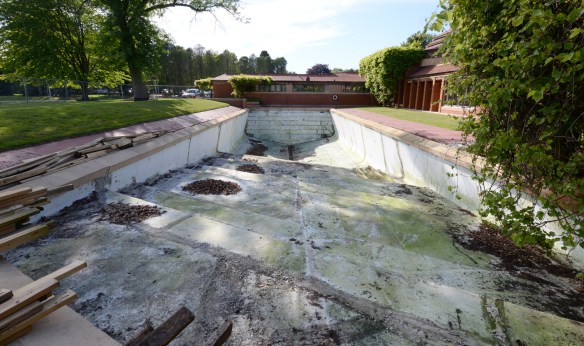
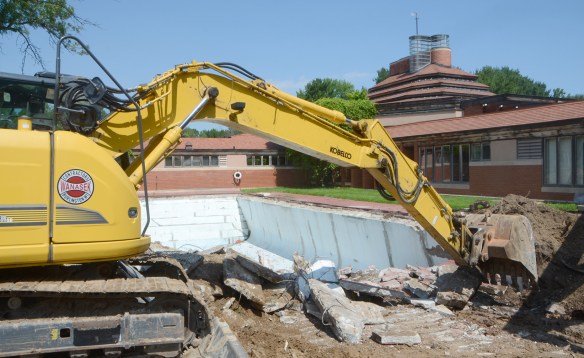
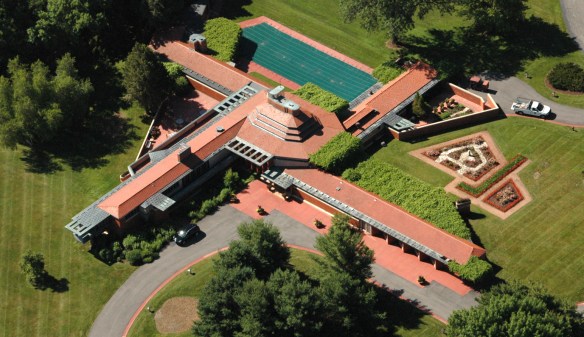
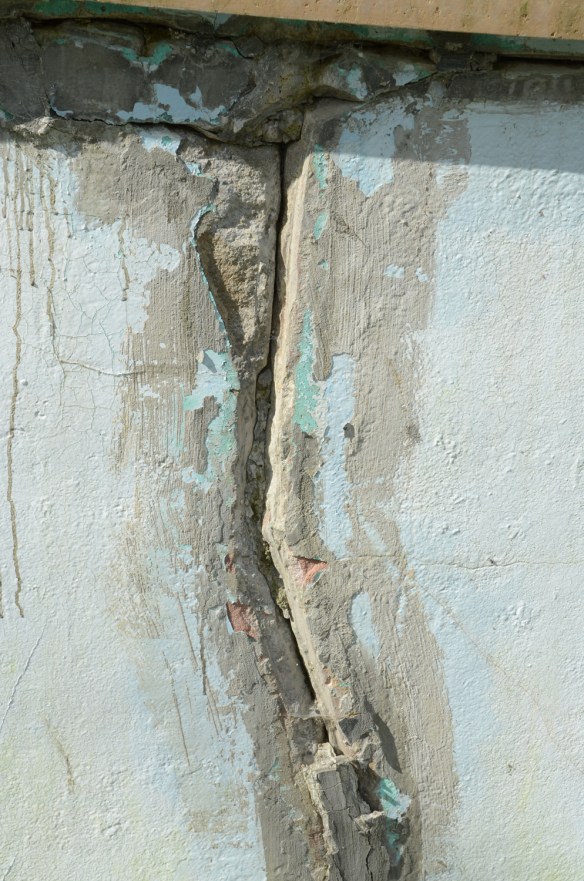
The swimming pool at Wingspread (shown covered by a tarp in 2009) is an integral part of the grounds. It was filled with water, but was ornamental for many years, rather than being used, when it was drained after leaks were discovered more than 10 years ago.

Wingspread Pool 018.jpg

The fireplace on the pool deck:

Wingspread Pool 020.jpg

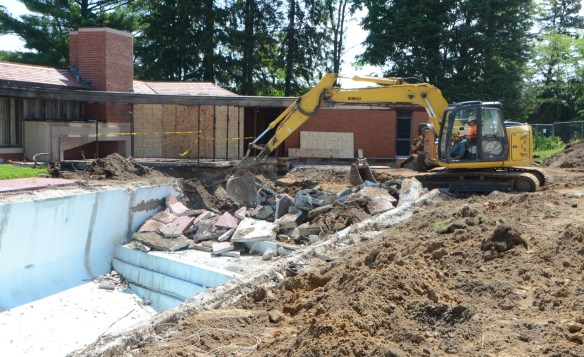
The pool is now being renovated, to be filled and again be a water feature of the house.

Wingspread Pool 009.jpg

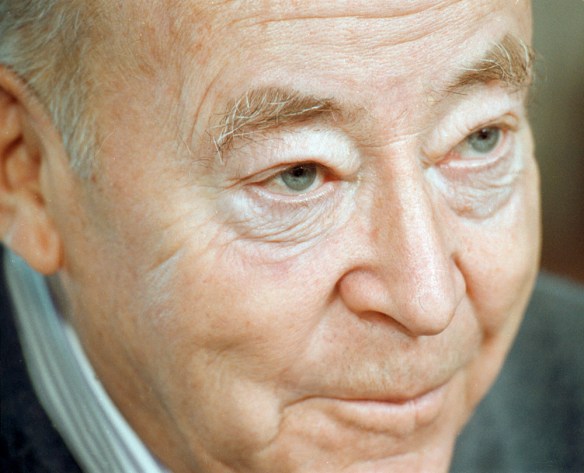
The are two wonderful anecdotes about the pool. The first was told by the late Sam Johnson, whose father, H.F. Johnson Jr., commissioned the home by Frank Lloyd Wright in 1937. Sam Johnson in 2000:

Sam Johnson mh.jpg

The Johnsons would be moving more than five miles from their home on Racine’s south side, near the SC Johnson offices and factory, to their new home in Wind Point, beyond the city limits. Sam feared not seeing his friends anymore. He had no reason to worry: once his friends learned Sam’s new home had a swimming pool, they were anxious to bike out to visit him.

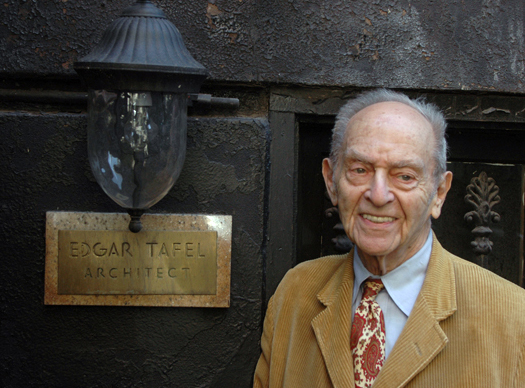
The second anecdote was told by Edgar Tafel, the young apprentice who was in his mid-20s when Wright trusted him to supervise construction of the SC Johnson Administration Building and then of Wingspread. Tafel, one of the original Taliesin Fellowship apprentices (1932-1941) recalled agreeing to a change in the location of some plumbing for the pool in consultation with contractor Ben Wilteschek while Wright was in the Soviet Union.

Tafel at this Greenwich Village townhouse in 2007:

Edgar Tafel 062.jpg

Wright was livid about the change when he visited the construction site after returning to the United States. Tafel kept backing up to get away from the angry architect, and fell into the excavation for the pool. He said Wright glared down at him and said, “That serves you right.”

Wingspread Pool 023.jpg

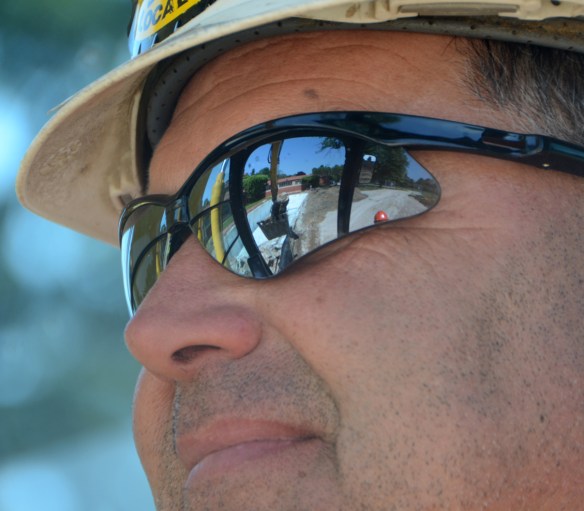
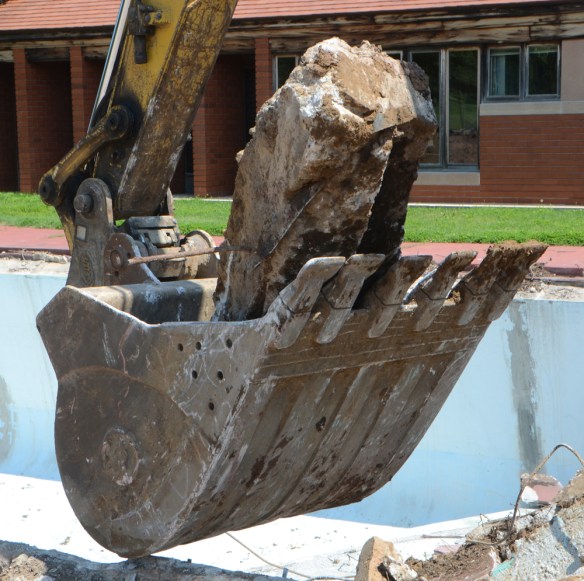
Scott Poritz, Utility and Grading Superintendent of Wanasek Contractors, moves concrete slabs from the pool Friday July 7, 2017:

Wingspread Pool 036.jpg

Wingspread Pool 031.jpgWingspread Pool 034.jpgWingspread Pool 043.jpg

The work is expected to be completed late this year by Riley Construction, the general contractor.