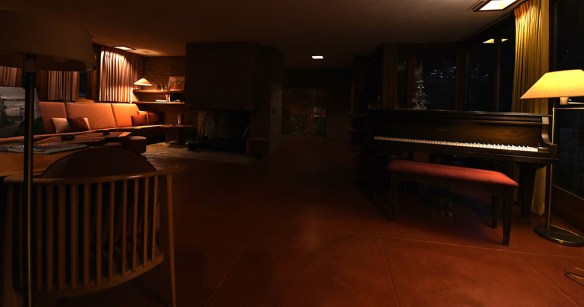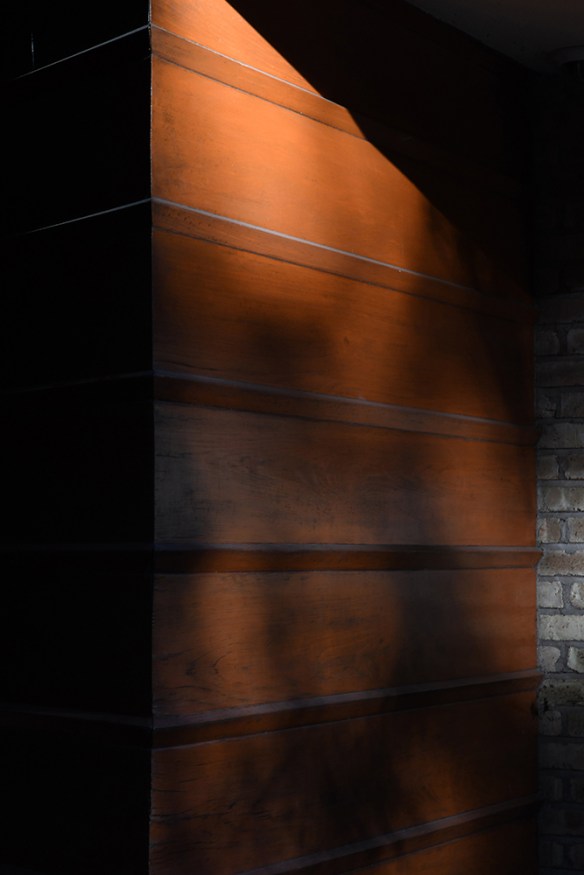
OA + D’s Encore 

© Mark Hertzberg (2022). Chandler photographs courtesy of, and © Michael Rust

There are seemingly not enough hours in the day for some people, including Randolph C. Henning, Eric M. O’Malley, and William B. Scott, Jr. 

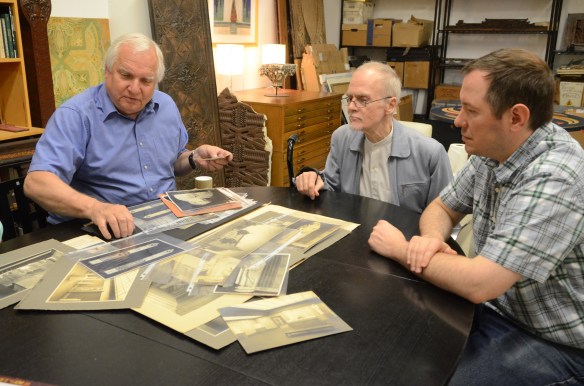
O'Malley Henning Scott 6.28.19.jpgO’Malley, left, Henning, and Scott  June 28, 2019, at Taliesin for a meeting of the Taliesin Fellows.

They have “day jobs,” but because they are also three individuals who are passionate about, and collected material associated with, Frank Lloyd Wright, his students, and other organic practitioners, they founded Organic Architecture + Design (OA+D) in 2013. Their mission is to honor the past, celebrate the present and encourage the future of organic architecture and design through education, conservation of original design materials, publications and exhibitions.

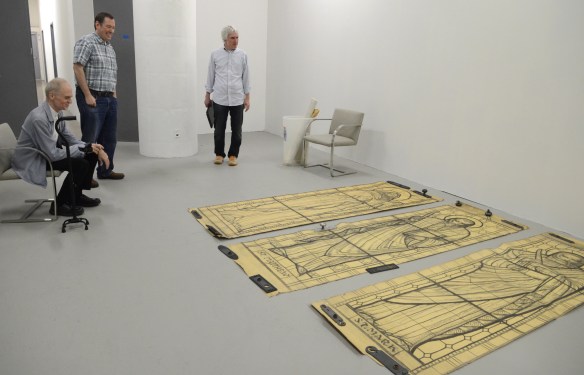
RHM Iannelli Planning Meeting 005.jpgO’Malley, Tim Samuelson, left, then the City of Chicago Cultural Historian, and David Jameson meet in Samuelson’s archives near OA+D’s, in June 2018 to plan an exhibit about Alfonse Iannelli at the Racine, Wisconsin, Heritage Museum.

RHM Iannelli Planning Meeting 014.jpgChristopher Paulson, right, Executive Director of the Racine Heritage Museum looks at cartoons of windows Iannelli designed for Francis Barry Byrne’s St. Patrick’s Catholic Church in Racine, which Samuelson was lending to the museum.

They felt that big institutions are selective about what is saved, often rejecting worthy collections. They perceived a rapid loss of material with historical value associated with the organic movement—especially regarding lesser known architects and designers. Drawing from their own personal collections, as well as others that they were aware of, they also felt that a journal promoting an awareness of Organic Architecture (past, present and future) could be of interest and sustained.

OA+D’s list of accomplishments since 2013 is impressive:

-They are in their ninth year of publishing the Journal of Organic Architecture + Design, a quality glossy journal produced three times a year, each issue guest edited by a scholar and devoted to a single topic supporting their mission.

Screen Shot 2022-01-12 at 4.58.15 PM.png

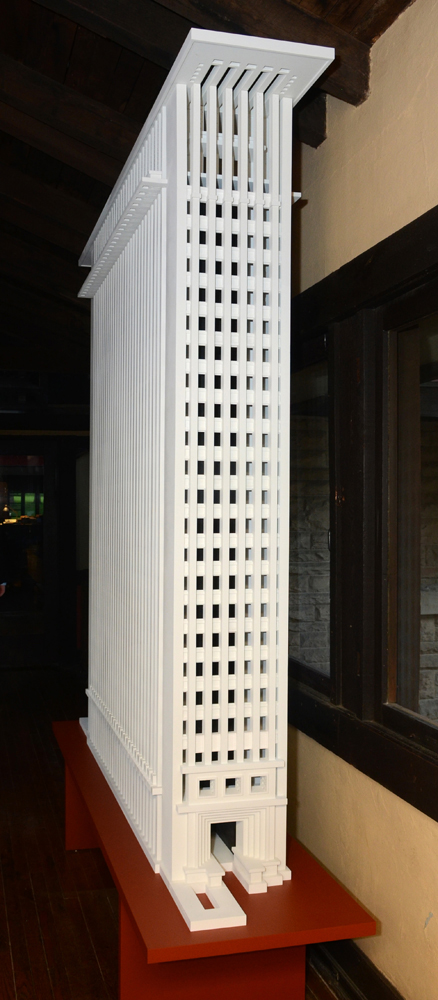
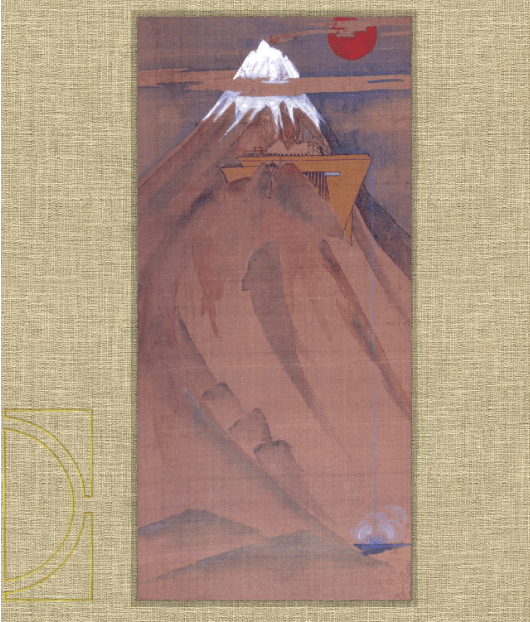
-In 2016 they built and placed on long term loan to the Frank Lloyd Wright Foundation a replica of Wright’s model of the unrealized San Francisco Call newspaper building (1913) to replace the original model which left its longtime home in Hillside at Taliesin when Wright’s models were acquired by the Museum of Modern Art. 

Call Building Model 001.jpg

-They have published several books, including a monograph about the box projects of William Wesley Peters:

Screen Shot 2022-01-12 at 5.02.58 PM.png

-They maintain archive space in Chicago, in Los Angeles, and in Lexington, Kentucky, and now also in Chandler, Arizona. A link to their noteworthy holdings is at:

https://www.oadarchives.com/collection-s-list

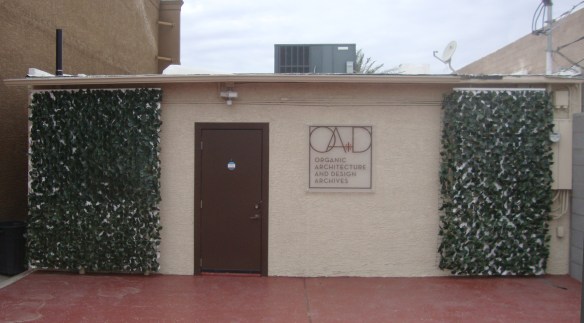
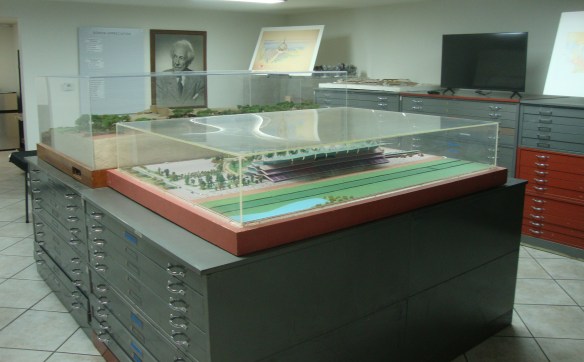
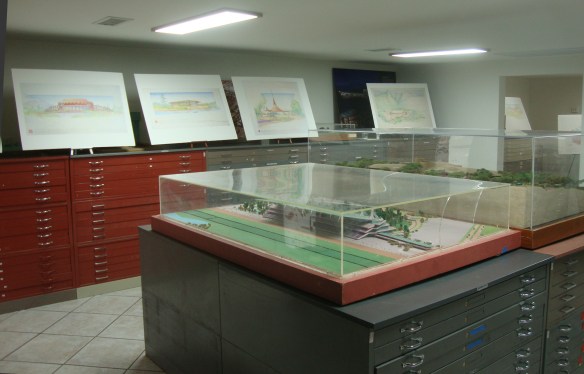
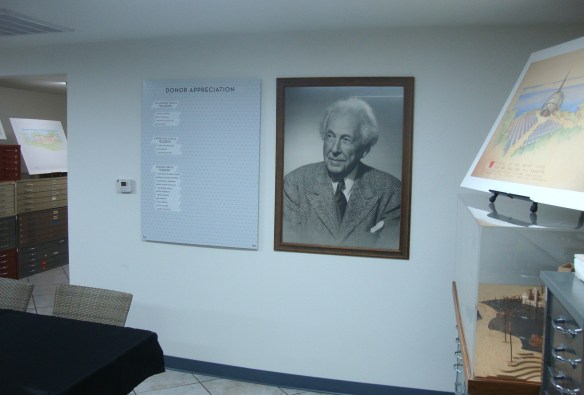
So, what could Organic Architecture + Design (OA + D) do for an encore? How about recently adding a fourth archive site (Chandler) after being selected by the Frank Lloyd Wright Foundation in July to be the stewards of what remains of the vast archive of Taliesin Architects (TA), first known as Taliesin Associated Architects (TAA), formed after Wright’s death in 1959? After the Museum of Modern Art and Arizona State University took their share, the majority of the collection, which includes more than 50,000 drawings, is housed in OA+D’s new archive in Chandler, Arizona.

DSC03037.JPG

The grand opening was in December. (While one of OA+D’s missions is to make their holdings available to scholars and aficionados of Wright’s and related work, the TA archive is so extensive that it will take time to ingest it, and there is no definite date for public access.)

DSC03030.JPG

Scott says, “Probably the most exciting things they (the Foundation) gave us are these models.” Those models include a seven foot model of the 1963 proposal for the Belmont (N.Y.) Race Course, a proposal published in Architectural Forum, and a model built by the late David Dodge of a country club in Hawaii ( based on Wright’s design for a home for Arthur Miller and Marilyn Monroe). There is also a seven foot long rendition of the Court of the Seven Seas in San Francisco by Ling Po. He adds that Stuart Graff (President and CEO of the Foundation) “deserves a big thank you for this” as does the entire archive staff at Taliesin West.

DSC03031.JPG

DSC03032.JPG

Some might step back and rest their laurels on an accomplishment like the TA acquisition. But that is not OA+D’s nature. Inevitably they will surprise us again. In the meantime, follow their work in the Journal. An annual subscription is $50, money well spent. 

Links:

OA+D: https://www.oadarchives.com

Frank Lloyd Wright Foundation on the transfer of the TA archive to OA+D: 

https://franklloydwright.org/frank-lloyd-wright-foundation-partners-with-oad-archives-to-steward-taliesin-architects-archive/

Art on front door.jpg

DSC03036.JPG

Wright’s “Little Gem” in Rockford

© Mark Hertzberg (2021)

Excuse me, but did you say that Frank Lloyd Wright referred to a house in Rockford, Illinois as his “little gem?” Rockford, that industrial city 88.8 miles northwest of Chicago? Not in Oak Park or River Forest or Racine or Scottsdale? That’s right, the Ken and Phyllis Laurent House (1949) is indeed in Rockford, a bit off the beaten track when it comes to Wright tourism (bear with me, I have another nearby Wright suggestion for you at the end of this article).

LR Laurent House 10.30.21 138.jpg

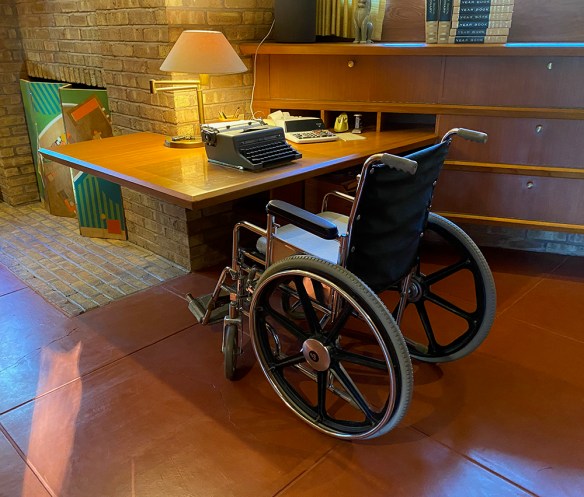
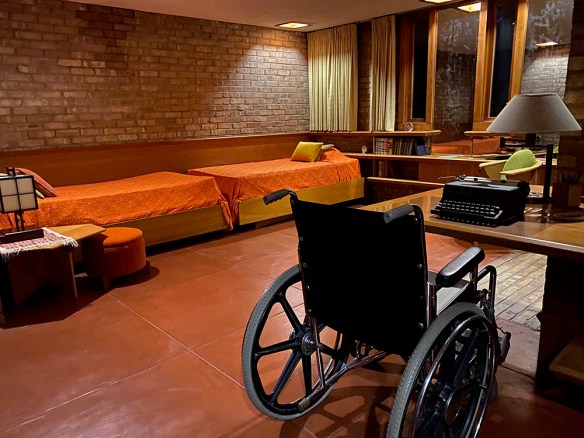
Although the Turkel House in Detroit had an elevator for Mrs. Turkel who used a wheelchair, this house is the only Wright commission entirely designed for a disabled client. A World War II veteran, Laurent was disabled after back surgery.

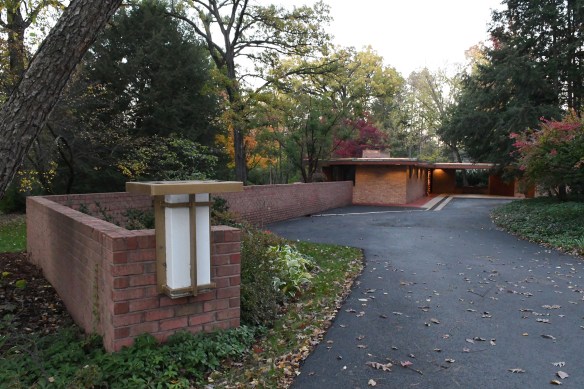
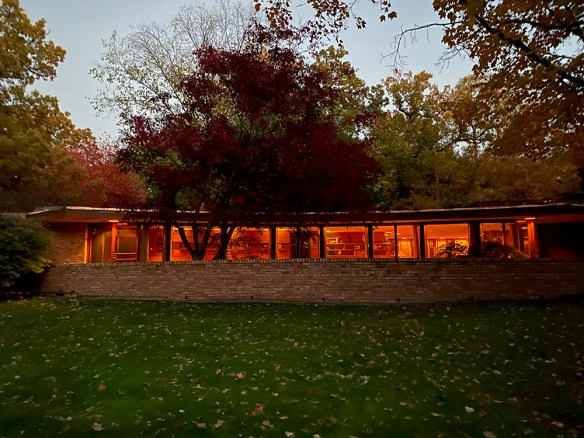
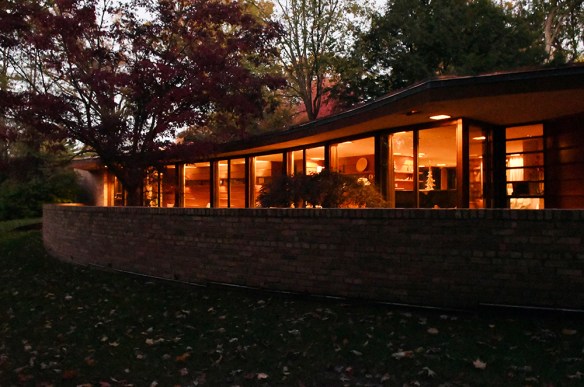
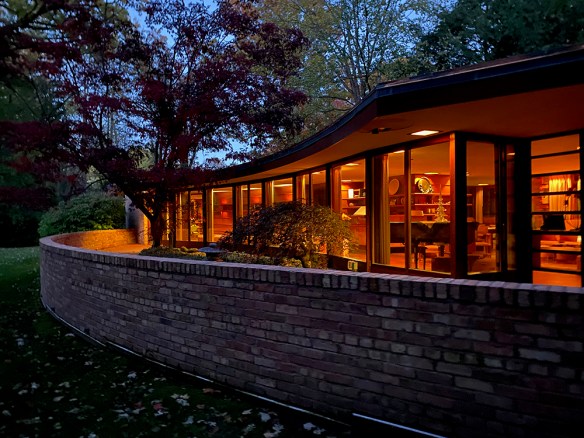
The approach to the house is deceptive. We seem to be approaching yet another Usonian home chock full of right angles. The original carport, visible at the end of the brick wall, was enclosed in 1959-1960 by John (Jack) Howe, working from plans by Wright. It became a bedroom, after the Laurents adopted children.

LR Laurent House 10.30.21 004.jpg

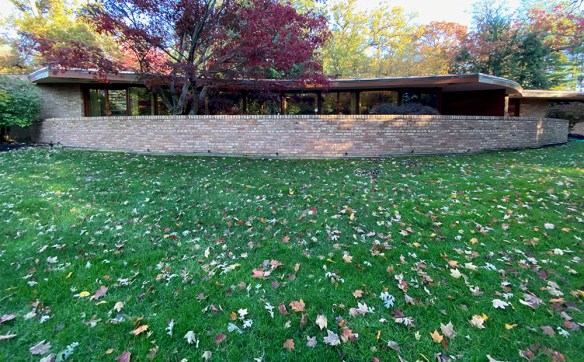
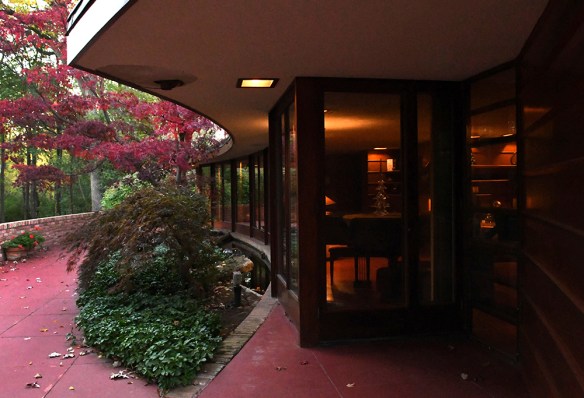
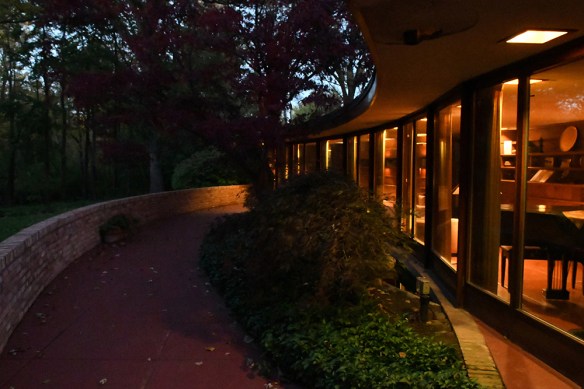
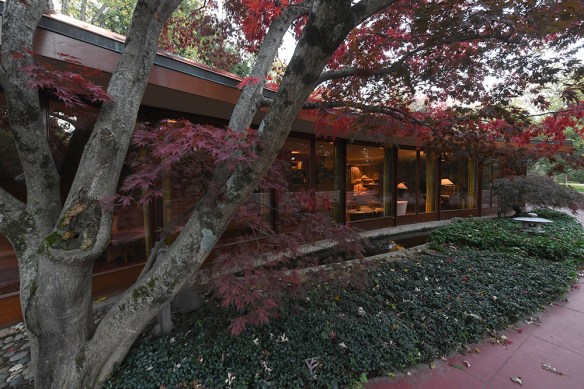
Instead, Wright’s 1,400 sq. ft. “little gem” is a hemicycle design, with intersecting arcs.

LR Laurent House 10.30.21 098.jpgThe living room and hallway to the master bedroom look out over the backyard and a semi-circular patio, under a semi-circular roof.

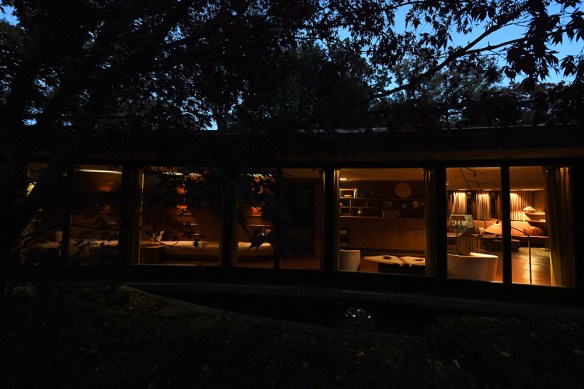
LR Laurent House 10.30.21 105.jpgThe master bedroom and its semi-circular aspect are not readily visible from outside. They are truly in a private wing of the house.

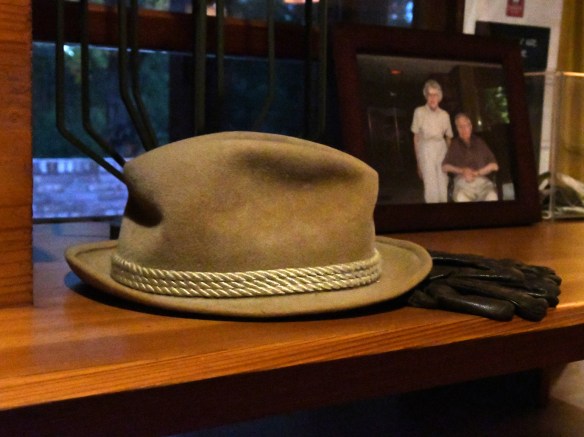
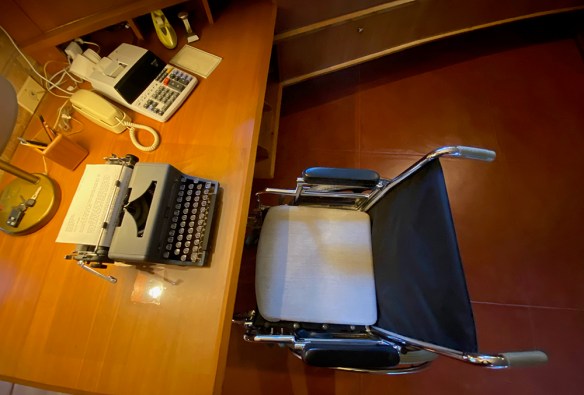
Let’s now take a tour of the house as we did in late October, as the guests of our friends Curt and Susan Pruitt and Dave and Barb Lange. I will intersperse some abstract photos to keep things lively. While some of the interior photos were taken from my normal height, 5′ 7″ (coincidentally said to have been Wright’s height), Barb Lange had an excellent suggestion that I also take photos from Ken Laurent’s vantage point, and she offered to push me through the house in a wheelchair. We start in the entry hall, where Mr. Laurent would have laid his hat and gloves after returning home:

LR Laurent House 10.30.21 019.jpg

LR Laurent House 10.30.21 016.jpg

LR Laurent House 10.30.21 017.jpg

LR Laurent House 10.30.21 020.jpg

LR Laurent House 10.30.21 024.jpg

LR Laurent House 10.30.21 028.jpgThe dining room table and part of the kitchen are visible at right.

LR Laurent House 10.30.21 082.jpg

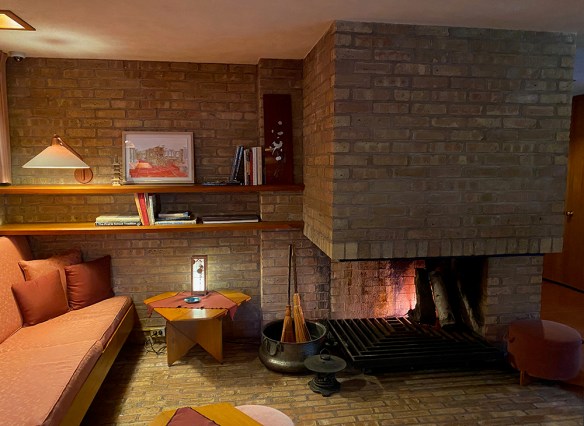
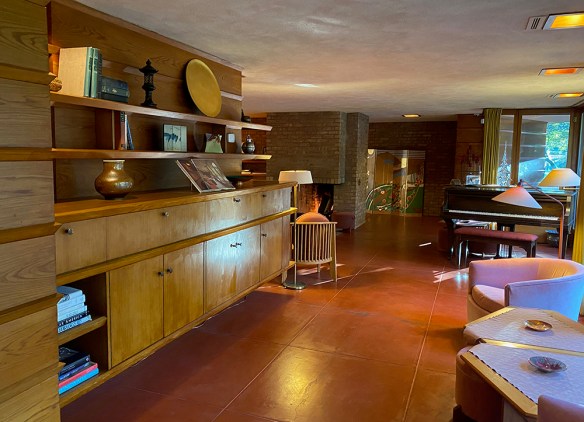
A sitting area and a small fireplace – which reminds me of the one in the Keland House in Racine (1954) – are at one end of the dining room:

LR Laurent House 10.30.21 035.jpg

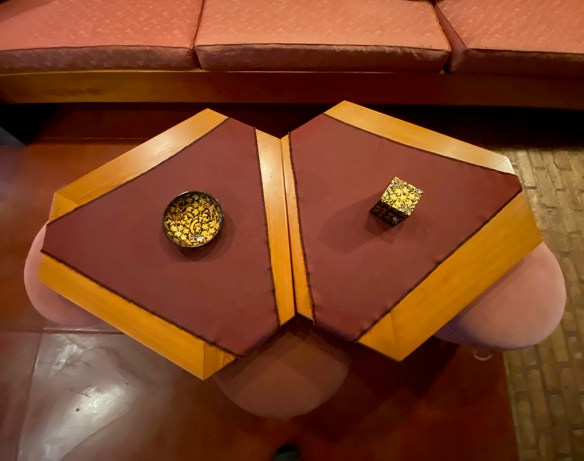
I enjoyed photographing the tables and hassocks in this space:

LR Laurent House 10.30.21 040.jpg

LR Laurent House 10.30.21 042.jpg

LR Laurent House 10.30.21 043.jpg

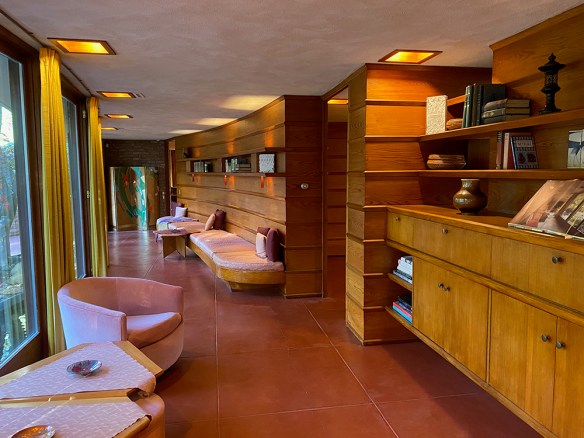
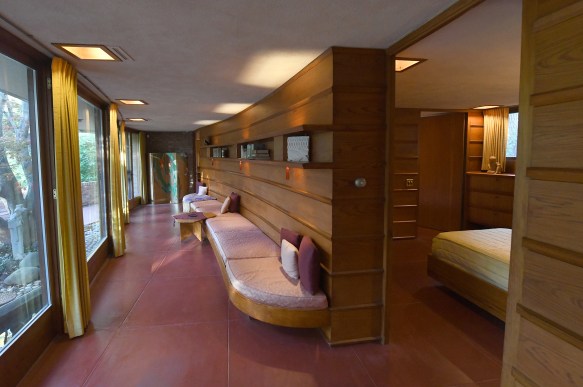
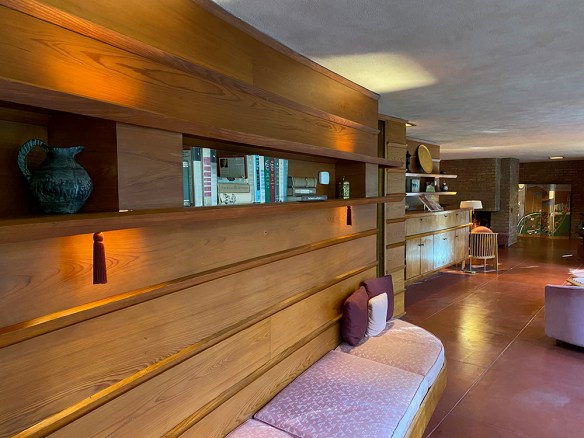
A long hallway stretches along the windows that face the patio and backyard. Unlike the narrow hallways in many of Wright’s Usonian homes, it was wide enough for Mr. Laurent to easily navigate with his wheelchair. The built-in cabinets would have been within reach for him:

LR Laurent House 10.30.21 044.jpg

LR Laurent House 10.30.21 048.jpg

LR Laurent House 10.30.21 054.jpg

LR Laurent House 10.30.21 055.jpg

LR Laurent House 10.30.21 060.jpg

LR Laurent House 10.30.21 061.jpg

LR Laurent House 10.30.21 081.jpg

LR Laurent House 10.30.21 084.jpg

Mr. Laurent’s desk in the master bedroom. Again, note the cabinets at his level:

LR Laurent House 10.30.21 064.jpg

LR Laurent House 10.30.21 065.jpg

LR Laurent House 10.30.21 067.jpg

LR Laurent House 10.30.21 069.jpg

LR Laurent House 10.30.21 070.jpg

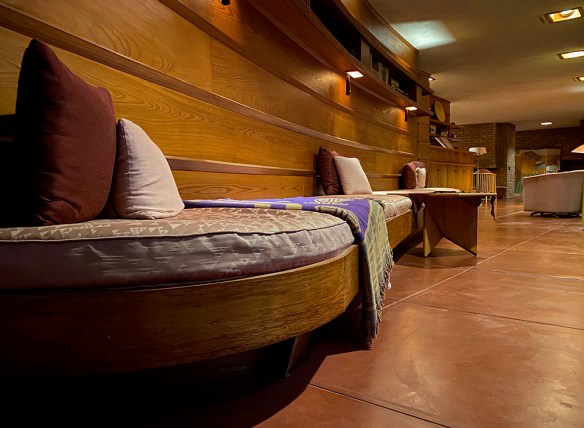
Let us now step outside onto the patio. We can see the hallway banquettes through the windows:

LR Laurent House 10.30.21 086.jpg

LR Laurent House 10.30.21 101.jpg

LR Laurent House 10.30.21 112.jpg

LR Laurent House 10.30.21 115.jpg

LR Laurent House 10.30.21 119.jpg

LR Laurent House 10.30.21 121.jpg

LR aurent House 10.30.21 122.jpg

LR Laurent House 10.30.21 124.jpg

LR Laurent House 10.30.21 125.jpg

LR Laurent House 10.30.21 131.jpg

LR Laurent House 10.30.21 132.jpg

LR Laurent House 10.30.21 134.jpg

LR Laurent House 10.30.21 137.jpg

Remember that I told you about another Wright building nearby? According to Google, the Pettit Memorial Chapel in the Belvidere Cemetery is only 11.4 miles away. Top your day with a visit to, and lunch at, the lovely Anderson Japanese Gardens in Rockford.

For more information:

https://www.laurenthouse.com

https://andersongardens.org
https://belviderecemetery.com/our-chapel/

LR Laurent House 10.30.21 139.jpg

LR aurent House 10.30.21 080.jpg

LR Laurent House 10.30.21 002.jpg

— 30 —

Where Famous Feet Did Tread

Photo and text © Mark Hertzberg (2021)
Procrastination sometimes pays off.

LR Hillside Drafting Room Aug 2021 004.jpg
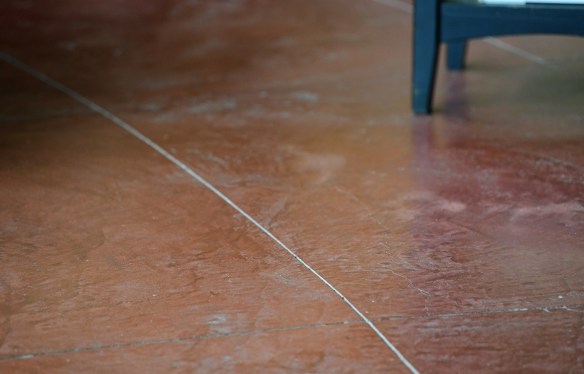
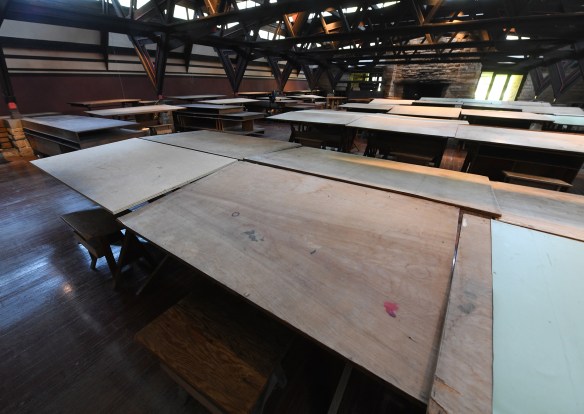
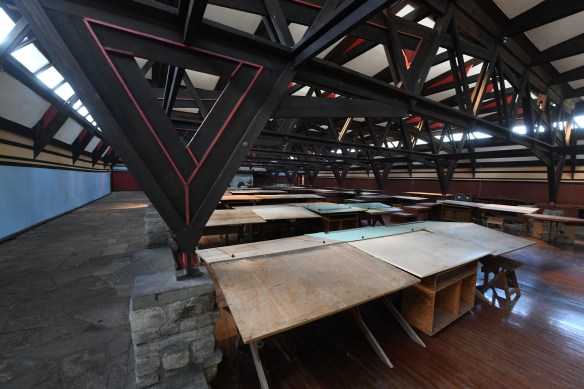
I took this photograph August 29, on a photo exploration of the Hillside Drafting Room. It’s a single frame, in a folder of 18 photos. While I was concentrating on other aspects of the drafting room, I glanced at the floor and wondered what famous people have walked on it since it was installed in late 1938. Frank Lloyd Wright was obviously one of them, but who else?

I posted other photos of the drafting room soon after (they are toward the end of the link below), but I sat on this one, intending to one day write a “who walked here” post:

https://wrightinracine.wordpress.com/2021/09/06/wright-through-the-lens/

It is fortunate that I held off because last week I read a new post from Keiran Murphy which tells the story of the floor, a backstory I never would have guessed. The floor is like a wafer cookie, and it has a relationship to the floor at Wingspread. That’s all I will tell you. Here is a link to Keiran’s post:

https://www.keiranmurphy.com/hillside-drafting-studio-flooring/?fbclid=IwAR3SSC_CAVWs7yuVtk-ah51JlWW535FWEgOXCJAwTfLX8NOxzLri9ggJ1rk

Julian Carlton in Black and White

© Mark Hertzberg (2021)

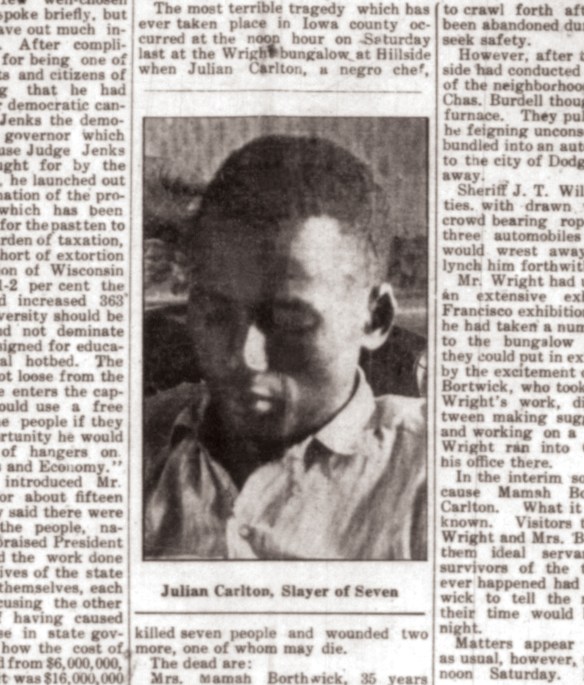
Carlton.jpg

Some Black guy from Barbados went berserk, setting fire to a house before slaying seven people with a roofing hatchet as they tried to flee the blaze. He never came to trial because he died from having ingested muriatic acid while hiding from authorities. That’s the story we have accepted for 107 years about what happened at Taliesin on August 15, 1914 when Wright’s partner, Mamah Borthwick, her two children, and four of Wright’s workers died a horrific death. 

Although Julian Carlton was the slayer, he was not legally guilty of the murders because he was never tried. There is only one known photo of him. It was taken in court and appeared in  a local newspaper six days later. I wrote about the photograph almost two years ago:

https://wrightinracine.wordpress.com/2020/01/19/reading-the-only-known-photograph-of-julian-carlton/

A comment about this article was posted on the website a few weeks ago by “whatever74,” an on-line email pseudonym. The comment gave me pause:

The account of this murder to me is very suspicious. So many things just dont add up. I dont think we have anywhere near the truth. Life for black people back then was so unfair, so hidden, so corrupted, we really have no clue what transpired. He sure doesnt look insane in this photo. He looks resigned to a fate determined by people in power that couldnt care less about anything except maintaining that power. Who dies of starvation while in prison? How does that even happen? And look at him in this courtroom shot. Does he look like someone that cant consume food? He looks perfectly healthy, hardly someone that is wasting away from lack of food.

It just shows you how dangerous it is when one group gets a lot of power. And it happens all over the world. We fear what we could lose and tend to do irrational things to protect against that loss.

I thought that the commenter is likely African-American, suspicious of a white narrative of the crime. It would be easy to dismiss the comment but we should not, especially with the awakening many people who are not of color have had since the murder of George Floyd. Why not believe the initial explanation of the Minneapolis Police Department that Floyd died after some sort of medical incident. Isnt law enforcement trustworthy?

Man Dies After Medical Incident During Police Interaction:…Two officers arrived and located the suspect, a male believed to be in his 40s, in his car. He was ordered to step from his car. After he got out, he physically resisted officers. Officers were able to get the suspect into handcuffs and noted he appeared to be suffering medical distress. Officers called for an ambulance. He was transported to Hennepin County Medical Center by ambulance where he died a short time later…”

The phone video that Darnella Frazier showed us otherwise. That kind of gulf between fact and fiction is not limited to George Floyd’s murder at the hand of police in Minneapolis.

I believe that what we generally know about the massacre at Taliesin is true, but we need to be careful about some of the nuances. It took more than 100 years, until Paul Hendrickson wore out the soles of his shoes with his gumshoe detective work and wrote Plagued by Fire in 2019 in which he established conclusively that Carlton was a native of Alabama, not Barbados. That undid a century-old “fact” about the killings.

Did it matter for some people that this crazed Negro (I am purposely using pejoratives) was, you know, from down there, from the West Indies? Wright described Carlton as “a thin-lipped Barbados negro.” The lead of the next day’s Chicago Sunday Tribune story was “A Barbados negro with a handax yesterday…” Maybe as a West Indian Carlton didn’t understand how “house Negroes” should do things in America. Conversely, Hendrickson wonders if Carlton wanted people to think that he was from Barbados and thus think that he wasn’t just a plain-old American Negro or N-word, with every connotation that came with such a description.

Hendrickson writes that race was an important identifier in describing Carlton: “The black butcher.” “The black beast.” “The Negro fiend.” “And,” writes Hendrickson, “in a few places worse than that.” Indeed, one of the witnesses to the massacre quotes the father of one the victims as saying, “That [N-word] up there. He killed my boy.” The late Ron McCrea makes a similar point in his 2012 book Building Taliesin.  He quotes Ernest Wittwer who was just four years old when his father took him to the jail in Dodgeville to look at Carlton. “He held me up so I could see him through the window. I had never seen a black man before. I never felt the same about black people after that.”

Hendrickson posits that Carlton’s race may have influenced how Richard Lloyd Jones, Wright’s cousin, may have skewed editorial coverage in his newspaper, the Tulsa Tribune, in 1921 and helped fuel the Tulsa Race Massacre.

I shared “whatever 74’s” comments with a handful of Wright scholars. One wrote:

“whatever74” brings an interesting and plausible perspective (albeit clearly unsubstantiated by any evidence or proof) to the final days of JC placed in the larger context of American culture and society in 1914…PS:  it certainly makes you think . . .

I emailed “whatever 74” and asked what prompted his comment. He replied: I was just reading about FLW.  As I reread my comment now I wish there was an edit option.  If he had swallowed that acid that made it impossible for him to eat he could have looked just fine and healthy for weeks depending on his condition when he swallowed it.  I’ve water fasted for weeks and its surprising how healthy you look when you don’t eat…I suppose is pointless to even discuss an event where we have no idea what really happened.  I’ve seen so much prejudice in my life I guess I’m hypersensitive to it.  Videos today just showcase how often people in authority misuse that authority to maintain their position of power.  I can’t imagine what transpired back then when so many people got away with so much behind closed doors.

Then came another email from “whatever 74”: Just a white guy that has spent quite a bit of time in black culture.

Just what I’ve seen and experienced.

But as we really don’t know what happened and can’t possibly ascertain

what really happened, its probably better to focus on what is happening

today.

Keiran Murphy, the esteemed Taliesin historian, has an unpublished nine page manuscript entitled “The human toll taken by madness:  Truth and Myth Surrounding the 1914 Murders at Frank Lloyd Wrights Taliesin.” It cites numerous inaccurate contemporary accounts, including in The New York Times, which many people consider “the paper of record.” The Times wrote that Carlton was arrested 16 miles away from Taliesin after being tracked down by bloodhounds. In fact, he was hiding in a boiler at Taliesin. 

Since 2007 many people have asked on social media what kind of soup was being served for lunch that day. The first mention of any soup (on an August day!) is in William Drennan’s woefully inaccurate 2007 book Death in a Prairie House. There is no documentation for his assertion that soup was on the luncheon menu that August day. And so the myths are created even the century after the events of that summer day at Taliesin.

There has been much speculation about whether Borthwick was the intended victim, or was it Emil Brodelle, a draftsman who had allegedly racially insulted Carlton, or was it indirectly Wright himself by killing his lover?  Was Carlton upset at being fired by Wright? Murphy sets the record straight that Carlton’s departure from Taliesin was quite possibly voluntary, and that he had told Wright some time before that he would be returning to Chicago.

I talked to a friend who is the steward of a Wright home, and who was recently asked to review an unpublished, but thoroughly documented Wright manuscript. One of the things that struck him was the description of Borthwick as a person of privilege, who, he thought, seemed to not be above using that privilege when addressing servants. Wright, according to the manuscript, was not above using the N-word. Last night, as I finish this article, a Wright scholar told me of a second-hand account from the son of one of the workers at Taliesin that another worker may have been sexually harassing Carlton’s wife. 

I appreciate whatever74 giving us something to ponder, although he undid much of the good in his questions with some things he later wrote that I think are gross negative generalizations about African-Americans who, he feels, have not reached their potential.

I do not doubt the general outline of what we have read and believed to be true about the events of August 15, 1914 at Taliesin. But whatever74’s initial comments and Daniella Frazier’s video are stark reminders for us to think twice before accepting a narrative involving race, even from “authorities,” as the unvarnished truth. Carltons motive is secondary to my point.

There have been discussions about whether or not Frank Lloyd Wright was racist. Some people dismiss his use of the N-word as a norm 100 years ago, and not perceived by whites as racially insensitive as it would be today. 

This is 2021, not 1914 and I daresay that your initial reaction about the veracity of “Some Black guy from Barbados went berserk, setting fire to a house before slaying seven people with a roofing hatchet as they tried to flee the blaze. He never came to trial because he died from having ingested muriatic acid while hiding from authorities.” would reasonably be different depending on whether you are white or Black. I welcome your comments.

–30–

Wright Through My Lens

All photos © Mark Hertzberg (2021)

I had not been to many Frank Lloyd Wright sites outside of Racine in more than two years until a week ago. I had a gracious lunch invitation from Minerva Montooth for Sunday, and a last-minute photo assignment in Sparta, Wisconsin (west of Spring Green) Saturday, so I overnighted in Spring Green. I have always enjoyed challenging myself to see new things at familiar Wright sites on return visits. These are some of the many fruits of last week’s visit.

I photographed at the famous cantilevered Birdwalk terrace from below:

LR Taliesin 8.29.21 109.jpg

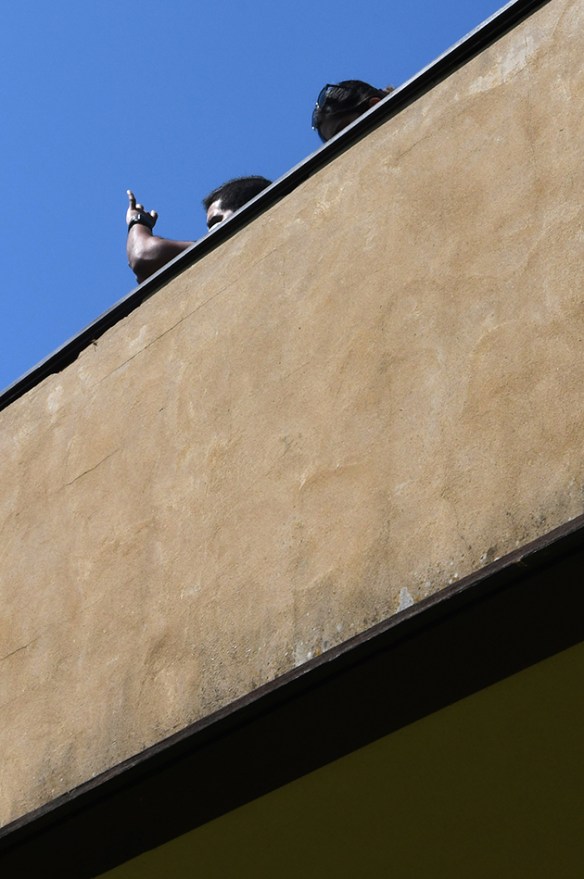
I noticed visitors taking pictures above me while photographing the Birdwalk:

LR Taliesin 8.29.21 066a.jpg

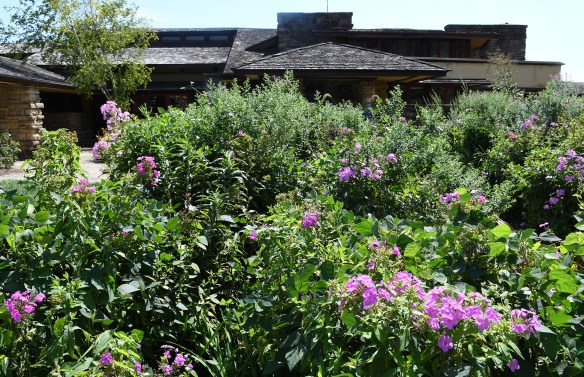
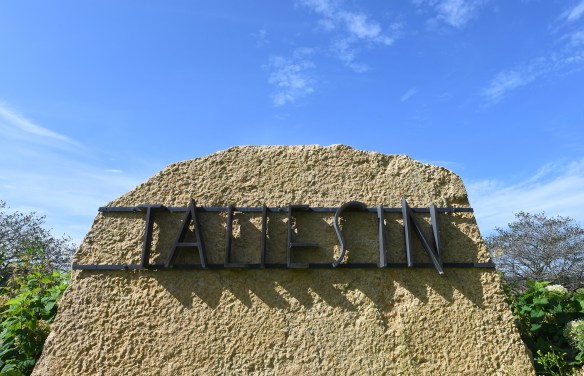
I do not plan my photo visits for a particular time of day / lighting…I shoot what is there when I am there. I explored Taliesin and the grounds of the newly-restored Wyoming Valley School Cultural Arts Center in wonderful evening light Saturday, before dinner with Keiran Murphy and “Mr. Keiran.” I visited both again in Sunday’s morning light. I saw the familiar sign for Taliesin in a different way, thanks to the sharp angle of the morning light:

LR Taliesin 8.29.21 005.jpg

LR Taliesin 8.29.21 002.jpg

The first thing I saw at Taliesin Saturday as I drove onto the grounds was the corn crib, dramatically lit by evening light:

LR Taliesin Corn Crib 8.28.21 001A.jpg

LR Taliesin Corn Crib 8.28.21 002A.jpg

LR Taliesin Corn Crib 8.28.21 017.jpg

Sunday morning I saw something different with a long lens as I drove up:

LR Taliesin Corn Crib 8.29.21.jpg

I used a powerful zoom lens to photograph Romeo and Juliet and Tan-y-deri from a distance both days:

LR Taliesin Romeo Juliet Tan-y-deri 8.28.21.jpg

LR Romeo Juliet Tan-y-deri 8.29.21.jpg

I continued to explore with the long lens:

LR Taliesin 8.28.21 009.jpg

LR Taliesin 8.28.21 010.jpg

LR Taliesin 8.28.21 011.jpg

LR Taliesin 8.28.21 012.jpg

LR Taliesin 8.28.21 014.jpg

LR Taliesin 8.28.21 015.jpg

LR Taliesin 8.29.21 028.jpg

I sat on the floor to photograph through one of the fireplaces inside Taliesin:

LR Taliesin 8.29.21 068.jpg

I explored Wright’s office – with its own cantilevered balcony – and the original drafting room:

LR Taliesin 8.29.21 053.jpg

LR Taliesin 8.29.21 051.jpg

LR Taliesin 8.29.21 058.jpg

I photographed Taliesin itself with long and short lenses:

LR Taliesin 8.29.21 006.jpg

LR Taliesin 8.29.21 018.jpg

LR Taliesin 8.29.21 024.jpg

LR Taliesin 8.29.21 021.jpg

LR Taliesin 8.29.21 062.jpg

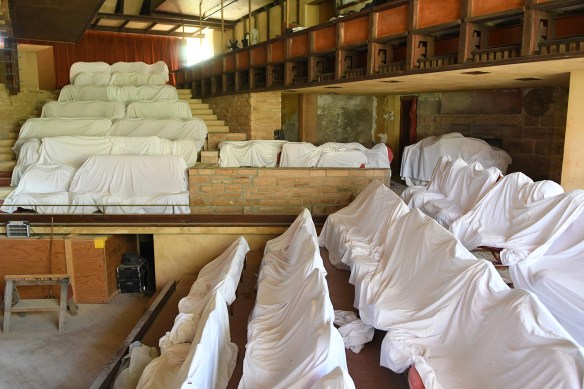
Going to Taliesin means also exploring Hillside Theatre and the drafting room. The theatre is currently being restored.

LR Hillside Theatre 8.29.21 003.jpg

LR Hillside Theatre 8.29.21 005.jpg

LR Hillside Theatre 8.29.21 010.jpg

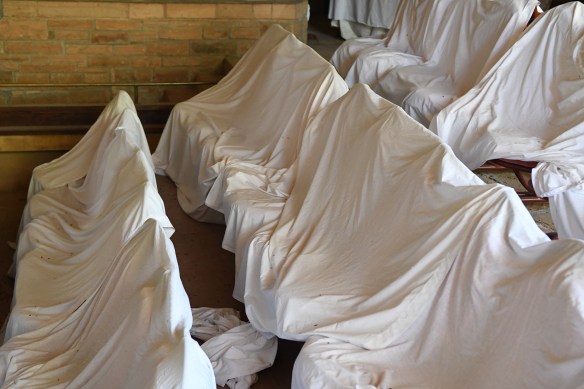
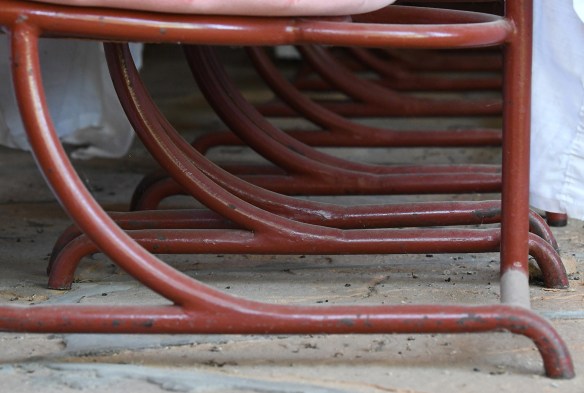
After photographing the ghost-like seats with the sheets covering them I looked for photos under the seats:

LR Hillside Theatre 8.29.21 013.jpg

LR Hillside Theatre 8.29.21 014.jpg

LR Hillside Theatre 8.29.21 015.jpg

LR Hillside Theatre 8.29.21 016.jpg

LR Hillside Theatre 8.29.21 017.jpg

I also looked up:

LR Hillside Theatre 8.29.21 020.jpg

LR Hillside Theatre 8.29.21 018.jpg

LR Hillside Theatre 8.29.21 019.jpg

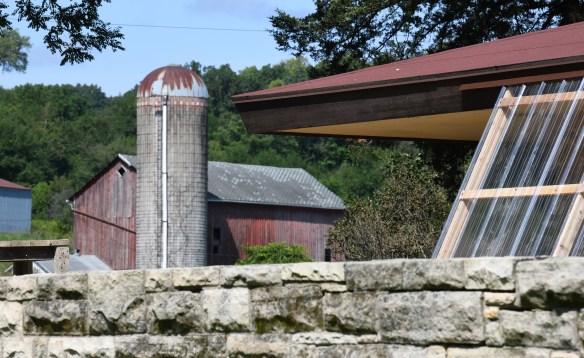
Outside is a view of the theatre and nearby farm:

LR Hillside Theatre 8.29.21 025.jpg

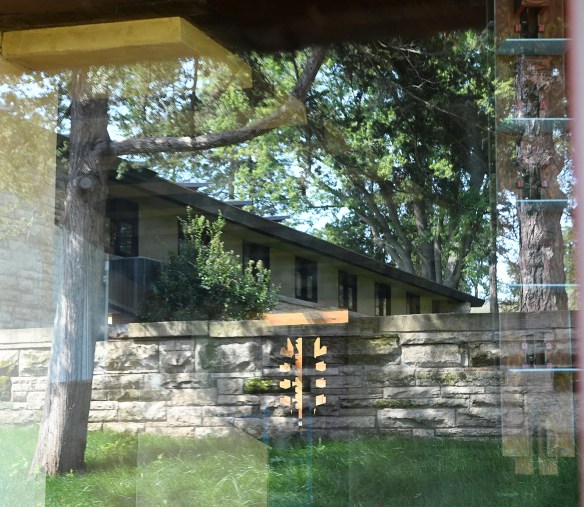
Then I went to explore the silent drafting room, first reflected in the theatre’s windows:

LR Hillside Drafting Room Aug 2021 001.jpg

LR Hillside Drafting Room Aug 2021 008.jpg

LR Hillside Drafting Room Aug 2021 007.jpg

LR Hillside Drafting Room Aug 2021 013.jpg

LR Hillside Drafting Room Aug 2021 012.jpg

LR Hillside Drafting Room Aug 2021 010.jpg

LR Hillside Drafting Room Aug 2021 017.jpg

LR Hillside Drafting Room Aug 2021 018.jpg

And, Hillside itself:

LR Hillside 8.29.21 005.jpg

LR Hillside 8.29.21 008.jpg

LR Hillside 8.29.21 009.jpg

LR Hillside 8.29.21 010.jpg

I photographed Midway Barn from the road, on my trips between Taliesin and Wyoming Valley School and once from Hillside:

LR Midway  Barn 8.29.21 001.jpg

LR Midway  Barn 8.29.21 002.jpg

LR Midway  Barn 8.29.21 004.jpg

The last set of photos is of the Wyoming Valley School, now known as the Wyoming Valley School Cultural Arts Center. One of the only upsides of the pandemic is that the restoration of the school was able to proceed without having to work around visitors. Many of the changes are structural and not visible. Perhaps the most visible change is that the bricks inside now approximate their original natural color…the yellow of recent years was painted over with a grayish tone.

LR Wyoming Valley School Aug 2021 020.jpg

LR Wyoming Valley School Aug 2021 005.jpg

LR Wyoming Valley School Aug 2021 002.jpg

LR Wyoming Valley School Aug 2021 023.jpg

LR Wyoming Valley School Aug 2021 008.jpg

LR Wyoming Valley School Aug 2021 009.jpg

LR Wyoming Valley School Aug 2021 015.jpg

LR Wyoming Valley School Aug 2021 010.jpg

LR Wyoming Valley School Aug 2021 011.jpg

LR Wyoming Valley School Aug 2021 012.jpg

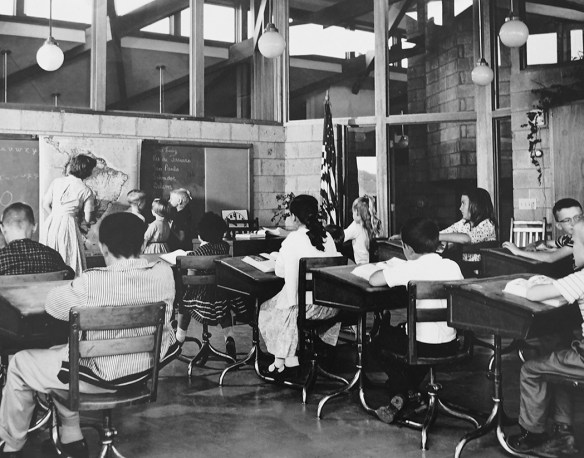
The desks in the classroom today are not original, but I enjoyed photographing them through the mitered glass in the evening light nonetheless. This historic black and white photo shows the original desks.

LR Wyoming Valley School Aug 2021 024.jpg

LR Wyoming Valley School Aug 2021 018.jpg

LR Wyoming Valley School Aug 2021 019.jpg

LR Wyoming Valley School Aug 2021 025.jpg

Robert Hartmann’s wonderful 1960s black and white photos of Taliesin and the school still hang on the walls. His photos documenting the construction of Riverview Terrace are in the rear of the dining room at the Visitors Center.

LR Wyoming Valley School Aug 2021 028.jpg

LR Wyoming Valley School Aug 2021 029.jpg

I leave you with a photo of the Marvelous Minerva Montooth and my Taliesin selfie. Technical notes: I do no “post processing” on my photos…I do not sharpen them or increase the color saturation. What I shoot is what I get. I sometimes open the midtones a bit and do a bit of dodging and burning in…nothing that could not be done in a traditional chemical darkroom. I use two camera bodies, one has a DX or crop frame sensor, the other is FX or full frame (equivalent to what would be recorded on a 35mm piece of film). The lenses used are: 14-24mm (used on the FX body); 17-35mm (on the DX body);  a 70-200mm on the FX body, and a 200-500mm, used on both bodies. When the 200-500 is on the DX body, it is approximately the equivalent in 35mm terms of a 350-750mm lens. I thank John Clouse for selling me that lens recently…I had a wonderful time exploring Taliesin and Wyoming Valley School with it!

LR Minerva Montooth 8.29.21 002.jpg

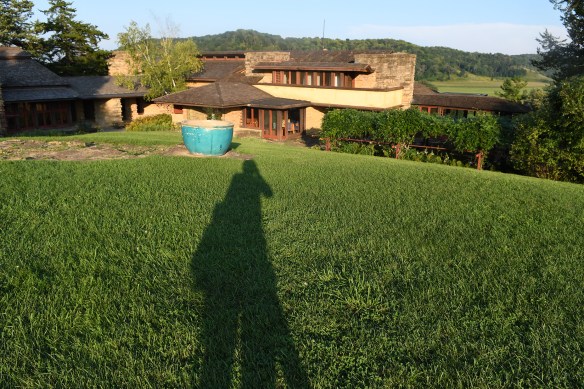
LR Taliesin Selfie 8.28.21.jpg

30-


A man, his camera, and Wright

© Mark Hertzberg (2021) Vintage photos © Estate of Al Krescanko. Portrait of Krescanko by Mark Hertzberg / The (Racine) Journal Times

Frank Lloyd Wright likely would have had conniptions if anyone had dared alter one of his drawings, but he thought nothing of altering one of photographer Al Krescanko’s negatives before signing and returning it to him. What had the architect retouched? He thought his hair looked too long, so he shaded it in on the negative.

LOCAL krescanko flw fllw mh.jpg

Krescanko was one of those quiet guys who said he was just doing his job when he photographed Wright some 60 years ago, but his insightful 1957 candid photos of the master architect have been republished in at least two landmark books about Wright. Yet, Krescanko’s byline has remained largely unknown. Among photographers of Wright, it has less name recognition than the work of Pedro Guerrero, Balthazar Korab, and Ed Obma.
Krescanko photographed Wright during the course of his work as a photographer for SC Johnson in Racine, Wisconsin. He also extensively photographed the construction of the Wright-designed Keland House (1954) for Willard and Karen Johnson Keland (later Karen Johnson Boyd), and took pictures for Willard Keland’s unrealized Wisconsin River Development Corporation in Spring Green.

Keland.png

Krescanko died in 2005, at age 78. A few of his photos of Wright have previously been published, but the Keland House photos were unknown until recently, when the Organic Architecture + Design Archives were lent Krescanko’s photos to digitize by Mary Jo Armstrong, his daughter, for a magazine article. The Keland House photos include the only known view of the original carport which became the master bedroom after a garage was built and the house modified by John (Jack) Howe in 1961.

I would be delighted to tell you more and share more photos, but I will instead direct you to OA + D’s website where you can buy Vol. 9 No. 2 of their excellent thrice-yearly journal. Each issue is devoted to a single topic. Eric O’Malley at OA + D has long been intrigued by Krescanko’s story and photos. Armstrong readily agreed to share her father’s photos with him when he proposed devoting an issue of the Journal to him.

The full story of Krescanko’s career and 41 of his photographs of Wright at Taliesin and at SC Johnson, and of the Keland House construction are in this 40 page issue. Bill Keland, Willard and Karen’s son, helped write the captions for the construction photos as he viewed them for the first time. (I am the “Guest Editor” of this issue of the Journal and wrote the profile. It is a much more extensive profile of Krescanko than the one I wrote in 2002 when I worked for the Racine newspaper. The profile includes interviews with his brother and his two surviving children).

If we have whet your appetite to see and read more about quiet, unassuming Al Krescanko and his not-unassuming subject, follow the link below. As they (whoever ‘they’ are!) say on late night television, “Operators are standing by to take your call!”

https://www.oadarchives.com/product/journal-oa-d-9-2

Mitchell House: Corwin/Wright’s Coda?

© Photos and text Mark Hertzberg (2021) unless otherwise noted

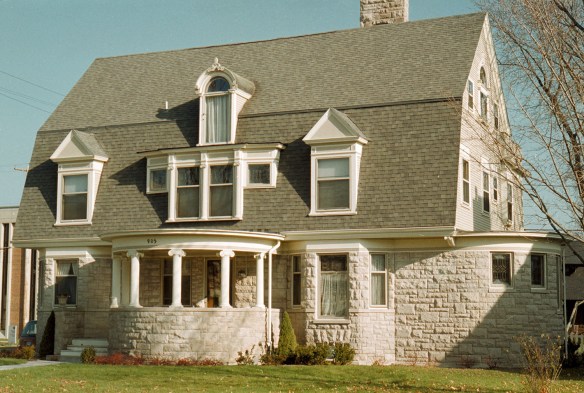
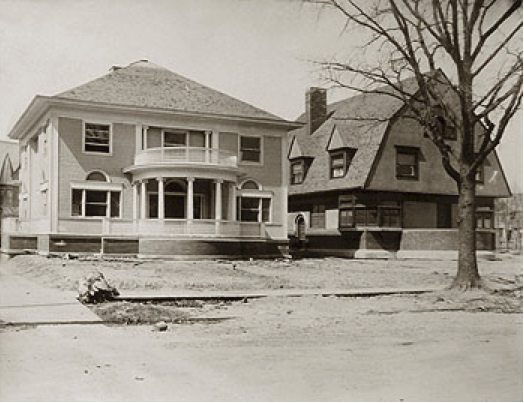
Mitchell House 1895.jpgThe Mitchell House in 1895, from the Racine Headlight, a railroad publication. Courtesy Racine Public Library. Note the second and third floor porch railings in this photograph and the 1908 one.

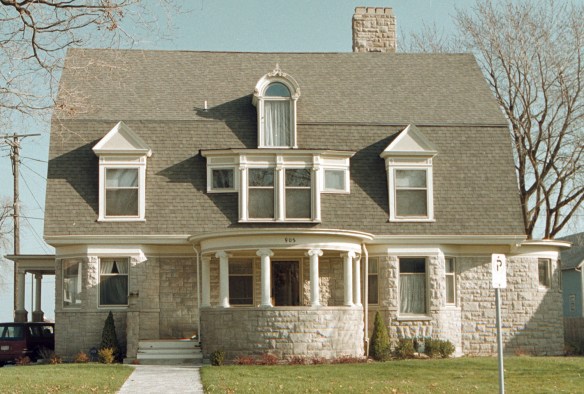
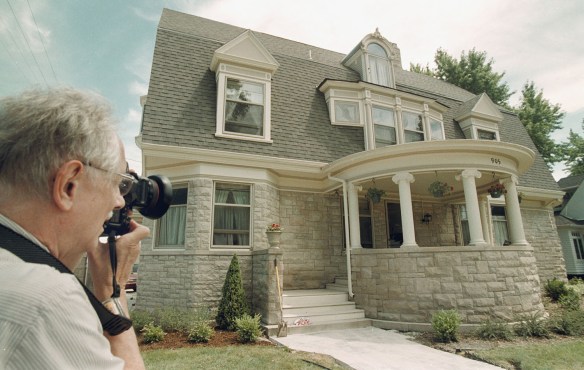
Perhaps no house linked to Frank Lloyd Wright has generated as much give-and-take about its provenance as the Henry G. and Lily Mitchell House at 905 Main Street in Racine, Wisconsin. Note that I wrote “linked to” and not “designed by.” 

MitchellExt MH FLW FLLW .jpg

MitchellExtMain MH FLW FLLW.jpg

Paul Hendrickson devotes four pages to the Mitchell House in Plagued by Fire (New York: Alfred A. Knopf, 2019, pp. 75-78) in the context of his writing about Corwin and Wright’s close friendship and professional association:

“This is the greatest house Cecil Corwin will ever design…”

“Call it the Last Fine Building Moment of Cecil S. Corwin.” 

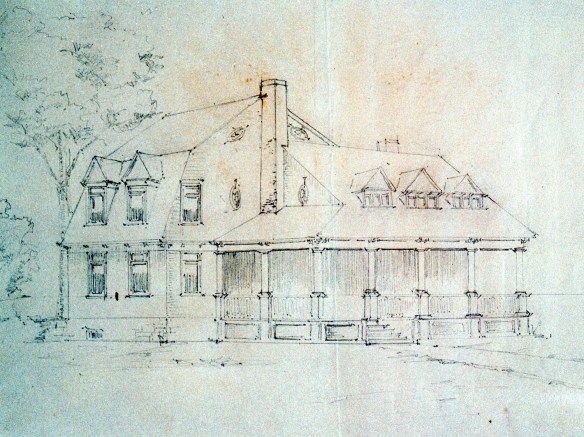
There is no documentation of Wright’s involvement – if any – in the design of the stately house, but there is much thought that Corwin likely designed the house in collaboration with Wright. A definitive answer to “Who Did What?” remains the proverbial “million dollar question” even after 20 years of sometimes contentious discussion. The lack of documentation means that the Frank Lloyd Wright Foundation is unable to ascribe any of its design to Wright.
John Eifler, a well-known Wright restoration architect who grew up in Racine and practices in Chicago, in 2001 was one of the first to suggest Wright’s influence on the design. He told me in an interview in 2003 that “It was Corwin and Wright who did that job together. I imagine that it was Corwin who was responsible for presenting the thing to his client because he probably got the job through his Dad.” (The Mitchells were members of the First Presbyterian Church in Racine. Corwin’s father, the Rev. Eli Corwin, was the pastor of the church from 1880 -1888). “This collaborative thing that happens between architects happens a lot. It’s a collaboration, I think between two people, two young architects.”

His conclusions were bolstered this summer with the discovery of a 1908 photograph of the house. The photograph is in a photo album that also included 1908 photos of Wright’s nearby Hardy House [scroll down at the end of this article to see a post with those photos]. The album pages were acquired for the Organic Architecture + Design archives to ensure their preservation and accessibility for research. I will give more history about the sometimes contentious history of the house before I get to Eifler’s reaction to the 1908 photograph .

1908 Mitchell House OA+D toned.jpgCourtesy of, and copyright by, Organic Architecture + Design (2021). All rights reserved.

In terms of official records, the house was designed by Cecil Corwin in 1894. It was so stated in the April 15 Chicago Inter Ocean newspaper and in the March issue of the Journal of the Inland Architect. This was the year after Wright left Adler & Sullivan, so he no longer had any reason to hide his work. In fact, his Bagley House is listed in his name a few lines below the Mitchell House listing in the Inland Architect.

Mitchell Inland.jpg

In addition, Corwin’s proposal to remodel Herbert and Flora Miles’s house in Racine in 1899 shows a mini-Mitchell House grafted onto the existing house (the remodeling commission passed on to Wright in 1901 but was not realized).

Miles Existing? Wright.jpgCorwin’s 1899 proposal to remodel the Miles House. Copied by the author at the McCormick Library of Special Collections at Northwestern University.

The “Who Did What” intensified in 2002 when William Allin Storrer visited the house on July 12. He photographed it extensively and declared it to be by Wright in a story in the Racine Journal Times and in stories that ran in USA Today and on the Associated Press news wire. Storrer was quoted as saying “Maybe it (the design) is only 75 percent Wright’s, but it’s still Wright. If it’s 51 percent, it’s still Wright’s.” He included the house in a subsequent edition of his The Architecture of Frank Lloyd Wright: A Complete Catalogue (Chicago: University of Chicago Press, 2017). 
Exterior Storrer.jpg

Storrer stairs.jpg

Storrer nook.jpg

Storrer once speculated that Wright may have designed the house as a gift to Corwin to thank him for letting Wright use his name on his “bootleg houses.” Those were houses that Wright surreptitiously designed while at Adler & Sullivan because his contract forbade him from taking on private commissions. 

As the discussion about the provenance of the house intensified, I asked Edgar Tafel about the house on April 7, 2003. Tafel, one of the original Taliesin Fellowship apprentices (1932 – 1941) told me, “On the very first trip to Racine (in 1936 for the SC Johnson Administration Building) we came down Main Street. In all the times I was there, we came down the Main Street, any number of times. He never mentioned anything about any house other than the Hardy House (four blocks south of the Mitchell House).

Fast forward to May and June 2021 after Eric O’Malley [of OA+D] emailed the 1908 photo to Eifler:

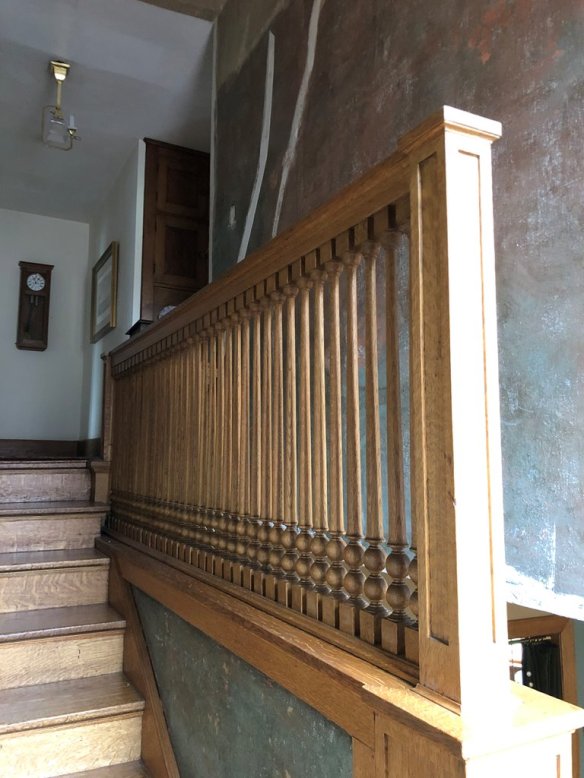
Eric sent the photograph to me as well, and when I saw the railings on the second and third floor, as well as the little bit of ornament adjacent to the dormer I became even more convinced of Wright’s involvement.  Most architects of the period would have interrupted the continuous rail with newel posts, or intermediate supports – I believe only FLW would have run the curved rail continuously.  I have also attached a stair photo from the Goodrich House in Oak Park (1896), with identically shaped balusters.” (Email to me June 17).

Goodrich House.jpgThe stairs in the Goodrich House, courtesy of John Eifler

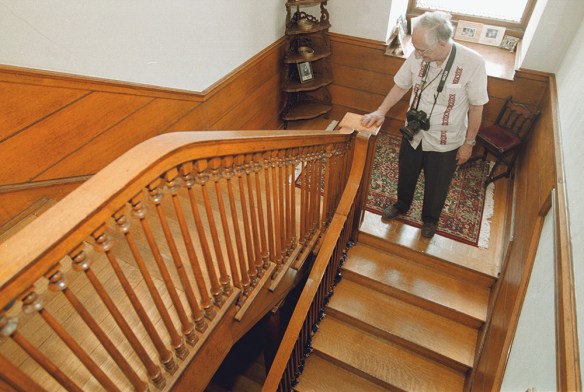
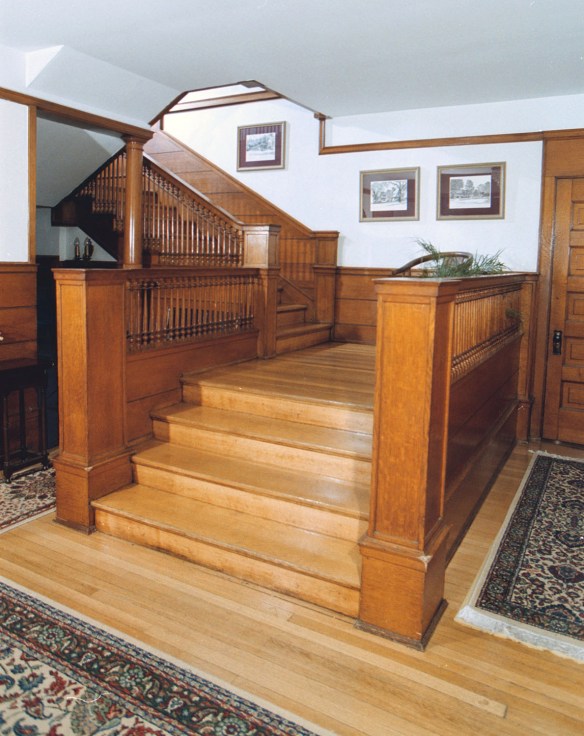
For comparison, my 2002 photo of the stairs in the Mitchell House:

Mitchell Stairs.jpg

And, in a follow-up email on June 21: (interspersed with more of my 2002 photos of Mitchell and 2019 photo of the Blossom House, left, and McArthur House, and a vintage photo of Blossom and McArthur, courtesy of John Eifler):

“1. the Bagley House in Hinsdale and the McArthur House in Hyde Park both utilize Gambrel Roofs and date from the same period.

Blossom McArthur 5.5.19 001.jpg

2. The Front Porch is similar to that on the Blossom House from one or two years before.  The continuous railing on top of the porch matches Blossom, as do the shapes of the “pickets”.

3. The trim on the interior of the Mitchell House has many similarities with Blossom and Charnley – for example, the window and door heads all align with the picture rail, there is no trim where the wall meets the ceiling.

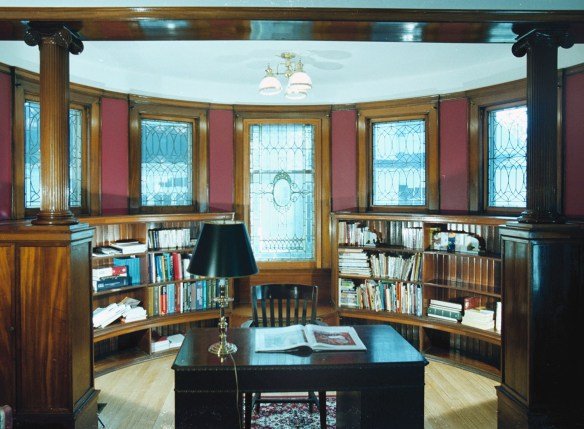
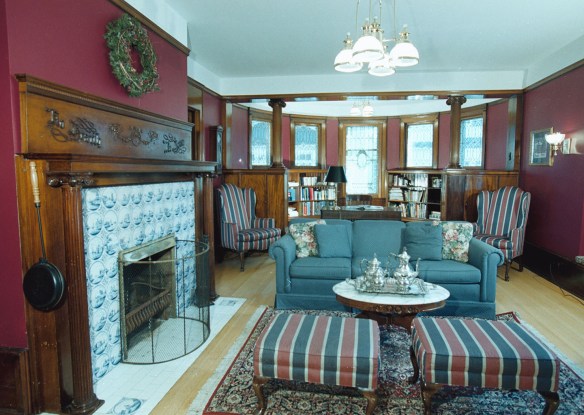
4. The Art Glass in the south facing study of Mitchell is similar to some of the art glass in the living room of the Charnley House and McArthur.

Library.jpg

Living Room.jpg

5. The wood used in the study is Santo Dominco Mahogany, a favorite of Wright (and Sullivan) and matches the Charnley Hs. Dining Room.”

Eifler elaborated in a followup email July 7: “It [an old photo of the Blossom House] shows a front porch on the Blossom House that is very similar to Mitchell – most notably it shows a railing on the second floor is continuous, with no intermediate supports, which is very unusual, and a continuous string of “pickets” or balusters, that are uniquely shaped with spheres, matching the 1896 Goodrich House in Oak Park by Wright.  Finally, the first floor of the porch is capped by a narrow projecting eave, or cornice (in classical terms) which projects out over the frieze – the proportions of which are unique, I think, to Wright.”
Blossom-McArthur1890s.JPG

Tim Samuelson, the City of Chicago’s Cultural Historian (and a dear friend of Paul Hendrickson’s…Plagued is dedicated to him), offers his thoughtful perspective, as well.

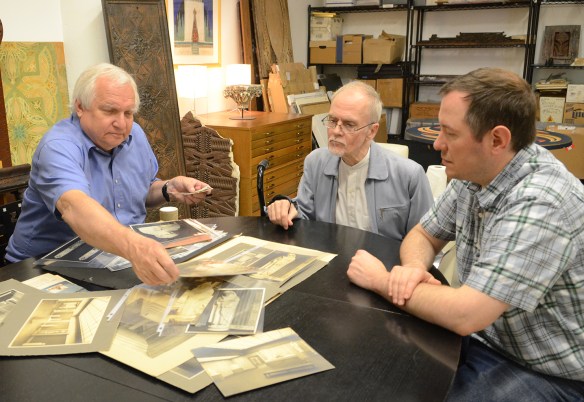
RHM Iannelli Planning Meeting 004.jpgTim Samuelson, left, David Jameson, and Eric O’Malley in 2018.

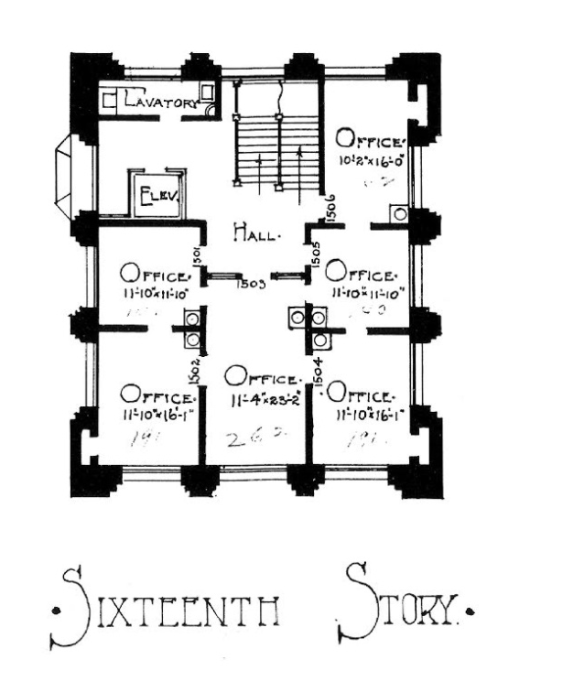
“As we all know from Wright’s autobiographical accounts, Cecil Corwin was a close and valued friend. We also know that they shared room 1501 in Adler & Sullivan’s Schiller Building to conduct their respective architectural practices. The room 1501 was very small – essentially 12′ x 12′.  It’s possible that they also occupied the connecting room 1502 which didn’t have corridor access, but even with that, it was pretty close quarters. (1502 could have been an used by the tenant of adjoining room1505 and had nothing to do with Wright and Corwin at all). (Floor plan courtesy of Tim Samuelson)

Screen Shot 2021-07-07 at 3.46.51 PM.png

“The Mitchell House indeed displays many elements characteristic of Wright’s work of the period. But at the same time, there are many aspects that do not.” (I am breaking up Samuelson’s comments with some of my 2001 and 2002 photos of the Mitchell House)

Peas Stairs detail.jpg

Reception room.jpg

Peas downstairs.jpg

Mitchell Peas Stairs .jpg

Mitchell mirror FLW FLLW mh.jpg

Mitchell closet FLW FLLW mh.jpg

Nook.jpg

“In my personal opinion, what you see is a matter of personal and professional osmosis between two architects sharing the same space.  Would they look over each other’s drafting boards and make comments and suggestions?  Sure!  Would Wright sometimes help Corwin with difficult design issues?  Of course!

“On the basis of Wright’s autobiographical writings, Corwin recognized and admired Wright’s unusual architectural gifts. Sharing the same space and personal camaraderie, Corwin would have learned from Wright and naturally tried to emulate aspects of his work.  And for a substantial commission on the main street of Corwin’s home town, he naturally would have welcomed comments and help from an admired colleague literally close at hand to create the best design possible.

“In such a closely shared environment between friends, it’s conversely possible that Corwin might have commented and critiqued Wright’s own work. We’ll never really know, but it’s a reasonable possibility.

“There’s always the temptation to skew perspectives to advocate the presence of a “lost” Wright work. But as a result, Cecil Corwin’s presence as a competent architect and a creative person gets lost. Sadly, it’s the story of his life.”

And,  Robert Hartmann, a friend of mine who is an architectural designer and Wright scholar in Racine, weighs in, as well: “The existence of the 1908 photo offers new evidence that the Mitchell house is a  unique one-off collaborative effort between Cecil Corwin and Frank Lloyd Wright. A dichotomy design with the more inventive parts of the house (the porch, and first floor interior detailing) either attributed to Wright or Wright’s influence on Corwin. Cecil Corwin never-the-less produced a masterful house that should be celebrated on its own merits and testifies to the close friendship between the two architects.”
Let us turn to Paul Hendrickson again, and we realize that Wright was concurrently designing his masterpiece Winslow House and Corwin was on the verge of moving to New York and to some measure of architectural obscurity. 

And so, there we have it. We will likely never know exactly who did what, but let us give Cecil Corwin his due for having designed a notable house, likely with help from his good friend Frank Lloyd Wright. 
This collaboration was not only a professional collaboration. It was also arguably the coda of their one-time close relationship (Hendrickson has a rich history of their relationship, elaborating on what Wright wrote in An Autobiography). 

The “Who Did What?” debate will continue with some discounting Wright’s possible involvement, absent documentation to the contrary (Tafel’s remarks keep reverberating in my mind), and others agreeing with the perspectives offered above.

Game on!

https://www.oadarchives.com

I appreciate the willingness of the Pettinger family, stewards of the Mitchell House, to allow me time to set up lights and photograph their home in 2001 and 2002.

— 30 —

(Scroll down for earlier posts on this website, including the 1908 Hardy House photographs)

Why the Flag Becomes Where’s the Flag?

© Mark Hertzberg

This is a story that has a different ending than I anticipated when I started writing about the flag on the Hardy House.

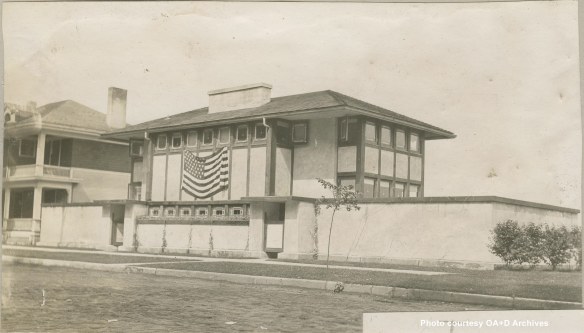
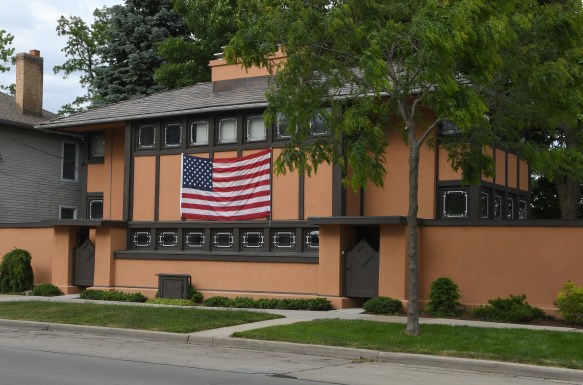
Tom Szymczak, one of the stewards of Frank Lloyd Wright’s Thomas P. Hardy House in Racine, Wisconsin, was moved by the 1908 photograph we have courtesy of the Organic Architecture and Design Archives (OA+D) to hang a 6′ x 10′ flag on the front of the house a few weeks ago. He intended to leave it up through the Fourth of July festivities which are a big event in Racine. The new flag was not a political statement. Quite simply, he wrote me, “The 1908 photo was the inspiration.”

OAD_Racine Homes c1908 photos_01.jpg© OA+D Archives, and used with permission.

DSC_1231.jpg

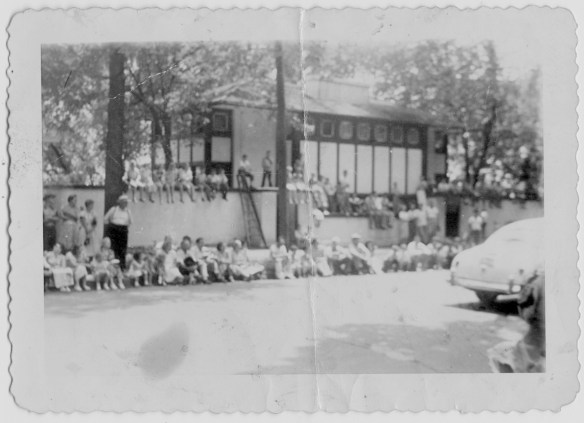
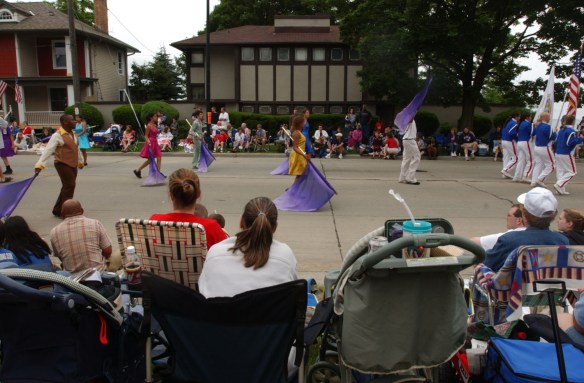
I took this picture after he hung the flag. It was to be a place holder in my files of photos of the house because I greatly looked forward to photographing Racine’s Fourth Fest parade passing by the house this morning with the flag as the background. Racine’s parade is legendary…it normally has 120 units and takes more than two hours to pass a given spot (this year’s parade was significantly smaller because of the pandemic). Below are photos which Dave Archer took when his family lived in the  house from 1947 – 1957, and one which I took in 2004:

Archer 4th July, 12.jpg

4th Parade Hardy003.jpg

So where is my photo of today’s parade? I didn’t see a flag when I went to the house. I emailed a “where is the flag” query to the Szymczaks and got a surprising and disappointing call back.

Their neighbor caught someone stealing the flag late Sunday night. How did the thief get the flag? She climbed onto the outside extension of the front hall cabinets in front of the house to pull it down. The neighbor got in a tussle with the thief. She lost the fight for the flag, but she got the thief’s license plate number and police are on the case. I used a common, but loathsome, expression when the Szymczaks told me what happened: “That really sucks.”
Hardy House Flag Theft 001.jpg

Hardy House Flag Theft 003.jpg

Hardy House Flag Theft 004.jpg

Hardy House Flag Theft 007.jpg

The thief did one positive thing, though. She left a nice palm print for the police.

Hardy House Flag Theft 002.jpg


Hardy Homecomings

Two people who grew up in Frank Lloyd Wright’s Thomas P. Hardy House in Racine, and a man who had the house on his paper route in the 1970s visited the house in May 2021. These are their stories.

© Mark Hertzberg (2021) with black and white photographs by Dave Archer and Anne Sporer Ruetz, used with their permission. Most of the photos in this article are Archer’s. A wide selection of Ruetz’s photographs are in the preceding article, below this one, or at:

https://wrightinracine.wordpress.com/2021/05/22/hardy-house-photo-proof-positive/

IMG_7194.jpegDave Archer greets Anne Sporer Ruetz who last saw Archer was he was 8.

Many people remember getting their first bicycle for Christmas. But unlike Dave Archer, few can say that momentous event happened in a Frank Lloyd Wright house. Archer was six years old when his parents became the third stewards of Wright’s Thomas P. Hardy House in Racine, Wisconsin in 1947. Two years later the young boy became the proud owner of a blue Huffy bicycle in the Prairie-style house built into a bluff overlooking Lake Michigan.

And, not many people can say that their future career – as a builder and developer in Florida – was inspired by listening as a youngster to Wright at the family dinner table as he told the story of his dendriform columns at the SC Johnson Administration Building. Wright was dining with the Archer family at the Hardy House, just blocks away from SC Johnson.

The Archers lived in the house until 1957, when they moved to Florida. Archer was back in Racine and visited the house May 28 for the first time in more than 40 years. He last saw the house, from outside, around 1980, on his way to Bozeman, Montana to go fishing. Archer was joined on his recent visit by Anne Sporer Ruetz, who grew up in the house from 1938-1947. Her parents had bought the house from the bank after Hardy lost the house in a court fight following its sale at sheriff’s auction in 1937. The last time she saw Dave, she said, he was just 8 years old. Our hosts were Curt and Mallory Szymczak who live there now. They were married in the house two years ago. Curt’s late uncle, Gene Szymczak, rehabilitated the house after buying it in 2012. 

Ruetz has visited the house more recently, so the morning was mostly Archer’s as they reminisced for three spell-binding hours. Before entering the house, Archer commented that there is no longer any evidence of window wells between the two entrances to the house. The window wells  are visible, along with what was likely a coal chute, in some of the photos young Anne took. Archer said the windows were in the sub-basement, or pantry level, below the kitchen level. There is no longer any evidence of the windows inside the house.

Sporer- Friends.jpg

Once inside, looking around the two-story living room, Archer first talked about bringing the family Christmas tree – the one the blue bicycle was under – in through the two story living room casement windows. He and Ruetz remembered decorating their family’s trees from the balcony above. Archer then talked about the two-story windows that look out on the lake. “These windows leaked when we had bad snowstorms. The windows bowed and we had snow on the seats. We had to get storm shutters.”

Archer tree.jpgArcher and Star, his beloved collie, by the family Christmas tree in the living room.

The pear trees that were in the north and south courtyards were so well known in the neighborhood that the Pfisterers, stewards from 1963-1968, once told me neighbors held a wake for one of the trees when it blew down in a storm. The trees were even with the upper level bedrooms. “I used to climb out the windows to get the pears,” remembered Archer. He also shimmied up one of them to get on the roof of the house to do mischief, mischief for which the statute of limitations has expired. Unlike Archer, Ruetz did not confess to any mischief on her watch.

Archer continued, “I crawled up (the pear tree) to the Shovers’ house next door. They had two windows there.” His friend Jimmy Shovers (and Anne’s friend, Suzy Shovers) lived there. I promised him I would not write about the mischief that ensued.

Pear Trees.jpgThe pear trees in the north courtyard are visible outside the upper bedroom windows in this photo that Dave Archer took of people watching the 4th of July parade passing the house, above, and in his photo of the south courtyard, below.

Pear trees 2.jpg

Then Archer said, still in wonderment at being back in his childhood home, “There are so many good memories of this house.” Ruetz agreed, “Me, too. I cried when we had to move.” Archer, replied, “I was too young to cry. The first time I cried, I saw Bambi.”

Archer snow gate 11.jpg

He remembered a big oil tank in the lower basement. “In heavy rains, water would raise up from the drain. My job was to clean the floor up.” He talked about an old gun he found in the basement and Ruetz mentioned that her father was a hunter. Said Archer, You didn’t have to go far to hunt. We had pheasants, rabbits, squirrels, raccoons (below the house)…What I loved was the kitchen. The kitchen windows opened up so they were pretty big. And I went down to make breakfast one morning and there was a rabbit that was trapped in the cul de sac (window well) and I fed him through the window. My mom came out and saved him and put him back in the wilderness behind us. I wanted to keep him.” 
Archer 13 pilings.jpgStar explores the area below the house, an area with lots of wildlife.

Then he turned his attention to the living room balcony. “My dad and mom were entertainers. I would sneak up and lie above this closet and I would watch (the parties below).” Ruetz has also confessed to spying on her parents’ parties.

Archer Balcony.jpgArcher shows his hiding spot for spying on his parents’ parties…a crawl space above the bedroom closets whose backs form the side living room walls.

Archer admired Gene Szymczak’s rehabilitation of the house. “This is such a beautiful job. When I lived here it was getting a bit old at the edges. But Frank Lloyd Wright slept here one or two nights. He had dinner with us once.” Wright remembered having designed a dining room table for the house (the table was no longer in the house when Wright visited). Ruetz chimed in, “We used to put a ping pong net across the middle and play ping pong on it.” A photographer for the Racine newspaper took a picture of she and her friends at the table during her 14th birthday party.

Birthday party.jpgThis is the only known photo of the Wright-designed dining room table. It was taken at Anne’s golden birthday party in 1946.

The house was designed in 1904/05 before automobiles were part of everyday life, so there is no garage (Wright did not design carports until the mid-1930s). Archer said his father “thought about opening up the courtyard on this side (the north side) so he could pull his car in there, make it an open kind of spot.”

Garage Top darker.jpg

Garage Title.jpgThe Sporers also thought about having a garage in the north courtyard. Plans were drawn by Edgar Tafel August 1, 1941, before he left the Frank Lloyd Wright Fellowship after nine years. © 2021 Frank Lloyd Wright Foundation, Scottsdale, AZ. The Frank Lloyd Wright Foundation Archives (The Museum of Modern Art / Avery Architectural & Fine Arts Library, Columbia University, New York)

There used to be a public beach just south of the house. Both Archer and Ruetz remember people thinking the stucco Hardy House might be a bathhouse for the beach. Archer also remembers tour buses with Wright aficionados. “In summer sometimes buses would come.. People were get out and take pictures of the house. I came home one day and said, ‘Mom, I need some paper.’ She asked why. ‘I’m going to make some tickets.’ She turned him down. I said, ‘Damn! I could have made some good money!”

Terrace.jpgRobert Archer, Dave’s father, built wooden slats to go over the surface of the dining room terrace which was often too hot to walk on.

Dave, Mary, Star, terrace.jpgDave and Star with Mary Archer, Dave’s mother, on the dining room terrace.

Archer Mary Painting.jpgDave sits in the living room under a portrait by his mother. She was a well-known portrait painter in Racine.

St. Luke’s Hospital, a block from the Hardy House, was building an addition when Archer was young. “They had a workman’s shack they stored stuff in. They had a Coke machine, the kind you had put quarters in [Coca Cola was packaged only in bottles then]. One Sunday we went over there and decided we were going to get some Cokes. We got two pea shooters and a can opener.” He and his friends popped off the bottle caps and used the pea shooters at straws while the bottles were in the machine which had an open top.”  “They also had a big thing with wheels for carrying equipment on it. We took it and built a tank out of it. We used a baseball bat as a gun. We used it in the 4th of July parade.”

By 1957, Mrs. Archer had died and Mr. Archer wanted to start an airline and sell real estate in DelRay, Florida. He planned to buy a section of DelRay beach and develop it. He developed the Sherwood Park golf course, among others. Dave followed in his footsteps. “I started out digging ditches in construction. I got a carpenter’s license then foreman’s, then I took the Realtor’s and broker’s exams. My father built Lanikai (a housing development), with the first underground parking in DelRay Beach, Sherwood Park, Sherwood Forest, then he bought Sea Horse Bath and Tennis Club, then East Wind Beach Club. By then I had a broker’s license and designed and built Ocean Reach and two others. He helped build golf course at Quail Ridge and DelRay Dunes. He was pretty influential in a lot of places in DelRay.” Mr. Archer died in 2002 in North Carolina. 

“I got into designing and building because of Frank Lloyd Wright. I was so influenced by this house. He also fascinated me because when he was here (he talked about) how he designed the pillars at the Johnson Wax building and how he had to fight the city (for permission to use the dendriform columns). It got me interested in construction. I was probably 12 or 13.”

Archer added to the Hardy House lore with a new name for his upper level bedroom. Among all his designs, Wright unknowingly designed a penal institution at 1319 Main Street. As Archer related stories of his mischief and told about often being banished to his room, “I was up in jail again.”

He had one birthday story to relate. “My grandfather was in advertising and hired Buck Rogers and his cohort girl to come down for my 10th birthday party here. Boy, was I famous for awhile! I was looking so forward to my 10th because I would be a teenager. ‘No, son,’ my father said, ‘You aren’t a teenager yet.’  I was so peeved. What made up for it was when Buck Rogers came for my birthday!”

After listening to Archer and Ruetz, Curt chimed in about what the house means to him and Mallory. “It’s a whole other world being in here. The moment you are in here or out on the deck you are transported into a whole different world. It’s magic. You forget you are in Racine, in the Midwest, you are in a whole different world.”

Curt Archer Ruetz.jpgCurt Szymczak bids adieu to Archer and Ruetz in the front hallway.

I had stopped at the house one morning in early May when I saw Joan and Tom Szymczak, Curt’s parents, in front, doing yard work, when a man walked up and asked if we had any connection to the house. He explained that he is a Residential Designer/CAD Drafter/Estimator in Milwaukee, and that he was greatly influenced by the Hardy House when it was on his paper route when he was 12 – 16 years old. I asked him to email me his recollections of the house and how it influenced him. I have edited them for brevity. Paul Alan Perez’s story continues the tale that Dave Archer tells about Wright influencing his future career.

Perez Hardy.jpg

I had several paper routes (including the Racine and Milwaukee newspapers and the Chicago Tribune) from 1975 to 1979. One of my customers was the Hardy Residence on Main Street. I did not know much about the owners except that he was a nice middle aged man, (Jim Yoghourtjian), although I think he had black hair and glasses looked like a professor or an attorney who had two really big dogs that barked a lot when I came to collect at the residence semi-private front door entrance (Yoghourtjian was a famed classical guitarist). He liked his paper inside the screen door and not folded. He didn’t say much but tipped me well when I gave him the next years calendar at Christmas time. 

I finished delivering my routes everyday near Johnson Wax and back then in the Mid to late 1970s there was no gates surrounding the complex like there is today and I would enjoy riding my skate board thru the smooth pavement and very cool architecture of the Johnson Wax Parking Structure (carport) because it was always open. It was then and there that I feel in love with the wonderful art of architecture. 

Later in life as an adult when I was studying graduate architecture at UWM-SARUP (University of Wisconsin – Milwaukee) I saw the movie documentary about Louis Kahn’s life and career and his son told his father’s story as he roller blades thru all his famous works. I thought that was a very unique and special experience that I once shared as a young boy with Mr. Wright’s famous works in Racine.

So it was really that experience coupled with my 7th grade ‘World of Construction’ class where we saw a documentary of Eero Saarinen’s ‘Gateway Arch to the West’, the building of the St. Louis Arch, and me and my school buddy got to design and build our own house in class. I was hooked and madly in love with the architecture and building things like tree forts to hide out and play cowboys & Indians. We built one that was really big with 3 levels the city eventually came and demolished it. 

Once in high school I began taking more courses related to architecture and construction and excelling in architecture and mechanical drafting classes which gave me confidence and the curiosity to learn more and found a wealth of information on FLW at the Racine Public Library and then I remember my last paper route customer was Cong. Les Aspin whose office was at the Post Office. After him I usually went straight to the library to read FLW books cause they had lots on him and that is really what fascinated me so much about FLW was his art of architecture in all those books.

(Perez describes the intricacies of a private millwork commission which I have chosen not to identify) It is a typical example of architects designing things that physically can’t be done yet. FLW was the best at doing that and that’s why we LOVE him so much!

Over the course of my professional career in the construction industry I have become a highly conscientious, detailed minded architectural professional who has built an excellent reputation for quality and in-depth knowledge of all facets within the architectural and woodworking fields owing it all to the wonderful experiences I have been blessed with growing up in Racine on Park Avenue near all of Frank Lloyd Wright’s masterpieces.

— 30 —


Happy Birthday, Mr. Wright

Photos © Mark Hertzberg

There is a small gathering to mark Frank Lloyd Wright’s birthday (June 8)  at Taliesin this evening, in lieu of the big celebrations of pre-pandemic years. My wife and I have been privileged to have been invited by Minerva Montooth to those lively evenings. We stopped to see Minerva Friday on our way to Minnesota. I honor Wright’s birthday this year with a photo taken yesterday of Minerva’s smile and the seemingly ever-present gleam in her eyes.

DSC_4044.jpg

DSC_4056.jpg

Thank you, Minerva, for yours and Charles’s friendship, and for all you do to keep Wright’s legacy – Mr. Wright to you and the Taliesin family – alive for the World of Wright. You are always stylish when we see you, with a lovely scarf! We love you!